In Rabat
In the deafening roar of the Prince Moulay Abdellah Stadium, where 45,000 voices collided in a tectonic wave of Congolese pride, Michel Kuka Mboladinga did something radical: he didn’t move.
As the Democratic Republic of Congo (DRC) dismantled Botswana 3–0 to secure a place in the Africa Cup of Nations (Afcon) last 16, the stands were a kaleidoscope of motion. Fans drummed, danced, and surged against the railings.
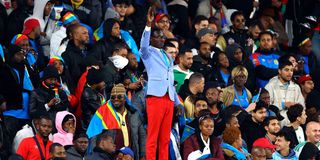
But amidst the chaos, perched atop a makeshift wooden podium, stood a man in a crisp charcoal suit and a narrow tie, his right arm raised toward the Moroccan sky in a rigid, eternal salute.
To the uninitiated, he looked like a glitch in the broadcast. To the Congolese faithful, he is ‘Lumumba Vea’ – the living ghost of their nation’s founding father.
Democratic Republic of Congo fan Michel Nkuka Mboladinga poses as a statue of the country's independence hero Patrice Lumumba during the round of 16 match between Algeria and DR Congo in the 2025 Africa Cup of Nations at Moulay El Hassan Stadium in Rabat on January 6, 2026.
Photo credit: Reuters
Mboladinga, 53, became the breakout star of the tournament, not for his footwork, but for his stillness. His tribute act was seen as a meticulous recreation of the iconic statue of Patrice Lumumba in Kinshasa, at the Place de l’Echangeur. Lumumba, the DRC’s first Prime Minister and a martyr of African independence, was assassinated in 1961.
In the bronze monuments of his homeland, he is depicted not as a soldier, but as a statesman, firm, forward-facing, and unyielding.
“I chose Patrice Lumumba because he is a model of courage and a model of freedom,” Mboladinga told reporters.
“For me, football is more than a sport; it is a remembrance. Lumumba gave his life for our dignity. If I can give 90 minutes of my muscles to honour him, it is a small price.”
Morocco fans display pictures of the Democratic Republic of Congo fan Michel Nkuka Mboladinga posing as a statue of the country's independence hero Patrice Lumumba during the quarter final match between Morocco and Cameroon in the 2025 Africa Cup of Nations at Prince Moulay Abdellah Stadium in Rabat on January 9, 2026.
Photo credit: Reuters
The feat is more than just theatrical; it is an athletic endurance test. During the DRC’s group opener against Benin on December 23, a series of injuries and VAR checks pushed the match to nearly 115 minutes of play. While players suffered from cramps on the pitch, Mboladinga remained frozen on his podium.
His pose, right arm raised, palm open, left arm at his side, mimicked the 1970s bronze cast in Kinshasa. His attire was interesting for a football game. A blue tie and a yellow blazer, reflecting the national colours, despite the cold stadium conditions.
Beyond the physical drills, Mboladinga points to a spiritual endurance that transcends sport. When asked about the stamina required to remain a human statue while thousands of fans surge around him, he credits his faith.
“Jesus Christ is my God,” he says simply. “He is the one who gave me the strength and the endurance. The work I do... I take it seriously. That is the real secret.”
The dedication has earned him a cult following. Members of the Congolese Supporters Club formed a ‘human shield’ around him as he entered the stadium, protecting the ‘statue’ from being toppled by the surging crowds.
How does a man stay frozen for 90 minutes, and sometimes up to 115 minutes during stoppage time, without a single muscle twitch?
“I know it’s not easy,” Mboladinga admitted. “It is a secret, but I train for this. I train every time.”
A fan of Morocco displays a picture of the Democratic Republic of Congo fan Michel Nkuka Mboladinga posing as a statue of the country's independence hero Patrice Lumumba during the quarter final match between Morocco and Cameroon in the 2025 Africa Cup of Nations at Prince Moulay Abdellah Stadium in Rabat on January 9, 2026.
Photo credit: Reuters
And despite the exhaustion and the physical pain of the pose, Mboladinga refused to lower his arm until the final whistle blew on the DRC’s tournament run.
For him, the suit, the tie, and the aching shoulder are a small price to pay to keep a legacy alive. After DR Congo’s agonising 1-0 extra-time defeat to Algeria in the Round of 16 stage, Mboladinga was seen breaking his iconic pose and breaking down in tears.
This display of emotion went viral, leading the Algerian Football Federation to honour him in Casablanca shortly after the match. They presented him with Algeria shirts as a gesture of sportsmanship and respect for his dedication.
Special gift and recognition
Additionally, he was granted a private audience with CAF President Dr Patrice Motsepe, who praised him as a symbol of the tournament’s spirit and patriotism.
Despite the national team’s exit, Mboladinga was granted an extended stay in Morocco with VIP treatment until the tournament’s conclusion on January 18, 2026.
However, he reportedly turned it down. The Congolese government, through the Minister of Sports and Leisure, Didier Budimbu, also honoured him with a special gift and recognition for his role as a ‘symbolic supporter’ and ‘living monument.’
His presence throughout the tournament helped raise awareness of Patrice Lumumba’s legacy and was interpreted by many, including his supporters’ group, as a sign of peace for the DR Congo.
Democratic Republic of Congo fan Michel Nkuka Mboladinga poses as a statue of the country's independence hero Patrice Lumumba during the round of 16 match between Algeria and DR Congo in the 2025 Africa Cup of Nations at Moulay El Hassan Stadium in Rabat on January 6, 2026.
Photo credit: Reuters
Though the Leopards were knocked out, Mboladinga left the tournament as one of its most indelible icons, moving from a silent performer to a celebrated continental symbol.
To understand why a man would stand still for two hours in a suit, one must understand the shadow Lumumba still casts over Central Africa. Patrice Hemery Lumumba (1925–1961) was the first democratically elected leader of the Congo. His tenure lasted only months before he was deposed in a coup and subsequently executed by a firing squad.
In a final attempt to erase his legacy, his body was dissolved in acid. For decades, he had no grave; his ‘return’ to the Congo only occurred recently when a single tooth, seized by a Belgian officer, was repatriated for a state funeral.
For a nation often defined in international headlines by conflict, the sight of a man standing in silent, dignified tribute to a dream of unity has become a powerful symbol.
“The Moroccan supporters are all in my heart,” Mboladinga noted, overwhelmed by his sudden popularity. “Sometimes I can’t even go out because so many people follow me for photos. It is too much for me, but I do it for the message.”