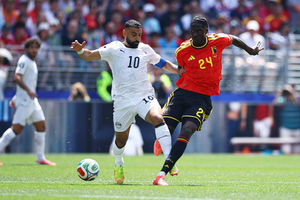
Marc Cucurella tried. Marcos Llorente tried too. Fabian Ruiz attempted something novel. Mikel Oyarzabal tried a trick. Nothing worked. Try as they might, the Spaniard footballers could not find a way past a 40-year-old goalkeeper who was doggedly defending the dreams of his African island nation of 600,000 people.
For denying the Spanish superstars a sight of goal, making seven saves in total and ensuring a 0-0 end to their match, the shot-stopper became an overnight celebrity and one of the heart-warming stories of the World Cup 2026.
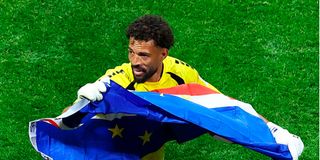
His name is Josimar Dias alias Vozinha, one of the 26 men representing Cape Verde in the country’s first ever appearance in the World Cup. Thanks to his heroics, his Instagram account that had less than 50,000 followers before the tournament shot up to 11.6 million followers by Wednesday noon, with the number growing by the hour.
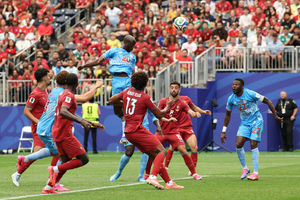
Cape Verde goalkeeper Vozinha makes a save during their Group H Fifa World Cup match against Spain at Atlanta Stadium in Georgia on June 15, 2026.
Photo credit: Reuters
To contextualise this, in Kenyan terms for instance and using the latest available figures, the goalkeeper went from being followed by the registered voters in Kamenu ward in Thika Town constituency to being followed by every human being in Nairobi, Kiambu, Nakuru and Kakamega counties combined.
Vozinha’s ever-growing followership, sparked in part by campaigns from Portuguese and Brazilian media outlets, has seen him get 20 times more followers than the number of citizens in his country.
Cape Verde, one of the westernmost points of Africa (it is four hours behind Kenya), comprises nine islands, and its official language is Portuguese. For such a tiny country, the fifth smallest in Africa, Vozinha’s exploits in the match on Monday evening fit perfectly in the motif of a David-versus-Goliath story.
Here was Cape Verde – ranked 64th in the Fifa standings – holding Spain – the reigning champions of Europe who lie third in the global Fifa rankings – to a barren draw.
Here was a country that had never played in the World Cup standing eyeball-to-eyeball with a European force that won the global showpiece in 2010 and which has some of the world’s most famous footballers. With the odds as they were, everyone could understand Vozinha when he shed tears at the end of the match while dozens of cameras faced his way.
Fun fact one: He was given a Brazilian footballer’s name. When he was born in Mindelo on June 3, 1986, the World Cup was being played in Mexico and his father Ze Pedro, then serving in the military, was fascinated with the Brazilian football team.
One Brazilian defender caught his eye: Josimar, a right-back who was not even expected to be a star until injury opened a door for him. He then scored against Northern Ireland and Poland, and by the end of that tournament had become one of the surprise headline-makers.
Ze Pedro’s first choice name for Vozinha was Jorge Valdano, the name of an Argentine forward who also grabbed headlines in the 1986 World Cup. However, as fifa.com reports, the registrar who handled the father’s application “rejected the Valdano-inspired choice since foreign names were not permitted”.
That is when the father turned back his attention to Josimar. It is a Portugal-linked name and it was accepted. And so, Josimar José Évora Dias he became. The naming story might partly explain why Brazilians – whose country is a former Portugal colony just like Cape Verde – are ecstatic about Vozinha’s story.
Ana Candida Evora, the mother of of Cape Verde goalkeeper Vozinha, poses for a photograph with other family members, during an interview with Reuters, at her home in Mindelo, Sao Vicente, Cape Verde, June 16, 2026.
Photo credit: Reuters
Next fun fact: His famous nickname started as childhood teasing. Why is he Vozinha and not Josimar? Well, it starts with a nickname he picked in his days as a street footballer. He has revealed before that he played with older, more hardened boys who would sometimes treat him unfairly and play rough. Whenever he could not respond, he would rush to his grandparents to complain. “Running to granny” somehow became “Vozinha”.
He told fifa.com: “I used to take quite a few knocks, and whenever I couldn’t get my own back, I’d go home angry and sulking…They would tease me, saying I was going to complain to my grandparents.”
When he started playing professionally, he found another goalkeeper in his team called Josimar. Rather than be Josimar II, he reverted to his childhood nickname, and Vozinha has featured on his shirt since.
Fun fact three: Vozinha got into professional football at the age of 25, which is considered advanced in the sporting circles. Unlike the academy-made footballers he is playing against at the World Cup, Vozinha’s career did not come polished and packaged from childhood. Growing up, he was more accustomed to street football.
The BBC, drawing from his post-match interview on Monday, reported that he was not always chosen because of his height.
“I started playing professional football when I was 25 years old, in 2012. It was too late for a person like me,” said Vozinha. “I was one of the best keepers on my island, but I was small. “Even when I performed well, I wasn’t selected because of my height.”
The BBC noted that at 40 years and 12 days, he became the oldest player to appear in a nation’s debut World Cup match, surpassing the record set the previous day by Curacao’s Eloy Room.
After turning professional in 2012, he has since played for clubs in Angola, Moldova, Cyprus, Slovakia and Portugal. Since 2024, he has been signed to Chaves, which plays in the Portuguese second division, amid reports that he will be out of contract at the end of June.
Final fun fact: His mother was not cleared to visit the US to watch him play. Cape Verde is one of the countries in the restriction list under President Donald Trump’s administration. That makes it hard for its citizens to enter the US. One of the casualties was Vozinha’s mother.
Ana Candida Evora, the mother of Cape Verde goalkeeper Vozinha, poses for a photograph with her grandson Marvin Junior and granddaughter Lais Sofia at Cesaria Evora International Airport near Mindelo, Sao Vicente, Cape Verde, before she begins her journey to the United States, June 17, 2026.
Photo credit: Reuters
The processes and the cost that she needed to be cleared to watch her son play confined her. Now the issue has captured the attention of American politicians. On Tuesday, Mr Hakeem Jeffries – who is the minority leader in the American congress – urged US Secretary of State Marco Rubio to ensure Vozinha’s mother attends his next match.
“His mum was unable to be there because of visa complications,” Mr Jeffries wrote on X. “No mother should miss the chance to see her child make history.”
Vozinha was raised by his grandparents while his father served in the military and his mother worked. The grandparents who helped shape him had died a few years before his World Cup stardom.
Given the attention he is receiving, and his ever-ballooning number of followers, one can argue that life has indeed started at 40 for Vozinha.