When Morocco walked off the pitch at Boston Stadium in Massachusetts after their 2-0 quarter-final loss to France on Thursday night, Africa’s World Cup was over.
The Atlas Lions had carried the continent farthest for the second tournament running, but unlike their historic march to the semi-finals in Qatar four years ago, their journey ended in the last eight.
It was a disappointing conclusion to a tournament that had initially promised something transformative for African football. Of a record 10 African teams that arrived in the United States, Mexico and Canada, nine reached the Round of 32. Only Tunisia failed to survive the group stage.
Algeria, Cape Verde, Côte d’Ivoire, DR Congo, Egypt, Ghana, Morocco, Senegal and South Africa all advanced, giving Africa unprecedented representation in the knockout phase. And after France ended their campaign, the uncomfortable question was unavoidable; was this really Africa’s greatest World Cup, or another demonstration of the continent’s growing depth without the killer instinct required to turn promise into sustained success?
France's Desire Doue consoles Morocco's Achraf Hakimi after their Fifa World Cup 2026 quarter final match at Boston Stadium on July 9, 2026.
Nine teams reaching the knockout stage cannot simply be dismissed as a consequence of the World Cup’s expansion from 32 to 48 nations. Africa had 10 representatives and nine progressed, a 90 percent success rate.
On Thursday, Morocco’s coach Mohamed Ouahbi said his side had still left a good image despite a laboured performance as they lost to France for a second successive tournament.
“I told my players to keep their heads high because we gave our all, we gave our best, but, of course, we need to take stock of the situation, to progress, it’s essential,” Ouahbi said.
CAF president Patrice Motsepe said the tournament showed that investment in youth development, coaching, domestic leagues and infrastructure was “bearing fruit”.
DR Congo coach Sebastien Desabre also described the performance as evidence of Africa’s progress, while conceding there remained “room for improvement”.
At the 1990 tournament in Italy, Cameroon stunned defending champions Argentina 1-0 in the opening match and went on to become the first African team to reach a World Cup quarter-final.
Roger Milla became the symbol of the Indomitable Lions’ remarkable run, while goalkeeper Thomas N’Kono, captain Stephen Tataw and the rest of the team helped change perceptions of African football. Four years later, Nigeria announced another generation of African talent at USA 1994, reaching the Round of 16 before losing 2-1 after extra time to Italy.
The Super Eagles returned to the last 16 in France in 1998, while Senegal reached the quarter-finals in 2002 in South Korea and Japan, matching Cameroon’s achievement. In 2006 in Germany, Ghana became Africa’s only representatives in the knockout-stage before losing to Brazil.
Then came the heartbreak of Johannesburg in 2010. With a continent behind them, Ghana came within one penalty kick of becoming Africa’s first World Cup semi-finalist.
Uruguay’s Luis Suarez used his hands to stop Dominic Adiyiah’s goal-bound header in the final moments of extra time and was sent off, only for Asamoah Gyan to strike the resulting penalty against the crossbar. Uruguay eventually won the shootout. In Brazil in 2014, Algeria and Nigeria both reached the Round of 16 before losing to Germany (2-1) and France (2-0) respectively.
Four years later, Africa endured one of its worst performance in the World Cup. None of the continent’s five representatives reached the knockout stage in 2018 in Russia, as Senegal were eliminated on the fair-play tiebreaker after collecting more yellow cards than Japan.
Then Morocco changed the conversation in 2022 in Qatar when the Atlas Lions became the first African nation to reach a World Cup semi-final, beating Belgium in the group stage before eliminating Spain and Portugal in the knockouts. After that, the standard for African success could no longer be mere participation, a famous group-stage victory or an honourable elimination.
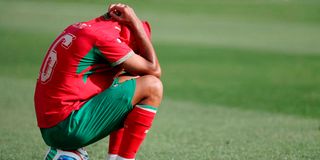
Morocco players react after their team's elimination from the 2026 Fifa World Cup in the quarter finals by France at Boston Stadium on July 9, 2026.
Photo credit: Reuters
If there is one lesson African teams will take from this tournament, it is that elite knockout football is often decided when concentration, game management and emotional control become more important than entertainment.
South Africa, playing in a World Cup knockout match for the first time, held Canada to a 0-0 draw until Stephen Eustáquio struck in the second minute of stoppage time to hand the co-hosts a 1-0 victory.
Côte d’Ivoire were level with Norway before Erling Haaland delivered the decisive blow in a 2-1 defeat. DR Congo led England, but Harry Kane eventually decided the contest, scoring the winner in the 86th minute of a 2-1 victory.
Senegal’s collapse was perhaps the most painful, the Lions of Teranga led Belgium 2-0 and were only five minutes away from the next round, but surrendered their advantage, were dragged into extra time and eventually lost 3-2 after a late VAR-awarded penalty.
The defeat exposed tensions inside the team, with midfielder Pape Gueye announcing that he would take a break from international football while the coaching staff remained in place.
Coach Pape Bouna Thiaw admitted afterwards that his substitutions had failed. “Once you lose, you can’t say they paid off,” he said.
Cape Verde’s extraordinary debut also ended painfully, the tiny island nation had gone unbeaten in the group stage, drawing with Spain, Uruguay and Saudi Arabia, before pushing defending champions Argentina into extra time and eventually losing 3-2.
Then came Egypt, the Pharaohs were 2-0 ahead of Argentina and appeared to be heading for one of the greatest results in their World Cup history.
Instead, Argentina scored three times in the closing stages, through Cristian Romero in the 79th minute, Lionel Messi in the 83rd and Enzo Fernández in stoppage time, to win 3-2.
The defeat was surrounded by controversy though, Egypt had an earlier goal disallowed after a review and were furious when a late challenge on Mohamed Salah did not result in a penalty, shortly before Argentina scored the winner.
Coach Hossam Hassan said Egypt had “suffered injustice”, while the Egyptian Football Association questioned the “consistency and fairness” of several key decisions.
But beyond the controversy lay an equally uncomfortable footballing reality. Egypt had been two goals ahead. Senegal had been two goals ahead.
DR Congo had led England. South Africa had been minutes away from extra time. Cape Verde had twice fought their way back against the defending champions.
Had even two or three of those teams managed decisive moments better, the continental conversation might now be entirely different.
Egyptian players remonstrate with referee Francois Letexier after Enzo Fernandez scored Argentina's their third goal in their Fifa World Cup 2026 Round of 16 match at Atlanta Stadium in Georgia on July 7, 2026.
Photo credit: Reuters
Before South Africa had even played their opening match against Mexico on June 11, the tournament exposed fractures in continental solidarity.
Across social media, many African fans openly backed Mexico against Bafana Bafana, linking their hostility to anger over xenophobic violence and anti-immigrant sentiment in South Africa.
Memes, Mexican flags and mariachi imagery flooded social platforms as some fans symbolically adopted Mexico for the night. South Africa lost the match 2-0. The reaction was not universal, with Bafana Bafana still receiving support in parts of Africa and among the diaspora.
But the episode demonstrated how political grievances could disrupt the traditional expectation that Africans automatically support the continent’s representatives at the World Cup.
Cape Verde, meanwhile, provided one of the tournament’s most compelling stories, the Blue Sharks, representing a country of roughly half a million people, were playing at their first World Cup.
They did not win a match, but they also went unbeaten in the group stage, holding Spain, drawing 2-2 with Uruguay and sharing the points with Saudi Arabia before taking Argentina to extra time.
Cape Verde coach Bubista had summed up the significance of their qualification earlier in the tournament. “Football belongs to everyone,” he said.