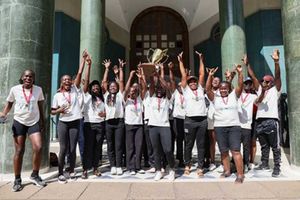
After surviving a lengthy ban and paying hefty fine to Africa Hockey Union following a failed campaign in 2023 Women’s Africa Cup for Club Champions in Malawi, Kisumu-based Lakers Hockey Club returned to the competition and triumphed against all odds this year.
They beat Ghana Revenue Authority in the final to win the 27th edition in Zimbabwe. But when they returned home, there were no bonuses waiting for them, no commercial endorsements, and no life-changing contracts. This is the story of champions without cheques whose only reward is empty handshakes.
On February 1 this year in Harare, they stood at the top of African club hockey, medals dangling around their necks and trophy raised.
But when Lakers Hockey Club returned home to Kisumu after winning the 27th Women’s Africa Cup for Club Champions (ACCC) in Zimbabwe, there were no bonuses waiting. No commercial endorsements and no life-changing contracts.
The medals did not shield them from everyday demands. Teachers among them had lesson plans to file; surveyors reported back to sites; counsellors resumed client appointments, and rent remained due.
For some, pride had to be set aside as they reached out to family members for upkeep money, a humbling reality for athletes who had just conquered the continent.
Lakers Hockey Club players pose for pictures with the 2025 Africa Women’s Hockey Club Championships trophy outside the Nation Centre in Nairobi on February 5, 2026, after arriving by bus from Harare, Zimbabwe.
Photo credit: Wilfred Nyangaresi | Nation Media Group
Before they even stepped onto St John’s College Astro Turf in Harare, Zimbabwe, Lakers had already endured a challenge that speaks volumes about the economics of African hockey.
The journey would cover more than 2,900 kilometres.
The squad departed Nairobi on January 17, travelling through Dar es Salaam before continuing south toward Zambia and Zimbabwe by road. There were mechanical delays. There were cramped seats. There was muscle fatigue that lingered even after arrival. Air travel was beyond budget.
That road trip did more than test endurance, it underlined hockey’s financial limitations.
Lakers’ first match reflected the toll of travel. They lost 2–0 to defending champions Ghana Revenue Authority Hockey Club. The defeat was disciplined but telling. Reaction times were slower. Transitions lacked sharpness.
But champions are not defined by their opening result. Lakers regrouped and dismantled Zimbabwe’s Hippo Valley Hockey Club 4–1. They followed that result with a commanding 3–0 win over Bulawayo Hockey Club.
Elizabeth Opoku struck first for GRA from a penalty corner. The defending champions looked composed. Lakers looked determined. Captain Alice Owiti rallied her side. Faith Amondi poppoped up wth the equaliser. The final went to a penalty shootout.
“We told ourselves, ‘this is ours. We didn’t travel all that distance to finish second’,” Owiti recalls.
They were declared African champions. After lifting the continental title in Harare, the celebrations quickly gave way to another reality, the long road trip back home.
According to the team’s technical advisor Austin Tuju, the most emotional moment of the entire trip came not during the tournament, but just before the team boarded the bus back to Kenya.
“The first hour before departure was very emotional. Some of the players broke down because the journey ahead reminded them of what they had just gone through, the breakdowns, the sleepless nights and the uncertainty we experienced on our way to Zimbabwe,” he recalls.
Tuju admits the questions reflected a deeper frustration about the sacrifices required in elite sport without corresponding support.
“I told them ‘honestly, I have been in this game for many years, and sometimes the level of commitment we put in does not match the rewards. It may look like misplaced passion, but that is the reality of our sport.’ What keeps us going is belief and love for the game.”
Lakers Hockey Club's technical advisors Austin Tuju (left) and John Paul display the African Cup for Club Champions trophy at Nation Media Group offices in Kisumu on February 6, 2027.
Photo credit: Alex Odhiambo | Nation Media Group
Players comforted one another, sharing hugs and reassurance before eventually agreeing to board the bus.
“The team had to encourage each other. After some conversations and reassurance, they agreed to travel,” Tuju says.
Although they get trophies, African Hockey Federation which is headquartered in Cairo, does not give cash prizes to winners of Africa Cup for Club Champions. Likewise, Kenya Hockey Union does not give winners of its leagues cash prizes.
The players told Nation Sport they travelled to Harare driven by ambition and a promise made to them shortly before departure a pledge that sharpened their resolve to fight
“We were scheduled to leave Kisumu on January 13, but by that date, the money in our M-changa account was barely Sh5,000. On January 16, a Member of Parliament stepped in and paid for our transport from Kisumu to Nairobi. That’s how we managed to board Guardian bus,” said Maurine Owiti.
According to Maureen, the legislator encouraged them to give their all in Harare and assured them that if they lifted the ACCC trophy, he would organise a meeting with President William Ruto.
“If Harambee Stars were rewarded with financial incentives and promises of affordable housing despite falling short at the 2024 African Nations Championship, what would await a team that actually returned home with silverware?” she posed.
However, the upshot of the dream is unbearable to some of the players.
“The reality is harsh, some of us have not even received our January salaries. Employers assume we made money at the championship because we won it, but in truth, we don’t even have a single penny,” said Joan Ngie.
Nation Sport contacted several senior members of the squad to understand what sustains their commitment to hockey despite the financial uncertainty and how they manage to meet their everyday expenses away from the spotlight.
Quinter Okore, one of Kenya’s national team goalkeepers and a key member of Lakers, say that hockey doesn’t pay.
“Hockey is an expensive game but the players are ever broke. For Instance, a good goalkeeper’s kit costs Sh300,000 and above. Helmet, leg guards, chest protector, everything is expensive. So I normally ponder to myself, if the equipment is so expensive why can’t we have a salary for the players,” she posed.
Lakers Hockey Club players pose with the 2025 Africa Women’s Hockey Club Championships trophy outside the Nation Centre in Nairobi on February 5, 2026.
Photo credit: Wilfred Nyangaresi | Nation Media Group
Okore does not have formal employment and depends fully on relatives and friends in order to pay her bills.
“If you truly love the game, play for passion. But for money, there is no money in hockey,” she added.
“No, not if I’m thinking about financial stability,” she asserted.
Yet she still dreams of qualifying for the 2028 Summer Olympics. Alice Owiti, Lakers’ captain and the ACCC Most Valuable Player in Harare, represents the balancing act many Kenyan hockey players must master.
By profession, she is a trained teacher. A holder of bachelors degree in Education (French), she currently teaches at Ng’iya Girls High School in Siaya County.
“I prepare my lessons early and train after school. Teaching has made me more organised and responsible,” she said.
Owiti joined Lakers in 2017 while still a student and grew under the guidance of mentor Gilly Okumu. Leading the team to continental success was a personal milestone.
“I want to continue representing Kenya internationally and achieve more continental success. And I want to mentor younger players so they believe they can succeed both in education and sport,” she explained.
Lakers Hockey Club team captain Joan Ngiye and team manager Judith Owino pose with the 2025 Africa Women’s Hockey Club Championships trophy outside the Nation Centre in Nairobi on February 5, 2026.
Photo credit: Wilfred Nyangaresi | Nation Media Group
But even as captain and continental MVP, her salary comes from teaching, not hockey.
Maurine Owiti, the twin sister to Alice Owiti, started her hockey journey while still in secondary school. She joined Sinyolo Girls High School as a footballer but changed to hockey after seeing trophy displays and hearing about East Africa Secondary School Games.
Her twin sister, Alice, was already playing hockey. Their father initially disapproved of their choice of sport.
“When we went home for school holidays, he told us if we didn’t abandon hockey, he wouldn’t pay school fees,” Maurine recalls.
In 2018, after continental success, they were invited to France. Travel broadened horizons and softened parental resistance.
“My father saw that hockey helped us in many ways, and he changed his mind,” she says.
Maurine later joined Kenya Under-18 team, and graduated to the senior squad, travelling with the team to Ghana and England for championships.
“At one time, the boys were sponsored, but the ladies were left out,” she says.
Injuries and a team ban in 2023 disrupted her momentum. She now balances fieldwork, volunteering and family support with elite competition.
“I want to play in the Pro League. I want to play in the Olympics in Los Angeles in 2028. If we qualify, that will be a plus for me,” she says.
Stacy Chentry Achieng began hockey in 2014, inspired by Sinyolo’s dominance at East Africa Secondary School Games. Today, she is a professional land surveyor.
“My working hours are from 7am to around 4pm or 5pm.I train from 5pm to 7pm,” she says. She is yet to earn a single penny from the game but keeps playing.
“I play hockey for passion, maybe in future I’ll earn money from it when a miracle happens,” she adds.
Maurine Achieng began hockey at Form One at Nyamira Girls High School and quickly rose to the position of an assistant team captain. After playing the game for Masinde Muliro University of Science and Technology, she joined Lakers Hockey Club. She holds qualifications in general agriculture, but currently works as a salonist and nail technician.
“Unless you have been called to the national team, there’s no money in hockey,” she says.
And even then, payment is tied to tournaments.
“After that, you’re broke. If not for my hustle, I don’t know if I could even be getting fare to attend team training sessions,” she says.
Joan Ngie’s hockey career began in 2014, motivated by travel opportunities to Rwanda, Tanzania and Uganda. After leaving Chuka University, she returned to Lakers in 2023 and featured at the ACCC in Zimbabwe. Professionally, she is a psychologist working as a counsellor at a cancer centre in Kisumu.
“Hockey doesn’t pay, we are here for the love of the game,” she said.