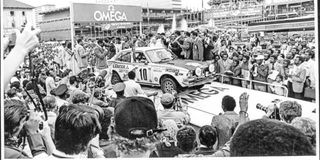
Simba wa Kenya Joginder Singh in a Mitsubishi Lancer 1600 GSR at the ramp at Kenyatta International Conference Centre ready to start the 1977 Safari Rally on Paril 7, 1977.

There was only one Joginder Singh. Lionised by President Jomo Kenyatta as Simba wa Kenya, idolised by the Sikh community as “The Flying Sikh”,and considered by every rally loving Kenyan during his era as the best ever driver in the world.
Every Easter, millions of kids across Kenya would make their own Joginder Singh Safari Rally car out of cartons and bottle tops held together by wires or sticks. They would then challenge each other for a duel between Joginder and the rest of the world. The name Joginder was the catchphrase for the East African Safari Rally.
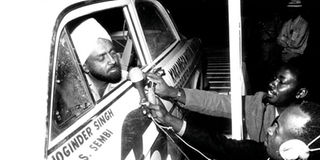
PHOTO | FILE Joginder Singh in an interview with journalists at Jamhuri Park during the East African Safari Rally on March 26, 1967.
Joginder was the first man to win the Safari Rally three times (1965, 1974 and 1976). He competed in 22 Safari Rallies failing to finish in only three races -- 1972, 1975, 1978..
He was the first truly Kenyan national sports celebrity whose appeal transcended age and sporting disciplines.
His legend has spurred a group of rally enthusiasts to remember him and keep his spirit alive 12 years after his death.
A group of Joginder Singh admirers have come together to remember the departed Kenyan great with a motor rally event.
Joginder died aged 81 at his home in Surrey, UK on October 22, 2013.
Unique way
On August 7 to 9, Joginder Singh, will be celebrated in a unique way by these rally enthusiasts led by Frank Tundo, one of the few living drivers who competed against him in the 1970s and 1980s.
They have renamed the Jim Heather Hayes Memorial, which was first held in 2023, to the Joginder Singh Memorial Rally and changed the race objective to now be celebrating selected departed great Safari Rally drivers.
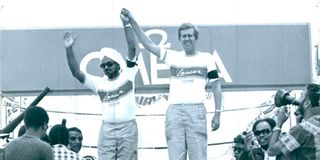
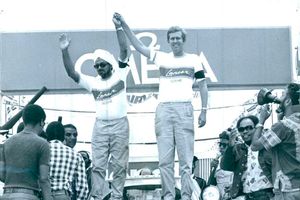
The 1976 Safari Rally Winner, Joginder Singh and David Doig the finishing ramp at Kenyatta Conference Centre.
“Having had such a success with the Jim Heather-Hayes Rally organising committee, and seeing how people loved remembering him, we decided as a committee to honour all our great iconic rally drivers who have rested, one by one, annually,” said Natasha Tundo, one of the organisers of this historic rally.
“Choosing Joginder was easy. He is a household name and an icon that needed to be celebrated not as forgotten. We had proposed Shekhar Mehta but settled for Joginder,” he added.
Tundo is the sister of five times Safari champion Carl Tundo and daughter of Frank Tundo.
“My parents, Chantal Young, Harry Sagoo, Anne Troughton, Renzo Bernardi, Marzio Kravos, Jonathan Somen and Richard Hechle, came together and settled on Joginder following the success of the Jim Heather Hayes Memorial Rally over the last two years.
“We have already contacted Joginder’s brother Davinder and his son Bhachu in England and Australia respectively. They are extremely happy and touched. We asked them if we could honour their father/brother. I’m hoping one of them or both of them will join us in August.”
Natasha remembers Joginder. “The Flying Sikh! Lovely gentleman, I remember him while I was running around the service parks and he was racing against my dad
The Joginder Singh Memorial Rally we will start in Nanyuki town, day one and two will head north into Laikipia county and day three we are planning around Nanyuki area.”
Frank Tundo said if there is one driver who will forever be associated with the Safari, then Joginder fits the bill.
“Joginder was a natural. We all looked up to him, to be like him,” beamed Frank.
It is the same reaction of reverence exhibited by many adults of the 1950s to the 1980s.
Joginder’s last Safari Rally was in 1980. He had the ability to transform even the least powered or docile cars into flying machines.
Finishing first
Sample his 1965 victory in a Volvo PV44 which had done 64,000km, starting first and finishing first with his brother Jaswant Singh.
This car was supported by so many companies that it looked like a mobile billboard, and so in Joginder and East Africa, branding of sponsors' logos became the new found norm of advertising in motorsport.
Roger Barnard and Peter Moll, in their book, The Flying Sikh, illustrated by Mohamed Amin, Joginder once almost caused hearts to stop in the Swedish Rally where he had been invited to compete after his 1965 Safari Rally heroics.
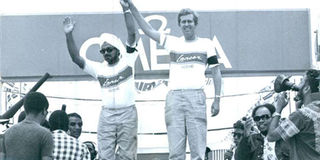
1976 Safari Rally winner Joginder Singh (left) and David Doig at the finishing ramp at the Kenyatta Conference Centre, Nairobi. PHOTO | FILE |
Many Swedes had never seen a Sikh before, and a woman went hysterical when Joginder emerged from the car in his trademark Sikh turban which she mistook for a massive head bandage from a possible accident in the rally.
“He’s hurt ...!” she exclaimed. “Get a doctor!” But Joginder calmed her down, explaining that it was a simple head gear for a religious Sikh.
Joginder Singh Bachu was born on February 9, 1932 in Kericho, the eldest of eight sons and two daughters born to Batan Singh Bachu and Swaran Kaur.
His father had sailed to Kenya in the 1920s in a small dhow from the Punjab region of India.
Joginder went to Highland Indian School in Kericho until 1946 before joining the Indian High School, later renamed Duke of Gloucester School, and today Jamhuri High School.
He lost a left thumb in an industrial accident in 1947 in a sawmill in Nairobi that belonged to his father’s friend when he tried to fix a loose belt that caught his hand.
“Where my thumb should have been there was just a bloody pulp. When my father heard about it, he drove to Nairobi in four and a half hours.
“In those days, the over 200 miles was marrum road. I think that feat almost made the loss of my thumb worthwhile,” Joginder said in the book.
You can deduce where Joginder’s driving talent came from
Amongst Joginder’s memorable rallies are the brutal 1968 Safari that attracted 74 starters and only seven finished. They were hailed as the “Magnificent Seven”. That rally was won by the Kenyan crew of Nick Nowicki, navigated by Paddy Cliff in a Peugeot 404[
Joginder gave Mitsubishi their first victory in 1974 in a Colt Lancer and repeated the same feat in 1976 in a similar model.