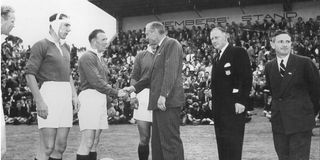
The official opening of the Rugby Football Union of East Africa Ground, Nairobi, on September 28, 1955. On the right is RFUEA president Dave Goldstein before East Africa played against the British Lions.

A demand letter last year from Rugby Football Union of East Africa (RFUEA) to Kenya Rugby Union (KRU) to pay rent of Sh16.8 million has led to a court case over the ownership of land considered the home of the game in the country.
Following the demand, KRU filed a case at the Sports Dispute Tribunal seeking ownership of the 10-acre piece of land along Ngong Road, where the iconic RFUEA Ground is built.
KRU argued that RFUEA, who own the land, ceased to exist as a sports organisation, and thus the land should be for local rugby development as originally envisaged.
So, how did RFUEA get to own the land, and how did KRU become their tenant?
The story of the RFUEA and its eponymous ground cannot be told without that of the Rugby Football Union of Kenya (RFUK), the original body formed to run the game in the country.
On August 1, 1921 delegates at a meeting at New Stanley Hotel in Nairobi resolved to form RFUK to manage rugby in the Kenya Colony, Uganda Protectorate & Tanganyika Territory.
It was unanimously agreed by acclamation that Rev John Flemming Gordon Orr be chairman and William Rees Bartholomew be secretary.
That meeting decided that a temporary committee be appointed to get in touch with the outlying districts and ask them to nominate representatives who would draw up a constitution and rules and put the union on a working basis.
The RFUK minute book for August 1, 1921, their inaugural meeting, recorded that all delegates present contributed Sh5 each to get the organisation started.
A logo of a lion aka simba was decided at a subsequent meeting held in Nakuru reported a local paper The Leader of British East Africa.
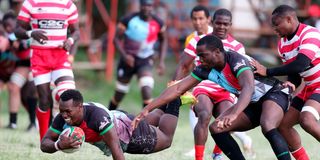
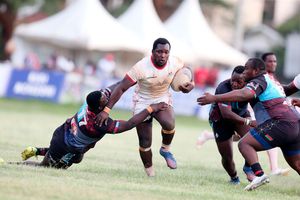
Paul Mutsami of Kenya Harlequin scores against Impala during a Kenya Cup match at RFUEA ground in Nairobi on January 11, 2025.
The RFUK became fully operative with the split of the Nairobi District and formation of Harlequins RFC and Nondescripts RFC on July 11, 1923.
Then on December 6, 1923 at New Stanley Hotel in Nairobi, the first RFUK office bearers were elected.
The main officials were: President Colonel Dennis Paul Whetham, Vice-President Captain Edward Lewis Townsend Paddy Lester, Secretary Graham Wedderburn and Treasurer John Leonard Worlledge, with three vice presidents and a patron.
RFUK sought and got affiliated to England Rugby Football Union (RFU) as an honorary member in 1921 and to the South African Rugby Board in 1928.
One of the aims of the RFUK from the AGM of March 2, 1925 at the Stanley Hotel in Nairobi was securing their own grounds as a matter of priority.
Various committees were put in place to pursue land at Kabete in the Westland’s area, at City Park area. However, this never came to fruition until 30 years later.
In 1925, RFUK instituted the first formal rugby competition in the country, the Nairobi District & Championship. This was a league competition where all rugby teams in the country took part.
The Northern Province of Tanganyika Rugby Football Union was formed in 1928 to manage the game in Tanganyika. Together with the RFUK, they were the only administrative unions in East Africa.
The urgency of having a national stadium came up again when the University of Cape Town toured East Africa from December 1949 to January 1950. Their three matches recorded massive turnouts.
In fact, RFUK was forced to hire the Nairobi City African Stadium for the third and final fixture between the East Africa XV and the University of Cape Town XV on January 28, 1950 as Parklands Sports Club, where the union was headquartered, was deemed too small. The first match between the two teams on January 7 at the Eldoret Sports Club, Eldoret, and on January 21, at the Royal Agricultural Showground, Nakuru were filled to the rafters.
All three matches were attended by Sir Phillip Euen Mitchell, the Governor of Kenya, who was also the patron of RFUK.
Because of the venue hitch in Nairobi, RFUK formally requested the government for land in Nairobi to build a rugby stadium.
Mitchell narrates in his autobiography African Afterthoughts, that RFUK Secretary David Moss Goldstein wrote to him on January 29, 1950, requesting for a piece of land. Then, on December 4, 1951, at another AGM, Goldstein reported that Governor Mitchell and the Commissioner of Lands had granted the union land next to the Old Cambrians Club (now Impala Club).
First official match
Mitchell narrated in his book: “The letter read, and I quote. ‘Sir Phillip Mitchell Governor of Kenya Colony granted the RFUK land parcel No 209/4529 for a Rugby headquarters on behalf of King George VI. The lease was issued on 1.10.1951 for a period of 50 years at KSh72 per year.’ There was to be a tenant club.”
The original plan was to construct a new union headquarters and then give it to the Old Cambrian Club as tenants. Nondescripts also needed a new ground, and they were considered. But Norman Burton Larby, President of Nondescripts in 1951 and 1952, and who was present during the discussions, refused the offer because they already had a tenancy agreement with Parklands Club. Eventually, Old Cambrians also declined the offer and it fell on Kenya Harlequins, formed in 1952, who accepted.
Quins were initially based at the Civil Service Club.
The RFUK set about constructing the clubhouse and developing the playing surface, but faced financial constraints. They set about raising money through gate collections during matches. For example, on March 30, 1953 gate collection from the match pitting West Kenya XVs against the Uganda Cranes XVs at the African Stadium in Kisumu, went towards the construction fund.
A charity sweepstakes was also held to raise funds while the union sold life membership seats. Money was also raised through harambees, tea parties, and auctions.
Then at an RFUK meeting on July 4, 1953 a proposal was made for the name of the Union to be changed RFUEA.
Dar-es-Salaam Gymkhana supported the change of name, seconded by Tanga Rugby Football Club, so long as sub-unions were formed with the mandate of managing the game in their respective territories.
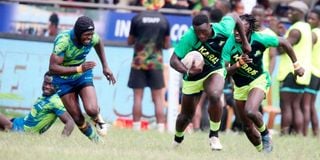
William Mwanji (centre) of Kabras Sugar charges past Vincent Onyala (left) of KCB during the Kabeberi 7s Rugby tournament at RFUEA ground in Nairobi on September 7, 2025.
On Sunday, August 2, 1953 at the RFUK AGM held at the New Stanley Hotel, adopted the change of name by a show of hands. Rugby Football Union of East Africa was born and immediately took over the running of all rugby activities in the Kenya Colony, Uganda Protectorate and Tanganyika Territory.
RFUEA also took over all the liabilities and assets of the RFUK including the 10-acre piece of land the government had allocated to the Kenyan union in 1951.
The first three trustees of the Ngong Road grounds were Christopher Fredrick Schermbrucker, David Moss Goldstein and Fredrick Roy Fear.
What had necessitated the change of name?
The England RFU, when requested for a loan by the RFUK to help in funding the construction of the new grounds, in turn asked the local body to change its name to justify their jurisdiction over Uganda and Tanganyika.
In early 1954, the Tanganyika RFU and the Uganda RFU were formed as agreed at the RFUK AGM in Nairobi.
They were both affiliated with the RFUEA. The sub unions were also formed, namely, the West Kenya RFU, Kenya Central Province RFU, Coast Province RFU – consisting of Dar-es-Salaam RFC, Malindi RFC, MacKinnon Road RFC, Tanga RFC and Mombasa, Tanganyika Central Union, Southern Province Rugby Union, and Combined Military Services Clubs.
RFU of England subsequently gave RFUEA a loan of £3,500 for the construction of a rugby ground.
The Rugby Football Union of East Africa Grounds was completed and officially opened by Sir Evelyn Baring, Governor of Kenya Colony and Jack Siggins Team Manager of the British & Irish Lions, on September 28, 1955.
The new ground hosted its first official match on the same day that sold out, the East Africa XVs versus the British & Irish Lions.
The RFUEA minute book for 1956 says that “Uganda Cranes & Tanganyika Giraffes national sides can use the grounds for training as well as host matches because they are also owners of the place alongside the Kenya RFU.
The RFUEA was now the umbrella body in East Africa, with Tanganyika and Uganda RFUs running the game in their respective countries. This was the way the game was managed until 1970. Due to a reduction of players and clubs, the sub unions were dissolved, and a new Kenya Rugby Football Union was formed.
However, the RFUEA continued to manage the game after the three countries gained independence in the early 1960s.
On February 14, 1979 George Ngure Kariuki was elected chair of the RFUEA and KRFU. He made history by becoming the first and only African chair of the RFUEA, a position he has held to date.
The RFUEA last held elections on February 16, 2003. Between 1970 and 1979 the RFUEA and the KRFU were run in parallel with the former’s structure, both bodies having the same executive officers and Executive Committee meetings.
In 1979, the KRFU Constitution was amended to give it wider powers, when clubs were given direct representation for the first time. By 1981 RFUEA and KRFU were meeting separately. KRFU changed its name to Kenya Rugby Union in 2010.