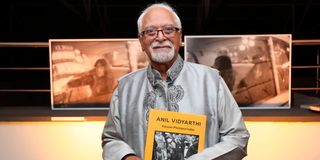
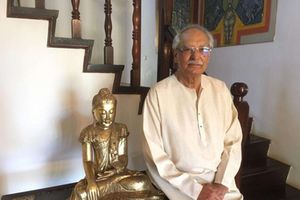
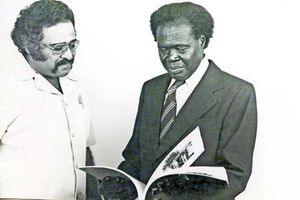
During the launch of a new book about him on the evening of Friday, February 13, 2026, former photojournalist Anil Vidyarthi asked us to ensure the photos in the story we publish are “big”.
In other words, the 81-year-old was suggesting that we cut down on text and let the photography do the talking.
It is easy to understand why. Anil has had his photos run in many publications, and so he knows the value of a strategically placed photo alongside text.
Among the publications is the Daily Nation , which started running his photos from 1962. He worked with the paper until 1967, and he still buys his copy of the publication daily — whereupon he silently judges the quality of photojournalism.
Moreover, the book “Anil Vidyarthi: Kenyan Photojournalist” – written by his son Shravan Vidyarthi together with his partner Erin Haney – goes by that policy. It has 150 pages, but the prose doesn’t go beyond 6,000 words. The rest are photos and captions.
As the reader turns the pages, the images place them on a journey through time. It is a carefully curated mix of triumph, nostalgia and power. The photos, snapped by Anil over time, bring out family ties, sports personalities, pre- and post-independence politics and a lot in between.
Anil’s love for cameras started by observing his late cousin Priya Ramrakha, who was 11 years his senior, as he photographed various powerful personalities in Kenya.
In his heyday, Anil was a daring photojournalist. He captured wars, among them the India-Pakistan clash over Bangladesh in 1971, which were published in English newspapers.
“Anil went to the frontlines, where he photographed the tragic aftermath of bombings, and witnessed child soldiers killing each other. He himself was almost lost when he fell down a well in the melee of the frontlines,” states a narration by Erin Haney.
The more he covered the war, the more the words he had been told before rang in his mind. Those words were: “No picture is worth your head.”
It is no surprise, therefore, that Anil dedicates the book to seven of his photojournalist friends who died while snapping photos in various conflict zones. The first on the list is Priya, the cousin who inspired him.
“He was my mentor and friend. He was killed covering the civil war in Biafra [in Nigeria] at age 33. His untimely death remains deeply embedded in my heart,” Anil told the crowd that gathered at a rooftop site in Westlands for the launch.
“Think for a moment [about those who] take these photographs at the cost of risking their lives. Many do this day in and day out. You will recall photos by Mohammed Amin, Dan Eldon, and so many more Kenyan and international journalists who were killed on their assignment covering wars,” he further said.
Mohamed Amin, Mohinder Marjara, Jens Albreksen, Dan Eldon, Dennis Royle, and John Mathai are the other deceased photojournalists the book is dedicated to “and many unsung heroes of the photojournalism world”.
The name “Vidyarthi” rings a bell for many Kenyans, as Anil is the father of former NTV anchor Smriti Vidyarthi.
In the introductory phases of the book, which are among the few areas populated with prose, the reader gets to learn that “Vidyarthi” emerged from a nickname. It was given to Mr Girdhari Lal (GL), Anil’s father, who was born in Mombasa in 1907.
Photojournalist Anil Vidyarthi displays some of the photographs he took.
Photo credit: Bonface Bogita | Nation Media Group
“GL’s friends gave him the nickname Vidyarthi, denoting a scholar or student, and he adopted this as a family surname,” says the introduction written by thespian and journalist John Sibi-Okumu, a long-time friend of the Vidyarthis.
Anil’s grandfather, Shamdass Horra, was among the 32,000 Indians brought to Kenya between 1896 and 1901 to build the Kenya-Uganda railway.
Shamdass and his son GL ventured into the printing business from 1933, running a company called Colonial Printing Works that published the Colonial Times among other publications.
By the time the business came to a stop in 1962, the two had had many run-ins with the colonial administration.
“The Colonial Times and other papers printed by the family were unequivocally outspoken in the espousal of freedom from colonial domination across the globe,” says the introduction.
The publishing firm also supported newspapers run by individuals such as Fred Kubai, Henry Gathigira, Francis Hamisi, Henry Mwaniki Mworia, Achieng’ Oneko and Jomo Kenyatta.
“GL was twice arrested, convicted and fined for sedition in 1945, when his son Anil was a year old,” the introduction says.
Years later, the family started a business called Colourprint Press that saw Anil get arrested and charged with sedition in 1994, which was 49 years after his father had faced the same charge.
A Taifa Leo photo of Anil being escorted from the courts by two stern police officers is reproduced in the book, and somehow it captures the air of intimidation under President Daniel arap Moi.
What was different with the son’s arrest over sedition was that it wasn’t long before the offence was removed from the Penal Code.
The Human Rights Watch indicates that sedition was expunged from Kenya’s list of offences in 1997 following the Inter-Party Parliamentary Group (IPPG) reforms, partly aimed at portraying the then president Daniel arap Moi as a change-minded individual ahead of the election.
The book “Anil Vidyarthi: Kenyan Photojournalist” by Shravan Vidyarthi and Erin Haney, pictured at Nation Centre in Nairobi on February 14, 2026.
Photo credit: Bonface Bogita | Nation Media Group
Colourprint Press faced relentless assault from the government for accepting to print works that the authorities considered unfavourable.
“On January 13, 1994, two hundred security agents stormed their offices to seize copies of opposition leader Kenneth Matiba’s new book Kenya: Return to Reason. His book exposed massive corruption in President Daniel arap Moi’s inner circle, alleged President Moi’s involvement in the 1990 murder of Foreign Minister Robert Ouko, and called on readers to reject the government,” says a narration by Erin Haney.
In 1995, the printing firm suffered a government-motivated arson attack.
“One hundred litres of petrol were poured into the press, which was set on fire. The arsonists accidentally set fire to their own vehicle and abandoned it. The insurance company investigating the situation traced the vehicle to a company owned by one of former President Daniel Arap Moi’s sons,” Anil is quoted saying in the introduction.
From Anil’s crossing from photojournalism to commercial photography following training in England, from his shift from the newsroom to the family printing enterprise, the book brings out the life story of Anil with the aid of iconic photos.
When he spoke at the launch, Anil explained his love affair with photography.
“Why do I take photographs? My answer is simple: I’m an introvert. And if it wasn’t for the camera, I would never step out. It’s a tool that has enabled me to see the world, to see people and cultures. I’m a different person behind the camera,” he said.
“I don’t take pictures to make you smile; I take pictures because they make me smile. I don’t take pictures to make you cry; I take pictures because they make me cry… Mostly, I’m curious to see if you feel the same way if these moments move you as well,” he said.