Kenya’s 2027 presidential race is already attracting a crowded field of aspirants, even though the polls are still two years away. The growing list of contenders, from seasoned politicians to emerging figures, is shaping the early political terrain— and possibly, according to some analysts, playing into President William Ruto’s advantage.
While some political observers argue that the proliferation of aspirants often benefits incumbents in Kenya’s electoral landscape, others say many candidates could force a runoff and unite behind an opposition figure who secures either position one or two in the second round.
While some aspirants have vowed to unite and form a formidable force to kick out President Ruto from power, others have promised to bite the bullet and face Dr Ruto head-on, accusing him of running down the country.
Former Chief Justice David Maraga speaks during the declaration of his 2027 presidential bid on the United Green Movement Party ticket, at the party headquarters, Nairobi, on October 2, 2025.
Photo credit: Wilfred Nyangaresi | Nation Media Group
On Thursday, retired Chief Justice David Maraga formally declared interest in the top office and unveiled his preferred political party. Mr Maraga will now fly the United Green Movement (UGM) party flag in the contest against Dr Ruto.
“Since I declared my intention to run for the presidency, most Kenyans have been asking which is my party, and I have been telling them that I’m looking for one. It has not been an easy job, as some people might think, to get a party that is aligned to the ideologies that describe the values that you do,” Mr Maraga said.
His unveiling came hot on the heels of another announcement by businessman-turned-politician Jimi Wanjigi.
Mr Wanjigi formally took over the leadership of the Safina Party from lawyer Paul Muite, promising to breathe fresh life into the 30-year-old political movement as he prepares to face off with President Ruto in the 2027 election.
Safina Party Leader Jimi Wanjigi speaks during the party's leadership transition ceremony at Ngong Racecourse in Nairobi on September 18, 2025.
Photo credit: Bonface Bogita | Nation
Mr Wanjigi, flanked by lawyer Willis Otieno, who assumed the role of deputy party leader, declared that Safina is committed to ushering in a new era of economic liberation and political accountability in a country he said is drowning in debt and crippled by corruption.
“The nation is in a deep crisis,” Mr Wanjigi told party members and supporters during the National Delegates Conference in Nairobi. “Our children’s future is mortgaged. Families cannot afford food or shelter, jobs are scarce even as taxes rise, and freedoms are under attack. Kenya is once again in bondage, but this time the coloniser is within.”
The billionaire, who previously sought the presidency on an ODM ticket in 2022 before breaking ranks with ODM leader Raila Odinga, has since styled himself as a political outsider fighting entrenched cartels.
But even as Mr Maraga and Mr Wanjigi formally got their parties’ endorsements, they will have to contend with the larger ‘united opposition’ team steered by former Deputy President Rigathi Gachagua, who has also entered the ring, even though he will have to wait a little longer for clearance by the courts following his impeachment last year.
His team, which held a meet-the-people tour in Kajiado County yesterday (Friday), consists of Wiper leader Kalonzo Musyoka, People’s Liberation Party (PLP) leader Martha Karua, Democratic Action Party–Kenya (DAP–K) chief Eugene Wamalwa, and Democratic Party (DP) leader Justin Muturi.
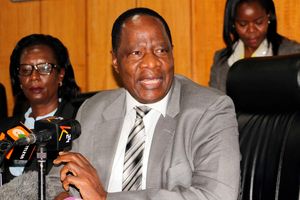
Former Interior CS Fred Matiang'i at a past event.
Photo credit: File| Nation Media Group
Former Interior Cabinet Secretary Fred Matiang’i, who is allied to ex-President Uhuru Kenyatta’s Jubilee Party, has also been coalescing around the team, but his conspicuous absence from Mr Gachagua’s rally in Kajiado yesterday only suggested a fragmented opposition team.
Instead, Jubilee Secretary-General Jeremiah Kioni told Sunday Nation that Dr Matiang’i “will be in Nakuru County.”
Insiders in the former CS’s camp told this newspaper that he had planned a youth engagement forum in Nakuru Town before proceeding to a funeral in Ngata. Speaking in Nakuru, Dr Matiang’i said: “I have started talking with the members of Jubilee at the grassroots level. This is the first of 47 such meetings I’m going to have in the country.” “I’m going to meet Jubilee members in every county in Kenya. I will go to every village where I can find them as I ask them to register as voters. I also ask them to consider me for the formal and official nomination for the presidential contest,” said Dr Matiang’i.
On the cracks in the united opposition, the former CS said: “Building unity in a coalition takes time; it’s not an easy matter. If you reflect, Mwai Kibaki, Charity Ngilu, the late Michael Wamalwa Kijana, Raila Odinga, and all those who were involved in forming Narc—it didn’t happen suddenly. It took time. It’s a long, painstaking exercise.” He noted that there are weighty issues that will take time to address, hence the need for patience.
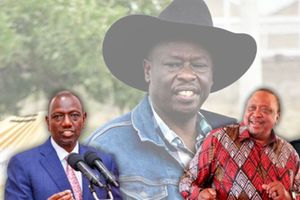
Former deputy president Rigathi Gachagua (background). Inset (from left): President William Ruto, his predecessor Uhuru Kenyatta and ODM leader Raila Odinga.
Photo credit: File | Nation Media Group
The feud evident in the Gachagua camp appears to be fast gaining traction, with what observers see as the sidelining of Dr Matiang’i—a move they say would only undermine the team’s strength against President Ruto.
In the Orange Democratic Movement (ODM), the uncertainty of its leader, Raila Odinga’s 2027 intentions, adds a further layer of intrigue. While the ODM leader maintains that his party remains in the race, he has also forged a working arrangement with Dr Ruto under the broad-based government framework.
Prof Macharia Munene of the United States International University (USIU) argues that a crowded presidential field has the potential to give Dr Ruto an edge over rivals.
“Yes. Although only a few are serious, the others being escorts, it makes a second round highly possible. They assume that Ruto has already lost, and the remaining question is who will replace Ruto; each assumes he or she will be the one,” Prof Munene says.
But while Prof Gitile Naituli of the Multimedia University of Kenya also agrees that a crowded field might give Dr Ruto an advantage, he warns that “it is not automatic, as it depends on how the opposition organises itself.”
“In Kenya’s political history, incumbents and dominant parties have often benefited from a fragmented opposition. When many candidates run separately, the anti-incumbent vote is split into smaller blocs, allowing the incumbent to win with a simple plurality, even without majority support.
“For instance, in 1992 and 1997, Daniel arap Moi retained power largely because the opposition was divided into several camps. Ruto could similarly benefit if his challengers scatter the vote rather than consolidate it.
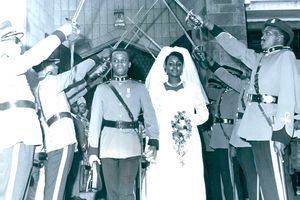
Late President Daniel arap Moi.
Photo credit: File
Even if the majority of Kenyans want change, disunity could deny them the chance to translate that into victory,” Prof Naituli says.
On the other hand, he adds: “If the opposition rallies behind a single credible candidate or builds a disciplined coalition, a crowded field may not work in Ruto’s favour. Instead, it could allow new voices to energise the electorate before converging on a unified ticket.”
He argues that the real question is not how many people declare interest, but whether those candidacies eventually coalesce into a common front. “If they don’t, yes, the fragmentation will tilt the advantage toward Ruto. If they do, then the crowded start may simply be part of a healthy competition leading to a stronger alternative.”
Political analyst Dismas Mokua insists that “while we have more than 15 Kenyans who have declared interest in the presidency, one can predict with accuracy that up to 80 percent are aspirational and have no capacity or competence to wage a successful campaign.”