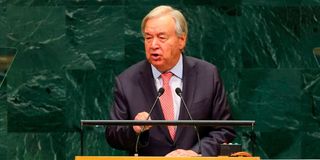
The 81st UN General Assembly sessions are drawing to a close in New York this week amid multiple global crises including escalating wars, artificial intelligence anxieties, and climate change.
Outgoing UN Secretary-General António Guterres used his final address and a high-level summit to turn the world’s gaze back on the climate crisis, which now runs the risk of being eclipsed by newer, more dramatic global concerns.
That tension was visible throughout Guterres’ speech as he tried to straddle the lengths and breadths of the growing challenges and the diplomatic bandwidth, they will each require.
To be sure, escalating wars and the rapidly expanding capabilities of artificial intelligence deserve every measure of attention they are receiving.
After all, the devastating global impacts of the ongoing wars in the Middle East and Ukraine are all too glaring, and warnings of a possible Artificial Intelligence (AI) ‘takeover’ couldn’t be starker.
But the real danger lies in allowing the urgency of these crises to reorganise our understanding of what can wait. This is because, climate change, slow and less dramatic as it may appear, will not suspend its consequences to give governments time to attend to other emergencies. Nor will the cost of delayed action simply be recovered when diplomatic attention finally returns.
Yet, the reordering of global priorities may already be well and truly underway, and it is not difficult to understand why.
Global development discourse
First, the three issues operate on different clocks of public attention. A missile strike or a bomb blast, grabs national and global headlines, and will demand an immediate response. A new AI capability can similarly provoke fears overnight about employment, deception or machines escaping human control. Such has been the case in recent weeks as whistle blowers and AI executives raised the possibility of an AI-triggered dystopian future of Sci-fi proportions.
Climate change, on the other hand, unfolds over many generations, through an accumulation of emissions and consequences. And even though its impacts are already immediate for many communities, public attention rarely focuses on the decisions that increased exposure in the first place.
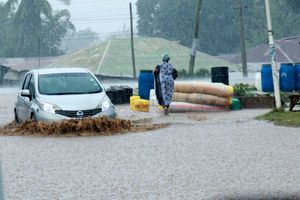
Disasters such as flooding or hurricanes, therefore become touch-and-go news events, while the underlying climate accountabilities recede unnoticed and unscrutinised.
That difference in tempo also creates a dangerous competition that goes beyond newspaper and TV headlines. Over the years, every war, whatever its justification, has demanded sustained diplomacy, and emergency spending.
Similarly, AI - in spite of the growing safety concerns - continues to attract extraordinary investment and government support, not least because countries increasingly regard technological leadership as a source of economic and strategic power. As such, governments can easily lose or win elections on such readily discernible benefits and consequences.
Climate action, by contrast, does not fall neatly into the calculus of electoral cycles. It often requires sustained expenditure and international cooperation whose benefits extend beyond the next election and national borders. That creates an unequal contest over what governments recognise as urgent, and therefore worthy of immediate attention.
To his credit, the outgoing UN Chief has consistently placed climate change at the centre of global development discourse. He argues that dependence on fossil fuels, for instance, does not just pump greenhouse gases into the atmosphere, but can also expose countries to geopolitical shocks. This means that climate policy and energy security need not be treated as competing priorities.
Delaying action on climate change
But perhaps even more consequential is the frequent warning by scientists that delaying action on climate change will dramatically change the problem we will eventually have to solve. Every increment of warming increases risks and can make future adaptation more difficult and expensive.
Indeed, according to the UN Environment Programme (UNEP), even full implementation of current national climate pledges would still leave the world heading towards roughly 2.3 -2.5°C of warming this century. At those levels, societies would face greater risks from extreme heat, drought, flooding, food and water insecurity, ecosystem loss and rising adaptation costs.
Unfortunately, the bulk of this burden would fall on countries and communities, in regions such as Africa, which have the least capacity to absorb it. In Uganda or Kenya, this can mean a failed harvest, a washed-out road, or greater pressure on household incomes. And yet, these are pressures being experienced before the world reaches the levels of warming implied by current climate pledges.
AI is also not far removed from climate change and the just energy transition it calls for. Of course, the tools could help optimise electricity grids and increase energy efficiency, in addition to enhancing climate risk models. But rapid development of AI will continue to demand vast amounts of energy and water to feed their gigantic data centres.
Yet African countries are still struggling to finance basic access to electricity and other services, which rank woefully below the global average.
A further slip of climate change finance down the international queue, in the face of this apparent competition, will therefore leave African countries with the inevitable task of financing adaptation from already constrained national budgets, while simultaneously trying to compete in a rapidly changing technological economy.
That is why the continent must resist any framing that forces it to choose between development, technological advancement, security and climate action.
Instead, international response must be designed so that solving one challenge does not make another worse.
Dr. Ageyo is the Editor in Chief of Nation Media Group - Uganda. He holds a PhD in media studies with a focus on science and environment communication