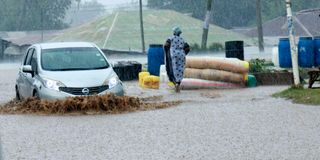
This week, light to heavy rains will start hitting several parts of Kenya, as the long-predicted El Niño phenomenon reaches full strength. In Uganda, for instance, some streets of Kampala, were already cut off by downpours that the government warns will spread to swathes of the country.
While flooding is often the most visually compelling representation of El Niño, the phenomenon is much bigger. It involves a widespread disruption of the ocean atmosphere in the tropical Pacific that shifts weather patterns across the world, with varying consequences.
This can mean heavy rainfall, prolonged droughts, extreme heat or a combination of different effects, depending on where one lives.
In East Africa, the phenomenon typically brings heavier than normal rains, and many residents are already ruing the prospects of a disaster that is predicted to be more severe than the devastating floods and displacements witnessed in 1997.
Inevitably, the focus in the region will now shift to the immediate needs of the affected people. That is critical, given the super-size scale of the expected disruption.
But the real story of El Niño is ultimately going to be about preparedness. Just what did we know when, and what did we do about it?
Over the past few decades, science has become remarkably good at observing the planet’s climate system. Using vast networks of satellites, buoys, supercomputers and other technology, scientists can now see developing climate patterns months before many of their consequences are felt.
The Inter-Government Authority on Development (Igad) Climate Predictions and Applications Centre (ICPAC) is a regional powerhouse in this regard.
Heavier-than-normal rainfall
However, this exponential growth in our ability to identify and predict danger, has not been matched by an equivalent willingness or capacity to act on that knowledge.
Indeed, the gap between knowing and doing seems to be the defining development challenge of a warming world.
But as the many warnings issued several months ago begin to materialise, it is tempting to reduce the conversation to “the government knew but did nothing”.
Of course, political will is critical and governments cannot be excused for failing to protect their people from climate risks and other vagaries.
Nevertheless, collapsing a complex risk governance chain into a single question of political will misses the big picture by a mile.
This is because the whole chain works only when knowledge moves seamlessly to early warning, all the way to a sound decision that produces a favourable outcome.
Real outcome flows from the decision makers’ capacity to act. As such, this complex chain is only as strong as its weakest link.
The meteorological agency may know that heavier-than-normal rainfall is likely to the hit the country; the city’s disaster authorities may issue warnings as a result.
The national government, on its part, may go ahead and develop contingency plans and even advise communities to move, yet flooding may still occur and cause damage.
Indeed, various actors across this chain claim to have done their part. Yet, here we are bracing ourselves for yet another season of disruption, and perhaps, even loss of life. Just where did the accountability chain break?
The answer to that question cannot lie in the mere fact that the government knew about the risk beforehand, important as this is. At the more consequential level, it comes down to whether that knowledge travelled successfully through the entire risk governance chain from forecast to warning, warning to decision, decision to resources, resources to action, and action to reduced loss.
Of course, this formulation may sound like a perfect alibi for authorities seeking to evade accountability, but the opposite is, in fact, the case. Rather than make the easy accusation that “nothing was done”, this should be a moment to ask the leaders and institutions the harder and more empirically answerable questions: When exactly did we know El-Niño was coming? Who received the warning? What decisions did we make, or not? Was the contingency plan developed and approved – in time? Was money released? Was it enough? Which drains were cleared? Which communities were offered relocation? What prevented implementation? In the end, did our interventions avert loss that would otherwise have occurred?
This framing, in my view, is more empowering for the citizens seeking to hold their leaders and institutions to account. It moves the debate from blanket blame attribution to accountability tracing, so that responsibility is placed where it truly belongs.
In other words, the real measure of climate preparedness must not be simply whether a government can demonstrate that it issued a warning.
Beyond accountability for the present moment, the region must now reckon with the fact that the current El Niño and future weather-related disasters will unfold in the context of a changing world, warmed by human activity. This has upended old assumptions about predictability and the space to act.
This means that preparedness can no longer be treated as an open and shut emergency activity. Every country must make it an integral part of its national development.
Dr Ageyo is the Editor-in-Chief of the Nation Media Group, Uganda. He holds a PhD in Media Studies with a focus on Science and Environment Communication.