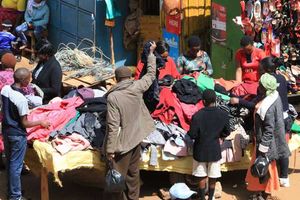
Gikomba is once again in the news. Since the 1950s, Gikomba has been remade by fire, flood, demolition and violence — and each time, it has refused to die. Now, with bulldozers advancing as part of a government plan to reorganise the market, traders once again find themselves fighting for space and survival. Yet Gikomba is far more than a marketplace under pressure.
It is one of Nairobi’s great symbols of resilience, a place where hardship, hustle and history meet. To tell the story of Gikomba is to tell a story not just about a market, but about the making of a city and the endurance of a nation.
Today, Gikomba does more than clothe Nairobi and its wider metropolis. It stands as one of Africa’s most vibrant second-hand clothing markets, providing livelihoods to thousands and putting food on the tables of tens of thousands of families.
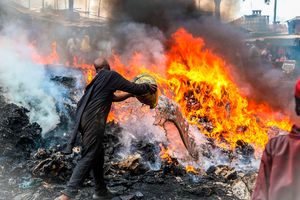
Traders salvage items from burning debris after fire broke out at Gikomba market in Nairobi on May 18, 2025.
Photo credit: Lucy Wanjiru | Nation Media Group
Gikomba began as a small open-air market on the edge of the Nairobi River in the 1950s, in a city still ordered by the rigid hierarchies of colonial rule. Then known as Quarry Road open-air market, it was initially dominated by Indian traders who sold second-hand goods to residents of Majengo, Ziwani, Pumwani and Racecourse Road.
But even within that racially layered colonial economy, where Africans were often confined to the margins of formal commerce, the market was already becoming something more significant. It offered a foothold into trade for those excluded from the city’s established centres of wealth and power.
Gikomba rose on the periphery of the city’s mainstream commerce. What started as a place for buying and selling cast-offs soon evolved into one of Nairobi’s earliest workshops of African entrepreneurship. Here, on the muddy edges of the river and beyond the polished fronts of settler commerce, African traders, artisans and labourers carved out their own economic space.
They learned how to source goods, negotiate prices, read customers, stretch thin capital and turn scarcity into opportunity. Wood carvers, especially from the Kamba community, timber dealers, repairers and hawkers transformed the market into a training ground where enterprise was not taught in classrooms but forged in improvisation, risk and hustle.
Around the market, a settlement emerged and came to be known as Gikomba. Though the village was demolished in the early 1960s and many of its residents were resettled in the present Kariobangi, its reputation had already taken root and, most likely, gave Quarry Road market a new identity.
Gikomba, besides being a busy commercial hub, was also known as Nairobi’s main source of chang’aa, the illicit brew distilled along the banks of the river, competing with Kileleshwa and Mathare valley villages. It was also the place of wood carvers, especially from the Kamba community, who carried their artwork alongside timber merchants and second-hand dealers.
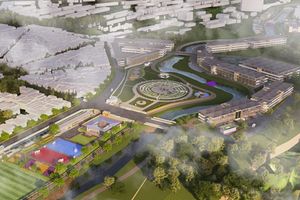
Artiste impression of Gikomba Market.
Photo credit: Pool
In that sense, Gikomba started as a meeting point where those locked out of formal avenues of accumulation sharpened their skills, built networks, created an economy from below and built their own pathways to prosperity.
Mitumba was never just a pile of cast-off shirts and dresses spilling across the stalls of Gikomba. In Kenya of the early 1990s, it arrived stitched into the fabric of power itself. What had once been a small, informal trade swelled into a booming industry as economic liberalisation flung open the country’s markets to imports. But the real windfall did not fall first to hustlers or petty traders.
It was seized by KANU mandarins, fixers, and businessmen with intimate ties to the Nyayo state, who turned second-hand clothing into one more channel of patronage and private accumulation. The trade in mitumba was thus woven tightly with the politics and corruption of the Moi era: a regime that spoke the language of reform while allowing its inner circle to feast on the spoils.
Parliament caught a glimpse of this murky nexus in 1993, when allegations were raised by opposition MP Mukhisa Kituyi that Gideon Moi, the President’s youngest son, was among the leading figures importing mitumba duty-free and without paying the required taxes. Whether as symbol or substance, the accusation laid bare the deeper truth of the Nyayo years: liberalisation did not create a level playing field, but a tilted market in which proximity to State House could mean exemption, privilege, and profit. As politically connected importers flooded Kenya with cheap second-hand garments, the Treasury appeared either too weak or too compromised to regulate the trade.
Meanwhile, the country’s textile mills were left to wither. Kisumu Cotton Mills, Rift Valley Textiles, Kenya Textile Mills in Thika, Raymonds, and Mount Kenya Textiles all staggered under the weight of this new order. Their decline told a larger story about the Nyayo regime itself, where the rhetoric of free markets concealed an older pattern of cronyism, and where the ruin of local industry became the hidden price of elite enrichment.
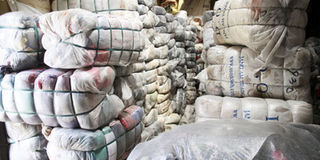
Yet the death of the textile industry was also the making of a new urban economy. As the mills fell silent, Gikomba found a new fillip and burst into life as the beating heart of the mitumba trade. Bales of used clothes, brought in through networks tied to the political elite, flowed into the market and then radiated outward across the country through a dense web of traders, hawkers, and brokers. In effect, Gikomba became the protected distribution channel of a liberalised economy whose profits were captured at the top and dispersed at the bottom in scraps.
Second-hand clothes buyers and sellers at Gikomba market in Nairobi on June 13, 2021.
Photo credit: Dennis Onsongo | Nation Media Group
The market thrived because it served both ends of the system: it enriched the well-connected importers who controlled supply, while providing the indispensable retail artery through which their goods reached millions of Kenyan consumers. In that sense, Gikomba’s boom was inseparable from the collapse of domestic textile production.
One industry died so that another—informal, precarious, but politically useful—could flourish in its place. The story of mitumba, then, is not simply about changing tastes or cheap clothes. It is about how the Nyayo regime rewove Kenya’s economy, cutting local industry down while clothing patronage, corruption, and political survival in the language of market reform.
But Gikomba is no longer just a Kenyan story. It sits at the crossroads of a far larger geography of waste, an endpoint in the global afterlife of fast fashion. Here, the Western clothing economy empties its bulging closets, offloading mountains of used garments that leave Europe and North America under the soft moral language of “donations” but arrive in African markets as hard-nosed business. What is presented as charity is often, in truth, commerce dressed in virtue.
Critics argue that this is how the global South is made to inherit the burden of excess: rich consumers buy too much, wear too little, discard too quickly, and then export the consequences of their habits to poorer countries. The work of sorting, salvaging, reselling, and disposing of the world’s cast-offs is thus pushed onto markets like Gikomba, where value is extracted from what others no longer want.
Kenya, in this sense, does not merely import clothes. It imports the overflow of distant appetites, the surplus of disposable fashion, and the waste of a consumer culture that has learned to shed its skin by sending it elsewhere.
The second-hand market has also been used in Kenya’s negotiations with the US. Under the African Growth and Opportunity Act, or AGOA, Kenya enjoys duty-free access to the American market for certain exports, especially apparel. That access has been a bright spot for the country’s garment sector, creating jobs and export earnings, particularly in export-processing zones. But there is a catch, or at least an understanding dressed up as principle: countries that want the benefits of open trade with America are expected not to shut their markets to used American clothing.
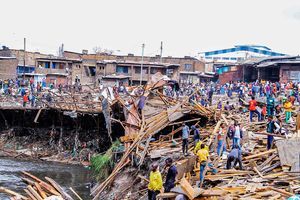
Traders rummage through the ruins as they try to salvage their belongings on March 31, 2026 after a section of Gikomba Market was demolished on Monday night by authorities.
Photo credit: Billy Ogada | Nation Media Group
In formal language, this is framed as avoiding barriers to trade. In practical language, it means that Kenya’s access to the U.S. market has been tied to keeping its own market open to mitumba. When East African countries tried to restrict used-clothing imports, Washington pushed back hard.
Rwanda faced penalties. Kenya, more cautious, stepped away from more confrontational restrictions. So while no clause is likely to say in plain words, accept old clothes in exchange for market access, the effect is difficult to miss. Kenya is allowed to sell garments to America, but only while remaining open to the old garments America no longer wants.
And that is how Gikomba has continued to thrive. As the Ruto regime seeks to redraw its physical and commercial terrain, pundits are left to speculate about the true endgame. But one fact remains stubbornly clear: beneath Gikomba’s restless energy lies a harder truth about Kenya’s place in the world.
It has become indispensable to the global clothing system precisely because it receives, sorts, and recirculates what richer economies throw away. Gikomba is vibrant, but its vibrancy rests on an unequal order in which the prosperity of some produces the cast-offs on which others must build a livelihood. However, thousands of families rely on this enterprise. It is a tricky balance.