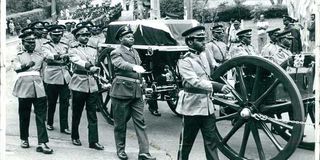
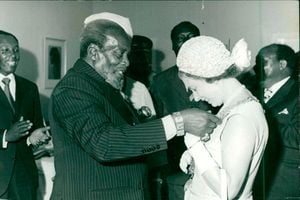
When Mzee Jomo Kenyatta passed away 47 years ago this month, one of the key elements of his funeral was a gun carriage, which was used to convey his casket from State House Nairobi to Parliament Buildings where he was laid to rest with full military honours. The request for a gun carriage, ammunition for a gun salute and assistance in organising a state funeral was made to Britain just after Mzee Kenyatta’s death.
In a telegram marked “restricted,” a Mr Owen of the British Foreign and Commonwealth Office wrote, “Armed Forces Liaison Officer at the Kenyan High Commission here has, on the instructions of the Kenyan Minister for Defence, asked Ministry of Defence for urgent information on United Kingdom procedures for a lying-in-state and funeral at head of state/commander in chief level.”
He also highlighted Kenya’s request for a gun carriage and 50 blank 105 mm artillery shells for the gun salute.
The use of gun carriages to carry coffins in a formal funeral processions dates back to the Victorian era when a carriage was the standard way of ferrying the remains of dead soldiers over a long distance. With time, it became the traditional vehicle for conveying the remains of British royalties in State funerals, and was adopted by the Commonwealth.
The gun carriage was first used in a State funeral in 1901 when it was used to ferry the coffin of Queen Victoria to Windsor Chapel. However, the procession almost turned into a disaster when the horses pulling the carriage got spooked and almost toppled the coffin. Royal Navy sailors quickly stepped in — and using improvised ropes, pulled the gun carriage to Windsor Chapel where the Queen’s coffin was offloaded. Since then, it has become the tradition for a gun carriage to be manually pulled by sailors or soldiers during a State funeral.
Kenya, being a member of the Commonwealth, has strongly borrowed its state funeral procedures from Britain. When Mzee Kenyatta died, the first request for assistance in organising for a State funeral came from the Kenya High Commission in London. According to the telegrams sent, this request was delivered to the British Ministry of Defence by a Mr Muchemi.
The only concern among British officials was whether Muchemi had come up with the idea himself or was acting on behalf of the government. It was, therefore, left upon the Foreign and Commonwealth Office (FCO) to verify the information with the British High Commission in Nairobi.
In a telegram to Nairobi in this regard, Owen of the FCO, while noting that the British Ministry of Defence (MoD) was already working on Kenya’s request, also stated, “MoD are however naturally concerned at the unreliability of the channel through Muchemi and propose therefore additionally to telegraph the information to your D.A. (Defence Advisor) desk contact. There must be of course some question mark about the accuracy of Muchemi’s information, particularly as it appears to have originated before today’s meeting of the Kenyan cabinet.”
Later, a more formal request for lying in State and funeral procedure was made by the Kenyan Ministry of Defence through the British Defence Advisor in Nairobi. The British officials first response was to try and book Major Anthony Mather of the Grenadier Guards on the next flight to Nairobi to provide guidance on the State funeral, especially in the use of gun carriage, which was to be sent to Nairobi.
Mather was a consummate military officer with great experience in State funerals. In 1965 he was the officer in-charge of the bearer party, responsible for carrying the coffin during the state funeral of British war time Prime Minister Sir Winston Churchill. Because of his role in organising and executing the State funeral, he was made a Member of the Order of the British Empire. He was to play another important role in the State funeral of Earl Mountbatten of Burma, who was assassinated in Ireland in 1979.
Casket bearing the remains of former President Daniel Moi’s body in a gun carriage is taken round the Nyayo National Stadium Nairobi on Tuesday, February 11, 2020 during the funeral service. PHOTO | DENNIS ONSONGO | NATION MEDIA GROUP
He was also in later years involved in planning the funeral of Queen Elizabeth II, long before the monarch passed away in September 2022. In 2002, when Edward Fitzalan took over as the Earl Marshal with the responsibility of putting in place an advanced funeral plan for the Queen’s death, the first person he approached was Anthony Mather, who was now retired. The two worked on a State funeral plan which they later shared with Queen Elizabeth herself and her husband the Duke of Edinburgh, who were all satisfied with the plan put in place for their future funerals.
Decades earlier, it was, therefore, a show of high respect and privilege to Kenya for Britain to send such a distinguished ceremonial guru to help organise Mzee Kenyatta’s State funeral. Although the initial plan was for him to fly immediately to Nairobi following Mzee Kenyatta’s death, it was later decided that because of how things were moving fast in Nairobi he should provide the written guidance, which was then transmitted to Kenya by telegram. He was then to fly with a team of four other experts after the delivery of the gun carriage.
The British Ministry of Defence’s first plan was to send the gun carriage and ammunition to Nairobi on a Royal Air Force Hercules plane, but this was dropped after a disagreement with the Foreign and Commonwealth Office (FCO) on who would foot the bill of the flight.
In the event, Kenya decided to meet the cost by chartering an aircraft operated by British Caledonian aircraft freight services. The only problem was that because the gun carriage and blank ammunition were technically considered munitions of war, permission had to be sought from countries the aircraft was to overfly on its way to Kenya.
“As it is proposed that the ammunition and the gun carriage which the Kenyans want to borrow should be sent on a British Caledonian Airways, it falls to us to obtain the necessary overflight and landing clearances, “Owen of the FCO wrote in telegram number 250635z marked “restricted”.
There were two routes the British were considering. One was Route A, which involved the aircraft taking off from Britain, overflying France, Italy, Greece, Egypt, Sudan and landing in Kenya. Route B involved the aircraft overflying Belgium, West Germany, Austria, Yugoslavia, Greece, Egypt, Sudan and land in Kenya.
Since seeking permission from these countries also involved disclosing details and purposes of the cargo, the British were not sure whether Kenyans would be comfortable for such information to be shared. For this reason, the FCO instructed the British High Commissioner in Nairobi, “Before doing this we should wish to be certain the Kenyans would have no objection to our informing the foreign authorities concerned of the purpose for which the ammunition is required. It will be necessary to do this in order to minimise the prospect of any delay in securing the clearances.”
With Nairobi having okayed the disclosure of the information, British diplomats in countries along the flight route were instructed to urgently approach the local authorities for overflying permission, explaining why the blanks were required. Austria was the first country to grant permission for the gun carriage and ammunition for the gun salute to overfly its airspace. Having secured clearance for the flight route, the British Ministry of Defence arranged for five military experts led by Major Anthony Mather to fly to Kenya.
Kenyan government officials conveyed their gratitude to the British Ministry of Defence for their quick response to the request.
Military officers escort a gun carriage carrying the remains of former President Mwai Kibaki, who died at the age of 90, for public viewing at Parliament Buildings in Nairobi yesterday.
Photo credit: Jeff Angote | Nation Media Group
“General (Jackson) Mulinge and Brigadier (Peter) Kakenyi delighted with the arrangements made and greatly appreciate the provision of Major Mather and the four experts. Both officers have asked me to pass you their sincere thanks and ask that you in turn should pass on their gratitude to all those concerned for such a quick response in meeting all their requirements.” Stanley Fingland, the British High Commissioner wrote to London.
The gun carriage and the ammunition arrived in Kenya aboard Caledonian Airways cargo flight SE577 and were received by Sir Fingland, who ensured their safe storage until the arrival of Major Mather and his team.
“I will personally supervise the offloading and storage of gun carriage to await the arrival of experts,” Fingland had assured his seniors in London. “Please confirm ETA (expected time of arrival) of Major Mather and team.”
On August 31, 1978, Mzee Jomo Kenyatta was buried in an elaborate ceremony befitting a head of state, with a tri-service bearer party pulling the gun carriage. Having served its purpose, the gun carriage was returned to Britain aboard a Royal Air Force Hercules flight 5092 in September.
But some misunderstanding later arose about the charges and the allowances of the five experts. While the Kenyan government had agreed to pay for all air movements, in-country costs and 50 blank rounds of ammunition, there were other incidental charges, which the British failed to raise with the Kenyans.
“The immediacy of the Kenyan request left no time to discuss these incidental charges before the event,” an official from the British Ministry of Defence stated in a correspondence with FCO dated September 19, 1978. These costs were: Hire charge and insurance of the carriage, transport within the UK, and pay and allowances for the five British experts, which all came to a total of £500.
The Ministry of Defence (MoD) official went on to explain, “In view of the circumstances of this case we intend, exceptionally, to charge the lower extra costs rate; on this basis the amount for which we seek reimbursement is estimated at about £500 (we do not yet possess all the information needed to calculate the actual figure.)”
The British were not ready to waive these additional charges but at the same time didn’t want to raise the matter with the Kenyans who were still mourning. For this reason, the Defence ministry asked the FCO if it could settle the bill on behalf of Kenya.
“I should be grateful to know whether the FCO will accept responsibility for reimbursing MoD with the amount, bearing in mind that our only alternative would be to request payment from Kenya,” the official requested.
Unfortunately for him, the FCO were equally not ready to take the responsibility for the additional costs, with one official pointing out to his colleague that the MoD benefits so much from Kenya, especially as a training ground for British soldiers, and therefore should shoulder part of the bill and charge Kenya the rest.
“I think we should reply robustly saying that given the benefits such as training MOD may need wish to bear at least some of the incidental expenses especially pay the allowances for the team, while the others should be charged to the Kenyans as FCO has no funds for such purposes,” he told his colleague. It is not known how the matter was settled.