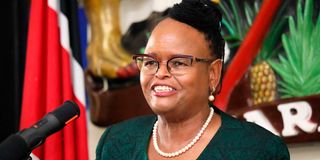
Two Chief Justices- Willy Mutunga and David Maraga- retired while still calling for allocation of more funds to the judiciary, to enable the courts to carry out their mandate and increase access to justice for Kenyans.
The same goes for the current Chief Justice Martha Koome, who has on numerous occasions pleaded with Parliament for more funds.
“For the past three financial years, the Judiciary has consistently received less than 0.92 per cent of the National Government Budget—significantly below the recommended three per cent. This perennial underfunding, especially when compared to the allocations for other coequal arms of government, has substantially undermined the Judiciary’s efficiency, financial independence, and operational autonomy,” Justice Koome said in her State of the Judiciary Address for the 2023-2024 year.
The report pointed out that from the 2021/22 to 2023/24 financial years, the Judiciary faced a persistent funding shortfall, with gaps of between 47 and 48 per cent, each year.
The meagre funding, according to the Judiciary, limits its operations.
Last year, the process was suspended after its budget was slashed following protests over the Finance Bill, 2024.
As for the expansion of the court stations, Chief Justice Koome noted that the Judiciary had made important headway in expanding its footprint across the country.
The CJ stated that the Judiciary’s target is to establish a High Court and courts of equal status (Employment and Labour Relations Court and Environment and Land Court) in every county.
Currently, High Court stations have been established in 46 out of 47 counties. The CJ added that during the last financial year, there were 140 Magistrates’ courts operating nationwide.
The latest High Court stations to be established were in Isiolo, Thika, Kibera, Nyandarua and Kwale, raising the number of High Court stations to 46. Nakuru, Kiambu and Laikipia counties have two High Court stations each, while Nairobi has three- in Milimani, Kibera and Makadara law courts.
The Judiciary also established 57 mobile courts, reducing the average distance to access these courts to 80 kilometres. Further, a total of 27 Small Claims Courts were established and two tribunals were moved from the Executive to the Judiciary.
Despite the setback in funding, Justice Koome noted that courts recorded improvements in the Judiciary’s performance, with the case clearance rate reaching 99 per cent, with 516,121 filed compared to 509,664 resolved in the 2022/2023 financial year.
Speaking during the presentation of the State of the Judiciary and the Administration of Justice Report 2023/24, Koome said that there had been a marked improvement in reducing pending cases, which dropped by 2.16 percent from 649,342 to 635,262.
The judiciary also continued to promote Court-Annexed Mediation (CAM) and Alternative Justice Systems (AJS) reforms, which the CJ said led to a reduction of the case backlog from 268,116 to 244,267.
“As we look ahead, we will continue to review, refine, and improve all our service delivery points to ensure that the Judiciary remains dynamic, inclusive, and responsive to the evolving needs of our users and stakeholders,” CJ Koome said.
Another issue plaguing the judiciary is allegations of corruption. President Ruto kicked up the storm early last year by accusing the Judiciary of corruption.
Although the CJ fired back, saying the sustained attacks were acts of intimidation, she later called for a meeting with President Ruto.
Lawyers picked up the cue and filed cases before the Judicial Service Commission (JSC) seeking the removal of some judges over alleged corruption.
Former Chief Justice Willy Mutunga.
Photo credit: File | Nation Media Group
Known as a reformist, Dr Mutunga initiated a radical transformation of the Judiciary.
When he took over as the first Chief Justice under the new law, Kenyans had lost confidence in the Judiciary.
At first Dr Mutunga tried to demystify courts by initiating judicial matches- where members of the public mingle with judges, court user committees- where stakeholders are involved in suggesting ways of service delivery and improving of performance.
Judges and magistrates too, became confident as the CJ ensured that courts retained their independence, with no interference from him, the Executive or the legislature.
In a book titled Beacons of Judiciary Transformation, Dr Mutunga revealed that he inherited a Judiciary that was designed to fail.
The former CJ revealed that the Chief Justice's office operated like a judicial monarch supported by the Registrar of the High Court, with power and authority that was highly centralised.
Photo credit: File | Nation Media Group
He took over from Dr Mutunga and continued with the reform path and expansion of court stations to enhance access to justice.
The former CJ, however, faced frustration towards the end of his tenure over budget cuts, disobedience of court orders and the refusal by President Uhuru Kenyatta to swear in judges recruited by the JSC.
When he succeeded Justice Mutunga, Justice Maraga upscaled the use of technology and promised to modernise the systems and to harness technology to improve service delivery.
During his tenure, courts were equipped with court recording equipment and the judiciary embraced E-filing System, which provides a platform for law firms, lawyers and litigants to initiate and complete the process of filing cases online.
Chief Justice Martha Koome.
Photo credit: File | Nation Media Group
First female CJ who leveraged on technology to enhance access to justice. Covid-19 pandemic came with a lot of disruptions but on a positive note, it accelerated the adoption of virtual hearings.
The Supreme Court and Court of Appeal conduct almost all their proceedings online, while other courts use a blended approach.
According to CJ Koome, virtual hearings have significantly reduced barriers of distance and travel costs for litigants and advocates.
After a phased rollout of E-filing, which began in 2020, the judiciary achieved full national roll-out of e-filing in early 2024.
All court filings are now done online, ensuring secure, tamper-proof records and eliminating the loss of physical files—a problem that once plagued the judiciary for ages.
Still on technology, Justice Koome enhanced the Integrated Case Management System (ICMS), which enabled the Judiciary to monitor cases in real-time, track progress, and identify bottlenecks, to enhance efficiency.
During her recent address, the CJ said the Judiciary was exploring how Artificial Intelligence could enhance judicial operations, through administrative support, case management, legal research, or predictive analytics.
“To ensure ethical, safe, and purposeful adoption, we are developing the Judiciary Artificial Intelligence Adoption Policy Framework to guide integration of AI tools while safeguarding judicial independence, data privacy, and due process,” Justice Koome said.
The CJ also introduced the Mahakama Popote Initiative- An initiative through which Judicial Officers are deployed to resolve cases across the country, regardless of the court station in which a case is filed.
This, she explained, is achieved through virtual courts and the e-filing system, and enables the Judiciary to optimise its limited human capital.
During the last financial year, 7,665 cases were handled through the Mahakama Popote Initiative, with 6,269 cases resolved, translating to a case clearance rate of 79 percent.
The CJ also launched the E-Judiciary Mobile Application, a platform for members of the public to self-search case information.
The case information they can get includes all historical case activities, corresponding case outcomes, provides access to court decisions such as judgements and rulings, checks payment status and verifies court orders.