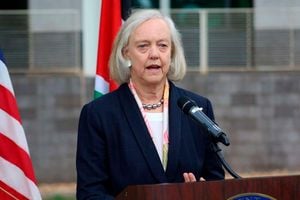
As she prepared to leave after two years as the US ambassador to Kenya, Meg Whitman was unambiguous when asked if she would consider settling in Kenya. But the diplomat was clear she had some unfinished business.
“I will not settle in Kenya, but I’ll be involved in a couple of projects,” she told the Sunday Nation two days after announcing her resignation , triggered by Donald Trump’s victory in the November 2024 presidential contest.
“There are conservation projects I’m very interested in,” she added, listing a rhino range expansion project among them.
The billionaire also mentioned Nairobi National Museum and her desire to “help it be the defining Museum of the origins of man anywhere”.
When Ms Whitman flew back, having left in November, she was sure to draw attention, given how her tenure had split opinion. It has emerged that she chairs the advisory board of the Kenya Rhino Range Expansion (KRRE), also known as the Room to Roam Programme.
The Kenya Wildlife Service (KWS) said the initiative seeks to widen the habitats of rhinos in the Tsavo and Laikipia ecosystems.
“The KRRE initiative aims to address challenges posed by crowded sanctuaries, territorial conflicts and limited ecological space resulting from Kenya’s successful rhino conservation efforts. By creating new secure habitats, KRRE seeks to promote sustainable population growth, enhance genetic diversity and ensure the long-term survival of Kenya’s black rhinos,” it said.
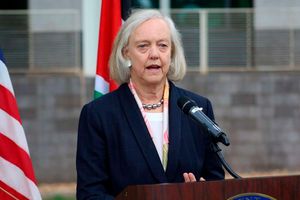
Former US Ambassador to Kenya Meg Whitman during the 20th anniversary of the United States President’s Emergency Plan for AIDS Relief (PEPFAR) in Nairobi on January 23, 2023.
Photo credit: File | Nation Media Group
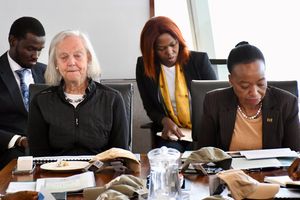
The KRRE Board held its first meeting, chaired by Presidential Adviser Monica Juma, on February 11.
Photos from the meeting showed Ms Whitman, a former Silicon Valley industry captain, following proceedings and contributing to discussions.
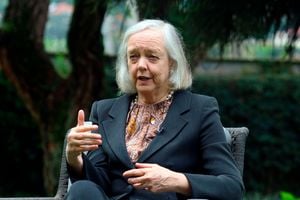
In her first interview after she became the ambassador in August 2022, Ms Whitman confessed her love for the outdoors and nature. A month into her role as the US envoy, she had visited Ngong Hills and Mt Longonot. She had also toured Maasai Mara Game Reserve and Amboseli National Park.
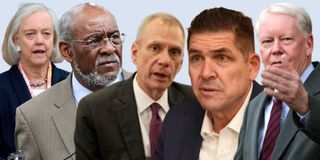
Ms Whitman’s return adds to a long list of former US ambassadors and their love-hate relationship with Kenya after completing their tour of duty. While some were welcomed back warmly, others got an icy reception.
They include the first US envoy to Kenya who bought land in Karen and was planning to settle when he was banned from setting foot in the country after writing a book that did not go down well with the government.
The list also has a diplomat who married a Kenyan. Ms Whitman’s return did not raise many political hairs because of her warm relationship with President William Ruto, not least because she caught the eye for marketing Kenya. Her mantra, as she said in the exit interview, was that she was working with the government of the day.
“I serve at the pleasure of the President of the US, and our job is to work with duly elected leaders of the countries in which we are assigned. The duly elected leader is President Ruto. I have worked with him, I have worked with his Cabinet...and I’ve also worked with many MPs, even more so with governors,” she said.
While some of US ambassadors have distinguished themselves for taking on the government, Ms Whitman’s critics said she was too close to President Ruto, even becoming a cheerleader and turning a blind eye to state excesses.
What has been the relationship between Kenya and US ambassadors after their tour of duty? What were some of the activities or roles the ambassadors were involved in that touched on Kenya?
Attwood: persona-non-grata
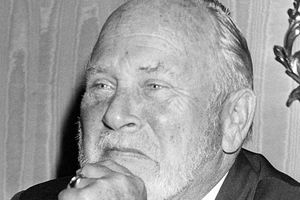
William Atwood was the first US ambassador to Kenya, taking up his role in March 1964. After his assignment in May 1966, he bought 50 acres in Karen, intending to retire in Kenya. President Jomo Kenyatta was so impressed that he encouraged Attwood to take Kenyan citizenship so he would be considered for appointment as Kenya’s ambassador to the US!
Things took a turn when Atwood published a hard-hitting book, The Red and the Blacks: A Personal Adventure. It did not sit well with the Jomo Kenyatta administration, which banned it. Atwood was then barred from entering Kenya.
A portion of the book was dedicated to the relationship between Jomo and then-vice president Jaramogi Oginga Odinga. It also dwelt on the Cold War undercurrents across the world in the 1960s and how they affected the Kenyan body politic.
Hempstone: ‘Rogue’ ambassador
Former US Ambassador to Kenya Smith Hempstone.
Photo credit: File | Nation Media Group
A journalist-turned-diplomat, Hempstone was posted to Kenya at the peak of the fight for pluralism, popularly known as the Second Liberation. He served from 1988 to 1992.
In the book The Rogue Ambassador: An African Memoir
He wrote in the book that the Kenyan government attempted to kill him two times. The book also linked president Moi and his aide Nicholas Biwott to the 1990 killing of Foreign Affairs Minister Robert Ouko. Moi and Biwott later sued Hempstone. Though Moi withdrew the case, Biwott won a substantial amount in a 2002 court verdict.
“US embassy officials in Kenya told Mr Hempstone’s family that they did not accept the jurisdiction of the court but advised Mr Hempstone not to return to Kenya,” the Washington Post reported in 2006 after Hempstone’s death.
Hempstone was also derogatorily referred to as the nyama choma ambassador by then-Kanu Secretary-General Joseph Kamotho because of his frequent visits to Kariokor market, Nairobi, for roasted meat.
Ranneberger: Married a Kenyan
Former US Ambassador to Kenya Michael Ranneberger.
Photo credit: File | Nation Media Group
Michael Ranneberger’s tenure as the US ambassador, from 2006 to 2011, saw him clash with President Mwai Kibaki’s administration often.
Ranneberger too, was given the “rogue ambassador” tag after the emergence of WikiLeaks cables, in which he gave not-too-flattering assessments of Kenya’s leaders.
Calls for his removal came from many quarters. Despite tensions with the political class, he married a Kenyan woman, Ruth Konchella, and had a dowry payment ceremony in 2016 even though they had been living together for 10 years. He gave 20 cows to the woman’s family.
“I was told eight cows but because she is an exceptional lady, I decided to give out more,” said Mr Ranneberger, who is now based in the US.
Former US ambassador to Kenya Kyle McCarter.
Photo credit: File | Nation Media Group
He was a senator in the US state of Illinois from January 2013 to January 2019 before being posted to Kenya as ambassador. He served from March 2019 to January 2021. Long before he became the ambassador, McCarter had visited and lived in Kenya many times as part of a charity programme in Tharaka Nithi County. That is why he was installed as a Tharaka elder after his posting to Kenya.
During McCarter’s tenure as the American ambassador, he championed the construction of the Nairobi-Mombasa expressway, at one point issuing a statement allaying fears that the project would leave Kenya in debt.
“Contrary to recent press reports, the highway is an investment that won’t saddle Kenya with unsustainable debt,” he said.
Incidentally, Mr McCarter, who is based in Oklahoma, now leads Everstrong Capital, a company seeking funding to build the road.
Scott Gration: Kiswahili speaker
Former US Ambassador to Kenya Jonathan Scott Gration.
Photo credit: File | Nation Media Group
Mr Gration spent his early life in the Democratic Republic of Congo and Kenya, which led to his mastery of Kiswahili. Gration studied mechanical engineering in the United States and later joined the Air Force.
He served as the US ambassador to Kenya from May 2011, resigning in July 2012 following claims of misconduct at the embassy.
He did not delink himself from Kenya after leaving the embassy offices, starting a company focusing on connecting Kenyan entrepreneurs and American venture capitalists.
In 2016, he released his memoirs through his company, Mulami Books. The book is titled Flight Path: Son of Africa to Warrior-Diplomat.
As per his LinkedIn profile, Mr Gration is based in Florida.
The African-American was the US ambassador to Kenya from 1977 to 1980 during the Jimmy Carter presidency. He witnessed Moi take the presidency after the death of Jomo Kenyatta. LeMelle had spent nine years in different parts of Africa, including Kenya, before president Carter made him ambassador.
McIlvaine the conservationist
A soldier, editor and later diplomat, Robinson McIlvaine served as America’s ambassador to Kenya from September 1969 to April 1973. Robinson McIlvaine went into conservation as soon as he left Nairobi.
In 1973, he became the head of the African Wildlife Leadership Foundation – today known as the Africa Wildlife Foundation. He was based at the Nairobi office before he moved to Washington to be the president of the organisation.
“One of the most successful (achievements) was the consortium he formed to protect the threatened mountain gorilla population of Rwanda,” his family said in his obituary following his death in 2001.
Carson: Choices, consequences
Former US ambassador to Kenya Johnnie Carson.
Johnnie Carson was the US ambassador to Kenya from September 1999 to July 2003. Coming after Prudence Bushnell, who was one of those injured in the August 7, 1998 bomb explosion in Nairobi, the African American oversaw the inauguration of the new embassy buildings in Gigiri.
Under the presidency of America’s 44th president Barack Obama, Carson became the Assistant Secretary of State in charge of Africa from May 2009 to March 2013.
Former Head of Civil Service Francis Muthaura would reveal in a 2023 book that Western diplomats “made every effort behind the scenes to have the two barred from running for office”.
Former United States Ambassador to Kenya Robert Godec.
Photo credit: File | Nation Media Group
The list of ambassadors who retained ties with Kenya and Africa after their tours of service extends to personalities like Robert Godec (2013 to 2019) who became the assistant secretary in the Bureau for African Affairs.
There is also William Bellamy (2003 to 2006), who later became the senior adviser at the Centre for Africa for Strategic and International Studies in Washington.