President William Ruto has expressed concern that organised criminal gangs, heightened political tensions and ethnic political mobilisation pose a major risk to the country's security apparatus ahead of next year's general elections.
In his State of the Nation Address to Parliament on Wednesday, the Head of State indicated that these factors, along with growing political intolerance, risk undermining national cohesion before the polls.
The State of National Security report, which covers the period from September 2025 to 31 August 2026, outlines the prevailing and emerging threats to national security and the government's strategic responses.
“The trajectory towards the 2027 General Elections is the principal concern. Party primaries, boundary review and voter registration will each concentrate political competition, and the pattern observed during the review period suggests an elevated risk of mobilised violence at those points,” He says in the report.
The period under review was characterised by heightened political polarisation, growing intolerance across the political divide and sustained efforts by competing political actors to mobilise support against their opponents.
Some political actors the report notes sanctioned political violence in parts of the country to project political strength and intimidate opponents.
“Political realignments organised around ethnicity, together with regional political contestation, threaten to polarise the country and undermine national cohesion ahead of the 2027 General Elections.”
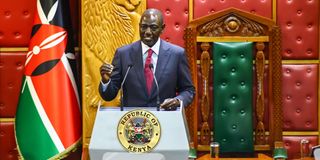
President Ruto's third state of the nation address
On hate speech, the president noted that the vice continues to undermine peaceful coexistence, national cohesion and democratic governance in the country, deepening ethnic divisions and contributing to violence, discrimination and social exclusion
“The consequences are not hypothetical: inflammatory speech was a material contributor to the violence that followed the 2007 General Elections, and to the displacement and destruction of property that accompanied it,” he said.
Last month, the National Cohesion and Integration Commission warned that hate speech was becoming an increasing concern ahead of the elections, particularly on digital platforms.
“We are witnessing the rise of hate speech as we move to the 2027 elections, especially on digital platforms. We will not allow the leaders to destroy this great nation that we have,” the commission cautioned.
Last week, Catholic bishops told politicians to tame their tongues, warning that their inflammatory remarks risk plunging the country into chaos.
Although the president noted that the Kenya’s security environment remained generally stable, he said the country still contended with security threats ranging from organised criminal gangs, drug and substance abuse, illegal aliens and undocumented immigrants.
Trade in contraband and counterfeit goods, Sexual and Gender-Based Violence (SGBV), road traffic accidents, illegal gaming and gambling, terrorism and violent extremism, money laundering, and cybercrimes were also rampant.
Additionally, insecurity in learning institutions, proliferation of illicit Small Arms and Light Weapons (SALW), cattle rustling and stock theft, Illegal, Unreported and Unregulated (IUU) fishing and transnational crimes complicated internal security efforts.
The country also struggled with persistent security threats including activities of organised criminal gangs, proliferation of Small Arms and Light Weapons (SALWs), incidents of banditry and cattle rustling, cases of gender-based violence and missing children, the threat of religious extremism, human and drug trafficking networks, and the challenges presented by a growing youth population.
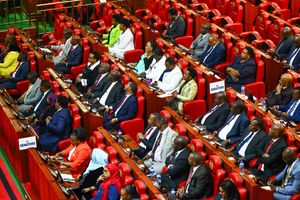
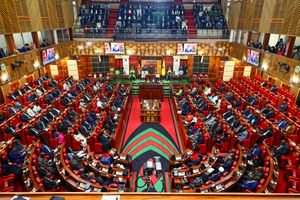
Members of Parliament attend President William Ruto’s annual State of the Nation Address (SONA) at Parliament Buildings in Nairobi on November 18, 2026, as the President delivers his address to a joint sitting of Parliament.
Photo credit: Wilfred Nyangaresi| Nation Media Group
The report also notes that there was misuse of online platforms, specifically in relation to misinformation and disinformation, recruitment into organised criminal groups, fraud, and coordination of civil unrest which resulted in 17 loss of life, destruction of property, and disruption of economic activities across the country
During the period under review, there was an increase in crime rates ranging from violent crimes, such as armed robbery and assault, to non-violent crimes, including theft, fraud and cybercrime.
A total of 97,946 cases were reported between September 2025 and August 2026, compared to 97,366 cases during 2024/25 representing an increase of 580 cases
The increase in criminal gangs in various parts of the country also continues to pose a security headache to the State.
“These groups undermine the rule of law through violent criminal activities, intimidation of communities and exploitation of vulnerable youth by recruiting them into criminal enterprises,” reads the report.
According to the report, the increase of criminal gangs in the country is fuelled by unemployment, political and socio-economic challenges, which make many young people susceptible to recruitment by organised criminal networks seeking financial gain through illicit activities
“Increasingly, the gangs are being used as goons to disrupt political gatherings, for political coercion and intimidation, destroying property, instigating violence and intimidating members of the public in pursuit of political and other vested interests,” reads the report.
Interior Cabinet Secretary Kipchumba Murkomen was taken to task this month by MPs over the increase in goonism culture that threatens the 2027 elections.
However, Murkomen fired back saying most of the goons are financed and bred by the lawmakers.
“This issue of criminal gangs has become a difficult area for the police officers because the owners of the gangs sit in this House, they sit in high offices, they are in Senate, National Assembly, some of them are in high political party offices and the problem is that every time these people are arrested, the political leaders go and intimidate police officers in the locality,” Mr Murkomen said.
During an earlier interview with the Nation, Independent Electoral and Boundaries Commission Erastus Ethekon said that the commission has a functioning Electoral code of conduct enforcement committee which will take action.
“If we have the evidence that there is a person harbouring gangs, paying them or facilitating them in any way, then such a person definitely is undermining a peaceful election and we will fine or even disqualify them,” Mr Ethekon said.
The report notes that during the period under review, law enforcement agencies recorded 1,316 arrests, compared to 602 arrests during the corresponding period of September 2024 to August 2025, representing an increase of 714 arrests
“This increase reflects both intensified security operations and the continued emergence and expansion of criminal gangs,” reads the report.
The government says it has taken steps such as strengthening law enforcement, community involvement, technological advancement, security sector reforms and socio-economic strategies in order to address the emerging challenges.
President William Ruto delivers his annual State of the Nation Address (SONA) before Parliament, flanked by National Assembly Speaker Moses Wetang’ula (left) and Senate Speaker Amason Kingi (right), at Parliament Buildings in Nairobi on November 18, 2026.
Photo credit: Wilfred Nyangaresi| Nation Media Group
The State is also developing six draft legislations to guide reforms in the security sector: The legislations include National Police Service Act (amendment) Bill 2025, The Independent Policing Oversight Authority Act amendment Bill 2025, The National Police Service Commission Act (amendment) Bill 2025, Public Order Act (amendment) Bill 2025, The National Police Service Veteran and Fallen Heroes Bill 2025 and National Forensic Science Bill 2025
On the economic front, the government says it has embarked on economic empowerment initiatives and employment creation through Affordable Housing Projects, aimed at addressing the root causes of crime, such as youth unemployment.
According to the government, a total of 10,364 youth and 600 youth leaders have been sensitised, alongside 51,000 receiving training on social emotional skills, while 91,000 having received the first tranche of grants under the NYOTA project.
Enforcing Political Parties Act, Elections Act (Electoral Code of Conduct), Chapter Six of the Constitution of Kenya, and other relevant legislation to deter politicians from abetting goonism.
The emerging risks come as electoral institutions and other stakeholders face pressure to demonstrate that 2027 will be conducted in a safe, transparent and impartial environment.
In July, a report by the Kofi Annan Foundation estimated an 81.6 per cent probability of election-related violence during the 2027 General Elections.
The report identified unresolved political divisions, economic hardship, youth frustration, ethnic mobilisation, declining public trust in institutions and the use of organised gangs in politics as factors that could have heightened tensions.
It also warned that heavy-handed policing of political rallies and protests could flame an already tense environment.