President William Ruto’s fourth State of the Nation Address on Wednesday before a joint sitting of the National Assembly and the Senate in Nairobi comes against the backdrop of a tightened fiscal reality flagged by the Parliamentary Budget Office (PBO) in its latest report.
Mandated under Article 132 (1) (b) of the constitution, the afternoon speech comes just days after the PBO projected a constrained Sh5.3 trillion baseline budget, out of which Sh1.5 trillion in interest payments alone is more than double what the country spends on development expenditures.
This is notwithstanding that public debt has climbed to Sh13.1 trillion amid a Sh60.2 billion revenue shortfall as of June 2026.
With the August 2027 General Election nine months away and the 2027/2028 budget calendar fast-tracked for approval by March 2027, the address will serve as a critical audit of his administration's record, pitting State House's economic gains against cost of living strains and demands of mega-projects across the country.
Photo credit: Nation Media Group
According to governance expert Mr Barasa Nyukuri, the president’s address will serve as a critical audit of his administration's record.
“This pits State House's macroeconomic and infrastructural gains against persistent household economic strain and stalled mega-projects,” says Mr Nyukuri.
He notes that the president’s speech will not be complete without assuring the country how he plans to deal with the issues of concern like university funding, youth unemployment, election preparedness and the escalating public debt crisis.
Other issues likely to come to the fore include affordable housing, security concerns, the cost of living and the universal healthcare under the Social Health Authority.
The president is also expected to address the country on the progress made on the Sh5 trillion transformation blueprint, the realisation of national values and international obligations, budget-neutral flagship initiatives and sector reforms.
Article 132 (1) (b) states that the President shall address a special sitting of parliament once every year and may address parliament at any other time.
Dr Ruto will also report, in the address to the nation, on all the measures taken and the progress achieved in the realisation of the national values, which will be published in the Kenya Gazette.
The president will also submit a report for debate to the National Assembly on the progress made in fulfilling Kenya’s international obligations.
Mr Nyukuri notes that the address will be measured directly against the ambitious Sh5 trillion plan, a 10-year transformation blueprint President Ruto unveiled during his November 20, 2025 State of the Nation address
To transition Kenya into a net exporter, he committed to constructing 50 mega dams and expanding large-scale irrigation to end reliance on rain-fed agriculture.
He also pledged to dual 2,500 kilometres of highways, tarmac 28,000 kilometres of roads, extend the Standard Gauge Railway (SGR) to Malaba and modernise Jomo Kenyatta International Airport (JKIA) alongside the Mombasa and Lamu ports.
Alongside these works, the president promised to scale national electricity capacity to 10,000 megawatts and give life to a National Infrastructure Fund (NIF) and Sovereign Wealth Fund to finance projects without new debt while empowering 820,000 youths through the National Youth Opportunities Towards Advancement (NYOTA) initiative.
But a year later, the measurable successes will be put to the test during the address.
Although PBO, which advises Parliament and its committees on fiscal matters, paints a sobering picture of an economy that has mastered survival, it equally notes that the economy “has struggled to find a higher gear.”
"Interest payments remain a major source of budget rigidity," the PBO report states, noting that as debt service absorbs more recurrent resources, "it reduces funding flexibility for discretionary programmes and remains a major source of budget rigidity.”
To navigate this financial constraint, the PBO is advising a departure from the “big-ticket spending sprees in favour of surgical efficiency.”
"The budget options emphasise efficiency within existing resources," the parliamentary team report advises, quantifying only Sh9.85 billion in new policy options focused on research and structured labour migration alongside an existing Sh20 billion commitment to the health sector transition.
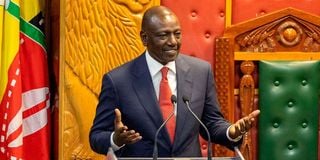
President William Ruto (center) flanked by Speaker of the National Assembly Moses Wetangula (left) and Speaker of the Senate Amason Kingi, delivers the State of the Nation address at Parliament Buildings in Nairobi on November 20, 2025.
Photo credit: Lucy Wanjiru | Nation Media Group
Ambitions that also include unlocking affordable housing offtake through pension funds, making carbon markets operational, or reviving the Lokichar-Lamu crude oil pipeline via private partnerships among others, “are designed to be strictly budget-neutral.”
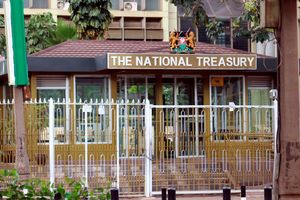
National Treasury Cabinet Secretary John Mbadi says that the President is expected to lean heavily on his economic turnaround to defend his fiscal policies and rally support for the Sh5 trillion infrastructure fund.
“There is a significant progress made since the NIF was enacted early this year by parliament and we can only build on the successes made,” said Mr Mbadi.
Conversely, governance analysts emphasise that voters are demanding concrete solutions to youth unemployment, public-sector corruption and high taxation rather than long-term projections.
“Ultimately, the address will test whether President Ruto can convince an impatient electorate that his capital investments are delivering tangible relief at the kitchen table before Kenyans head to the ballot box in 2027,” Mr Nyukuri.
PBO notes that Affordable Housing Programme’s impact will depend on how quickly completed units are sold.
“Sustainability rests on efficient delivery and offtake, so that sales proceeds can be reinvested in further construction. Better access to housing finance and a more responsive market are therefore critical to recovering capital, sustaining construction activity and supporting growth and jobs.”
While the NIF and the Sovereign Wealth Fund may have been created, mobilisation of the Sh5 trillion to finance the president’s four priority areas remains a pipedream.
Mr Mbadi frames the primary successes of the NIF and Sovereign Wealth Fund around the “historic legislative enactment,” securing Sh310.6 billion in initial seed capital and “shifting Kenya away from debt-driven development.”
The seed capital for the Fund includes the privatisation proceeds from the Initial Public Offering (IPO) of the Kenya Pipeline Company (KPC) that was concluded in March 2026, raising Sh104 billion, and the Sh206 billion being the proceeds from the 15 per cent partial divestiture of the Government’s stake in Safaricom PLC to Vodacom.
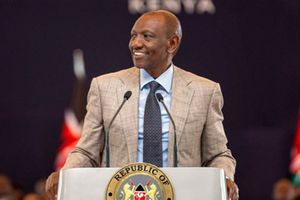
President William Ruto delivers the State of the Nation address at Parliament Buildings in Nairobi on November 20, 2025.
Photo credit: Lucy Wanjiru | Nation Media Group
The High Court’s decision to nullify the divestiture of the State’s 15 per cent stake in the telco has thrown President Ruto’s funding ambitions into uncertainty. The State is pursuing an appeal against the decision.
“This National Infrastructure Fund is a game-changer for Kenya, transitioning our development model from being debt-dependent to investment-led. By recycling capital through the KPC IPO, we are building a cushion that attracts pension funds and institutional investors," CS Mbadi said at a previous meeting with MPs.
He went on to state that “a project may be socially important, but if it is not commercially viable, it is not a candidate for NIF."
Mr Mbadi added: "The law shields it from political interference, ensuring investments are driven purely by economic viability. Additionally, the fund is not allowed to borrow on its balance sheet, which protects it from unnecessary financial risks.”
Kenya’s Sovereign Wealth Fund is a state-owned investment fund established to manage, invest and preserve revenues from natural resources and strategic assets for economic stability and future generations.
The fund shields natural resource earnings from being absorbed into day-to-day government spending by ring-fencing them at the Central Bank of Kenya.
However, the National Treasury has not yet published a standalone verified bank balance for the Sovereign Wealth Fund, as it was enacted in July 2026 and remains in its initial capitalisation phase towards a Sh200 billion operational threshold.
Looking ahead to the State of the Nation address, Mr Nyukuri summarises the speech as covering constitutional accountability and legacy-building ahead of the 2027 polls.