From the founding Head of State Jomo Kenyatta to President William Ruto, the State of the Nation address in all its forms has not only become a tradition, but a constitutional and political platform for successive administrations to outline their vision and defend policies.
Started as presidential speeches to the nation, the address has evolved into an obligation anchored in the 2010 constitution.
For Presidents Jomo Kenyatta, Daniel Moi and Mwai Kibaki, their addresses, though not constitutionally mandated, focused nation-building, national unity, economic and institutional reforms.
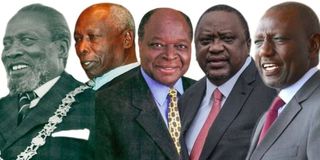
Kenya's presidents Jomo Kenyatta (left) Daniel arap Moi, Mwai Kibaki, Uhuru Kenyatta and William Ruto.
Photo credit: File | Nation Media Group
It has for years offered a platform for the president to report to Parliament and the country on the state of the nation and outline government achievements.
The address also offers a platform to assess the performance of the government, particularly in areas such as the economy, security, infrastructure, education, healthcare, employment as well as national cohesion.
The tradition dates back to 1963, when Kenya attained its independence. In the initial years, the founding president largely talked about the challenges of building a new nation and his efforts in consolidating institutions under the newly independent state.
The first President of the Republic of Kenya, the late Mzee Jomo Kenyatta.
Photo credit: File | Nation Media Group
His subsequent addresses focused largely on government policy direction, national development and consolidation of the new nation.
In his 24-year tenure, President Moi shifted his focus to address his administration’s emphasis on national unity, political stability and development.
The late President Daniel Arap Moi.
Photo credit: File Photo
Under President Kibaki, the State of the Nation address reflected on the country’s economic, institutional development and national policy priorities.
Kibaki’s administration prioritised economic recovery, infrastructure expansion, free primary education and revival of economic sectors.
The late former President Mwai Kibaki.
Photo credit: File | Nation Media Group
The current State of the Nation Address took shape under Uhuru Kenyatta’s presidency following the promulgation of the 2010 constitution.
The Constitution provided a legal foundation of the address by requiring the president to address a special sitting of Parliament once every year.
In the address, the president is also required to report on the measures taken and progress achieved in realising national values under Article 10.
The Article talks about national values and principles, which entails patriotism, national unity, sharing and devolution of power, the rule of law, democracy and participation of the people, human dignity, equity, social justice, inclusiveness, equality, human rights, non-discrimination and protection of the marginalised.
“The President shall (a) address the opening of each newly elected Parliament; (b) address a special sitting of Parliament once every year and may address Parliament at any other time,” the law says.
The president is also expected to report on all the measures taken and the progress achieved in the realisation of the national values, referred to in Article 10. This should be published in the Kenya Gazette and a report submitted for debate to the National Assembly on the progress made in fulfilling Kenya’s international obligations.
President Uhuru Kenyatta delivering his State of the Nation Address at Parliament buildings on November 30, 2021.
Photo credit: File | Nation Media Group
Uhuru Kenyatta’s addresses in his two terms largely focused on economic growth, infrastructure development, devolution, fight against corruption, national security, the Big Four Agenda and the Covid-19 pandemic.
He delivered what is widely recognised as the country’s first formal State of the Nation Address under the 2010 constitution on March 27, 2014.
In his March 2015 address, Mr Kenyatta tabled an Ethics and Anti-Corruption Commission (EACC) confidential report – commonly known as the ‘list of shame’— that contained 175 individuals, among them Cabinet Secretaries, Principal Secretaries and county governors.
The officials were under investigation for corruption and abuse of office. Although most of the cases collapsed under the weight of insufficient evidence, for President Uhuru Kenyatta, the tabling of the name-and-shame dossier was to be his Executive’s tough measure to tackle the pervasive graft in his administration.
His seventh address on November 12, 2020 was heavy on the Covid-19 pandemic, when he urged leaders and citizens not to drop the guard or succumb to pandemic fatigue.
Covid-19 pandemic also formed part of his November 2021 address when he viewed the disease as an “intergenerational opportunity’ rather than just a national crisis.
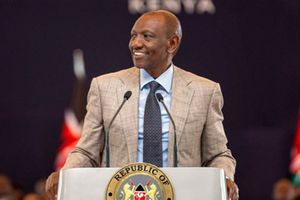
President William Ruto delivers the State of the Nation Address at Parliament Buildings in Nairobi on November 21, 2024.
Photo credit: PCS
Today’s address will mark the 14th address, with President Ruto having made his first address on November 9, 2023.
His heavily scrutinised 2024 address came five months after the Gen Z protests that forced him to dissolve his Cabinet. Last year, the address was on November 20.