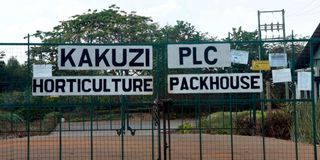
Kakuzi has once again been thrust into the national spotlight. Ordered to surrender 3,200 acres of its 32,900-acre Murang’a estate, the agribusiness giant now stands not only as a company in dispute, but as something more symbolic: one of the last standing outposts of a vanished empire.
The National Land Commission (NLC) order may read like a routine adjustment of title deeds, but beneath the legal language lies a story about conquest, dispossession and unfinished business of decolonisation.
Kakuzi is not alone. From Cape Town to Brussels, the material symbols of a lost empire are being questioned, toppled or re-contextualised. Statues that once towered unquestioned over city squares are now wrapped in protest banners or removed altogether; street names are being changed, monuments relabelled and museum collections re-examined.
A road that passes next to Kakuzi tree plantation in Makuyu, Muranga County.
Photo credit: File | Nation Media Group
What we are witnessing is not simply a quarrel over stone and bronze, but a global argument about memory, justice and who gets to define the past. Seen in that light, what appears to be a technical land settlement in Murang’a is, in reality, a reckoning with the enduring fragments of colonial rule – who belongs, who profits and who is still paying the price for decisions made in the age of empire.
The boundaries of the Kakuzi estate were once lines drawn to secure white settler privilege. Those same lines have become evidence in a much wider trial about historical wrongs and contemporary inequality. This struggle is mirrored elsewhere.
A few years ago, Italy, after decades of resistance, was forced to return the ancient obelisk Benito Mussolini had seized from Ethiopia. For years, it stood in Rome as a monument to imperial prowess. Its return was a public admission that what had been celebrated as triumph was, in fact, theft.
Across Western Europe, museums are returning the Benin bronzes looted from what is now Nigeria. These works of art, once displayed as proof of Europe’s “civilising mission”, are now recognised as evidence of plunder, forcing institutions to confront how such objects were acquired and who should own them.
A boy walking on along a railway line next to Kakuzi's tree plantation.
Photo credit: Evans Habil | Nation Media Group
Churches and mission societies face similar claims and negotiations over land they acquired under the umbrella of empire.
Kakuzi’s sprawling orchards and fences belong to a family of contested landscapes stretching from Ethiopian plains once marked by a stolen obelisk to European museums of looted bronzes and mission stations built on alienated soil. The fight the 3,200 acres is part of a wider moment in which the last remnants of empire – whether cast in stone, displayed behind glass or measured out in acres – are being dragged into the open and asked to answer a simple question: by what right?
For more than a century, Kakuzi has functioned as a kind of colonial relic in motion. Established as Kakuzi Fibreland Ltd in 1902, the company grew as an instrument of settler capitalism and land alienation. Its Makuyu holdings stretch back to the era of the Crown Lands Ordinances, when British officials reclassified African-occupied territories as “empty” land open to European acquisition. This imperial legal fiction created what historians describe as “invisible squatters”: communities that never actually left but were written out of the law, their presence erased from the very landscapes they had long inhabited.
In this imperial script, Kakuzi appears as a perfectly lawful entity. Armed with title deeds and leases, it ticks every bureaucratic box. Under legal frameworks crafted to serve colonial interests, this paperwork becomes the ultimate proof of legitimate ownership. The claims of indigenous communities are relegated to the realm of emotion and politics.
Courts are slowly assembling a new body of land jurisprudence that looks beyond the title deed to interrogate the processes that produced it. If colonial rule was, in essence, a project of dispossession – an elaborate form of theft wrapped in legal language – then contemporary Kenya faces a dilemma. How can ownership based on conquest, coercion and exclusion be treated as sacrosanct? Seen in that light, companies like Kakuzi are not neutral agribusinesses. They are the institutional descendants of an old empire.
This is what makes the battle over Kakuzi’s land volatile. For nearly a century, the estate has been surveyed, fenced off, cleared and planted in ways that seem to erase the memory of those who once lived there. It prides itself on having transformed grasslands into productive farms, recreational spaces such as the Makuyu Golf Club, and schools. But for those pushed into ever narrower margins around the farm, and denied access to water points, it has long looked like an enclosure in slow motion, a colonial order that continued to function long after the Union Jack came down.
From a colonial perspective, Kakuzi is still a story of extraction. It is a leading grower, processor and exporter of avocados, macadamia nuts, tea and emerging crops like blueberries. In 2024, it reported revenues of Sh4.8 billion. These figures sparkle in annual reports and investor presentations. For many residents of Murang’a, however, they quantify an uncomfortable reality: immense wealth continues to be generated on land they believe was seized in the era of empire and never truly returned.
Kakuzi Plc workers packaging avocados.
Photo credit: Pool
It is against this backdrop that the NLC convened hearings in 2024 to examine historical land injustice claims concerning Kakuzi. Self-described squatters and local representatives set out their case: that Kakuzi’s acreage sits on ancestral land taken under colonial laws, and that the last remnants of that imperial order must be dismantled through restitution. Kakuzi insisted that the matter be dropped, asserting the unimpeachable legality of its holdings. In a landmark ruling, the NLC instructed the company to surrender 3,200 acres as a settlement for historical land injustices in Murang’a.
Parallel struggles are unfolding on the tea estates of Kericho, where multinationals occupy former White Highlands; on the plantations of Del Monte; and the ranches of Laikipia. In every case, the same questions resurface: Who should benefit from land seized under coercive colonial systems? How should post-colonial states confront wrongs sanitised as “investment”? What does genuine restitution look like more than half a century after the empire formally withdrew?
Kakuzi has also been drawn into a storm over abuses . The Kenya Human Rights Commission and other organisations have urged the Murang’a County Assembly to halt the renewal of Kakuzi’s land leases until historical injustices and contemporary claims are addressed. Kakuzi’s parent company, UK-based Camellia Plc, agreed to pay Sh696 million to settle claims of abuses by workers on or near the estate, including killings and sexual and gender-based violence. Lawyers in the UK had threatened to sue on behalf of Kenyan claimants, and at one point a supermarket giant suspended imports of Kakuzi avocados.
In an era shaped by ethical consumerism, the legacies of empire are now part of the balance sheet. What Kakuzi calls a “smear campaign” echoes the way imperial powers often respond when asked to decolonise their spaces. In 2013, the British government expressed regret in Parliament for the torture and ill-treatment of Mau Mau detainees during the 1950s Emergency and agreed to compensate thousands of claimants. Germany has recognised the massacre of the Herero and Nama in Namibia as genocide and committed billions in development support.
These settlements are imperfect and contested, but they mark a shift: imperial powers are being dragged back to the scenes of their history and asked to pay. The Rhodes Must Fall movement in South Africa, which succeeded in removing the statue of Cecil Rhodes from the University of Cape Town in 2015, linked a single monument to wider demands for the decolonisation of education and public space.
Kakuzi is more than a corporate name stamped on a crate of avocados. It is a mirror held up to Kenya’s post-colonial conscience – and to the lingering structures of an empire that never entirely left. Do we accept the legal fictions inherited from colonial rule as the final word, or do we subject them to ethical scrutiny? Do we treat title deeds, however compromised their origins, as untouchable, or do we imagine new land regimes that prioritise historical justice and collective well-being?
The NLC directive will not, on its own, settle these questions. But it signals that the country is no longer prepared to treat imperial land grabs as immutable facts of history. That is how we come to terms with the past.
John Kamau is a PhD candidate in history, University of Toronto. Email: [email protected] @johnkamau1