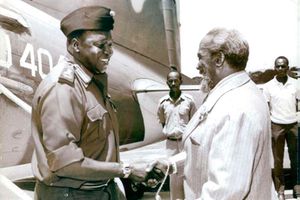
In June 1974, Kenya’s freedom fighter Kungu Karumba crossed into Uganda on what should have been a routine business trip. He never returned, becoming a victim of President Idi Amin’s paranoia.
Karumba, one of the legendary Kapenguria Six who faced trial alongside Jomo Kenyatta in 1952, was last seen in the lakeside town of Jinja, where he had travelled to recover a business debt. Instead, his journey ended at the hands of Amin’s soldiers.
Within weeks, whispered rumours drifted back across the border: Karumba had allegedly clashed with a senior military officer, and the altercation had turned fatal.
Freedom fighter and businessman Kung’u Karumba.
Photo credit: File | Nation Media Group
His body was never recovered. For years, his disappearance lingered as a ghostly reminder of a turbulent era, a time when a Kenyan crossing into Uganda stepped not into a neighbouring state but into a labyrinth of fear. Karumba was not alone. Throughout the 1970s, some Kenyans studying, trading, or merely travelling through Uganda vanished without explanation. It was an age when political paranoia eclipsed diplomacy, and a border that ought to have tethered East Africans together instead cleaved them apart.
More Kenyans are being held in detention centres. Among the missing is John Ogutu , a teacher shot on October 29 in Obungo District. Human rights organisations in Tanzania speak of mass burials, fuelling fears that his fate may already be sealed. His family continues to wait.
Angeline Juma Ogutu holds John Ogutu's photo in Siaya County.
Photo credit: Elizabeth Ojina | Nation
Last week, however, brought a rare moment of relief. The month-long search for abducted Kenyan activists Nicholas Oyoo and Bob Njagi ended when the two were dramatically released from what Uganda’s President Yoweri Museveni chillingly described as “the fridge”, a military detention facility. The pair had travelled to Uganda on October 1, reportedly to attend an opposition rally and pursue business opportunities, when armed men seized them and bundled them into a vehicle outside a petrol station. Museveni claimed that these were “experts in riots”.
Free Kenya Movement Chairperson Bob Njagi (left) and Secretary-General Nicholas Oyoo addressing journalists at Mageuzi Hub in Nairobi on November 12,2025
Photo credit: Evans Habil | Nation Media Group
The disappearance of Oyoo and Njagi, and the diplomatic storm it ignited, has revived uncomfortable memories of an earlier era. Many Kenyans see parallels between the current targeting of Kenyan nationals under President Samia Suluhu’s administration and the systematic harassment they endured in the 1970s, when President Mwalimu Julius Nyerere’s government adopted an increasingly hostile posture towards Kenya. That earlier hostility stemmed from the acrimonious collapse of the first East African Community in 1977, a rupture driven by ideological differences between socialist Tanzania and capitalist Kenya.
In the tense years preceding the dissolution, disputes over the division of the Community’s jointly owned assets, from railways and airlines to research institutions, fed nationalist sentiment and popular resentment. As negotiations grew more confrontational, ordinary Kenyans living or working in Tanzania found themselves singled out for intimidation and bureaucratic obstruction, reflecting the broader breakdown of trust between the two states.
By early 1977, Nyerere had already turned his fury on Kenya. That May, he sealed the entire border, seizing Kenyan trucks, cars, and private aircraft. The official reason was a dispute over the collapse of East African Airways, a jointly owned airline that had gone bankrupt. Tanzania accused Kenya of “sabotaging” the company, but the underlying issue was a deeper clash of ideologies.
Nyerere, who had built his nation upon socialist ideals, viewed Kenya’s capitalist system as exploitative. For six years, Tanzania closed its northern border with Kenya. Tanzanian soldiers turned traders away and confiscated goods. Kenyan lorries laden with cargo for Zambia rotted in Mombasa. Even the Maasai, whose families straddled the border, were cut off from their own kin.
Advocates Martha Karua, Gloria Kimani and Lyn Ngugi at Julius Nyerere International Airport blocked from entering Tanzania.
Photo credit: Pool
Former Chief Justice Willy Mutunga and veteran politician Martha Karua were recently detained and summarily deported from Dar es Salaam after attempting to attend Chadema leader Tundu Lissu’s trial, a stark indication that supporters of Tanzania’s dissenting voices — even those from across the border — are no longer welcome. For ordinary Kenyans, the hostility has been even more brutal.
Ugandan human rights activist Agather Atuhaire (left) and Boniface Mwangi address journalists at Mageuzi Hub in Nairobi on June 2, 2025 on the torture they underwent in Tanzania.
Photo credit: Evans Habil | Nation Media Group
When Amin seized power in 1971, Kenya’s western frontier became a killing field. Within months, Kenyans were being arrested, beaten, or shot by Ugandan troops. The regime accused Kenya of harbouring rebels and plotting Amin’s assassination. By 1976, the Kenyan government had compiled a chilling dossier, later presented to the United Nations Security Council, documenting the fate of dozens of its citizens.
The list included Ndolo Mwaniki and Musyoki Mwaniki, beaten to death by Ugandan soldiers; Dominic Onyango Amoth, a senior accountant shot in Tororo; and John Muli, a journalist who vanished along with two colleagues. James Mungai, a businessman, was beaten to death in Kasese. Twenty Kenyans were massacred in a cross-border raid, their livestock driven off by Ugandan troops.
Among the victims was Esther Chesire, a young Kenyan student at Makerere University . On 13 February 1976, Ugandan authorities arrested her at Entebbe Airport alongside her friend, Sally Githere. While Githere managed to escape, Chesire was never seen again. She was the sister of former MP Reuben Chesire and Zipporah Kitonny, and her disappearance struck a deep national nerve: the daughter of a respected family swallowed by a neighbour’s terror.
Esther Chesire as a 22-year-old university student when she disappeared.
Photo credit: John Nyaga | Nation Media Group
Archival records show that Kenya lost property worth more than Sh6 billion at today’s value after Ugandan authorities seized factories, vehicles, and accounts belonging to Kenyan businesses. Uganda Breweries, part of the East African Breweries Group, was nationalised. Chandaria Industries and Car & General were confiscated. Even Peter Muigai Kenyatta, the President’s son, lost a car and his company assets.
Amin dismissed the accusations as propaganda. In one of his bizarre rants, he claimed that “Mama Ngina’s lorries were killing our children” and that Kenyan leaders were colluding with Israel to overthrow him.
Tensions peaked in July 1976, when Amin accused Kenya of aiding the Israeli commandos who stormed Entebbe Airport to rescue hostages. He responded by threatening to bomb Nairobi. By then, Kenyatta’s patience had nearly snapped.
His intelligence chiefs quietly drafted contingency plans for military action. Amin’s forces, meanwhile, continued detaining Kenyans. One of the last recorded cases before the dictator’s fall involved John Oyuga Danga, a businessman who paid a bribe of Sh180,000 to escape captivity. He was among the fortunate few who made it home.
Although Amin’s reign finally collapsed in April 1979, when Nyerere’s Tanzanian army invaded Uganda and toppled the dictator after eight years of terror, the removal ended the nightmare of cross-border killings but did not erase the scars. The files of the missing, including Karumba and Chesire, remained unresolved.
Yet cross-border abductions have returned. There is some irony. In the early 1980s, Yoweri Museveni moved through Nairobi’s shadows as a hunted man. Kenya and Tanzania served as fragile lifelines for his guerrilla struggle against Milton Obote, offering spaces, sometimes reluctantly, where exiles could regroup, plan, and survive. Museveni’s family was not immune.
In 1983, kidnappers linked to Obote’s regime stormed the family’s Nairobi home, abducting the housekeeper and narrowly missing Janet Museveni, who later recalled in her memoir how a single knock on the door might have altered her destiny. Museveni himself slipped across the Namanga border only by bribing guards, smuggling his pistol and his hopes for liberation through a frontier that offered both sanctuary and peril.
Four decades later, the roles appear sharply reversed. The man who once relied on Kenya for refuge now stands accused not only of abducting Uganda’s political dissidents on Kenyan soil, such as his former comrade Dr Kizza Besigye, but also of kidnapping Kenyan citizens who dare to campaign for his opponents, even as he freely welcomes Kenyan politicians to campaign for him in Uganda. Kenyan lawyers have decried Nairobi as “a kidnapper’s paradise”, and Winnie Byanyima has condemned Uganda’s “return to politics of fear”.
Uganda’s opposition honcho and retired army doctor Colonel Kizza Besigye.
Photo credit: File
The symmetry is striking: in 1983, the Museveni family fled kidnappers in Nairobi; by 2025, Museveni’s government is alleged to be dispatching them. The border that once shielded him from persecution has become the stage on which similar abuses are now being projected outward, an irony history could scarcely script more neatly.
In this new era, the pattern has not changed. It has simply found new actors. President Samia Suluhu’s growing suspicion of Kenyan activists, evident in arrests, expulsions, and the quiet profiling of traders and journalists, echoes the old reflex of leaders who turn borders into barricades against imagined enemies.
To the south, Kenyans are treated not as partners in integration but as infiltrators in a nation wrestling with its own insecurities. To the west, Museveni’s dread takes a different form. It is not Kenya he fears, but the restless energy of Uganda’s youth, the very generation he once claimed to emancipate.
Their courage, organisation, and hunger for change now trigger the same authoritarian instincts that once hunted him across these borders. Together, these anxieties — Suluhu’s suspicion of Kenyan activists and Museveni’s fear of the young — reveal a region whose leadership remains trapped in the shadows of yesterday’s insecurities. The borders they command are no longer lines of trade or trust but frontiers of suspicion.