Rigathi Gachagua’s recent tirade against musicians, who visited Deputy President Kithure Kindiki , is a chilling affront to the fundamental freedom of association and expression. In a democracy — however fragile or imperfect — artists should not be frightened into partisan enclosures.
In the history of colonial control, domination often began with the regulation of cultural expression as part of a broader strategy to assert authority and impose rule over subject populations. As former deputy president positions himself as the political “kingpin” of the Mt Kenya region, he should recognise that suppressing dissent and undermining democratic engagement only exposes the limits of his leadership.
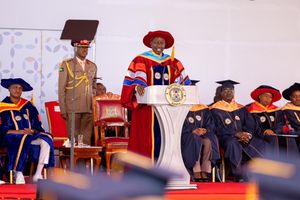
Nairobi Kikuyu community leaders address journalists in Nairobi on May 26, 2025 over the remarks made by former Deputy President Rigathi Gachagua on the politics of Mt Kenya and musicians who met Deputy President Kithure Kindiki.
Photo credit: Billy Ogada | Nation Media Group
History offers a cautionary tale: in 1929, the British colonial administration banned a Kikuyu dance known as Muthirigu, deeming it incompatible with their mission to Christianise the community and monopolise the cultural space. Scholars of colonial history have shown how such bans were not merely about morality or order but about silencing alternative voices and reshaping society in the image of power.
Gachagua’s undemocratic proclivities echo the repressive strategies of colonial governance, betraying not a commitment to consensus, but a deep-seated anxiety over erosion of authority. While he contends that the majority's will was subverted by the musicians’ visit to the Deputy President’s Karen residence, the more profound and unsettling question lingers: do minorities, assuming he speaks for the majority, not possess the right to exercise their agency without fear of reprisal?
That Gachagua would go so far as to call for a boycott of these musicians and the public spaces they patronise is not only surprising — it is dictatorial. Such behaviour mirrors the very tools of coercion and exclusion that were once wielded by colonial administrators to suppress alternative voices and enforce conformity.
In seeking to punish those who dared to step outside his script of loyalty, he reveals an intolerance for plurality and a dangerous willingness to weaponise influence against perceived political deviance.
In recent years, politicians in Kenya – including figures such as Kindiki – have increasingly recognised the strategic value of engaging performing artists to expand their political support, particularly among the urban and rural poor. This is not a new phenomenon. The instrumental use of music for political mobilisation in East Africa has deep roots, dating back to the early post-independence era.
A notable example is the song Kanu yajenga nchi , which became an anthem of party loyalty and national development in Kenya during the 1960s. Interestingly, this song traces its origins to a Nyamwezi war song from Tanzania. In 1962, Julius Nyerere, Tanzania’s founding president and a key architect of African socialism, adopted the melody and added new lyrics under the title Tanu yajenga nchi (Tanu builds the nation), referring to his political party, the Tanganyika African National Union. The song became an instant hit when a recording of the crowd singing it was broadcast on Radio Tanganyika, embedding it in the public imagination as a symbol of post-colonial optimism and collective action.
The influence of the song quickly crossed national borders. In Kenya, Tom Mboya, one of the leading architects of Kenya’s independence, adapted the song for Kanu and widely used it at rallies and public functions to evoke emotional loyalty to the ruling party.
Musicians have the right to take sides — and still remain popular. Julius Nyerere had artists who aligned with his vision, and for many years, Tanzanian musician Baraka Mwinshehe openly supported the state. His repertoire included politically charged compositions such as Mwongozo wa Tanu (The Tanu guidelines) and Miaka 10 ya uhuru (10 years of independence), which celebrated national achievements and promoted Ujamaa (African socialism). These songs were more than artistic expressions; they functioned as ideological tools for state-building and mass mobilisation.
Yet, Mwinshehe was not ostracised for his political leanings and his 1970s hit Shida reverberated through East Africa. His example affirms that musicians can exercise their right to choose a political position—and still command public respect and popularity.
Music functions as a powerful medium of communication and leaders such as Nyerere and Mboya understood the mobilising potential of sound. There is nothing wrong with Kenyan politicians enlisting like-minded musicians to compose campaign anthems or perform at rallies. These collaborations are not just for entertainment—they are strategic performances meant to forge emotional connections with voters.
Mwai Kibaki’s Narc coalition famously adopted the track Unbwogable as a rallying cry during the 2002 campaign, fusing popular culture with political messaging in a way that energised the electorate. Uhuru Kenyatta followed a similar script with Ben Githae’s Tano Tena , a tune that came to symbolise his bid for re-election, while William Ruto enlisted the Tanzanian gospel group Zabron Singers to soundtrack his victory celebrations.
Hip Hop duo Gidi Gidi and Maji Maji.
Photo credit: Pool | Nation
There is nothing inherently problematic about these choices —indeed, they reflect a broader global trend where political actors draw on music’s emotive power to galvanise support and craft relatable narratives. To criminalise or vilify such associations would be to ignore music’s long-standing role as a vehicle for political expression, solidarity, and identity-making. It is also unconstitutional and a sign of intolerance.
In the recent past, Gachagua has been condemning the state intolerance and killing of Gen-Z protesters, who were exercising similar freedoms under Article 37 of the Constitution. Thus, he should not display a similar kind of intolerance toward musicians—and hope to get away with it while violating Article 36 on the freedom of association.
To paraphrase it to him, it says: “Every person has the right to freedom of association, which includes the right to form, join or participate in the activities of an association of any kind” and that “a person shall not be compelled to join an association of any kind.” Further Article 38 says that “every citizen is free to make political choices, which includes the right— to campaign for a political party or cause.”
Attempting to silence or coerce musicians into political alignment undermines democratic growth and exposes a double standard in Gachagua’s leadership.
Musician Joseph Kamaru entertains guests during Madaraka celebrations in Nyeri on June 1, 2017.
Photo credit: File | Nation Media Group
Under Jomo Kenyatta’s regime, Joseph Kamaru, one of Kenya’s most prolific musicians, was persecuted for his bold song mourning the assassination of JM Kariuki — a track that rattled the status quo and pierced the veil of official silence. Even gospel groups were not spared. The PCEA Gathaithi Choir’s composition Mai ni Maruru (The Water is Bitter) so unnerved the power elite, including men like Simeon Nyachae, that the song was swiftly pulled from public airwaves.
Once upon a time, Bob Marley, the Jamaican reggae icon, famously used his global platform to call for peace between rival political factions in a deeply polarized Jamaica. His performance of “One Love” at the 1978 One Love Peace Concert—where he physically joined the hands of bitter political rivals Michael Manley and Edward Seaga—was an act of radical artistic intervention. For that, Marley paid a price: an attempt was made on his life.