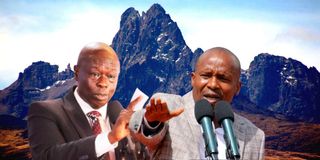
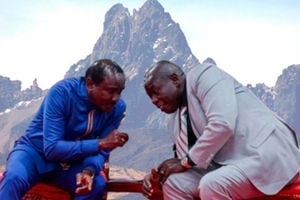
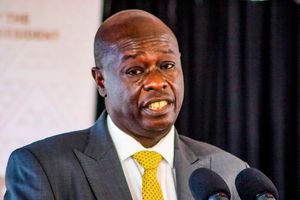
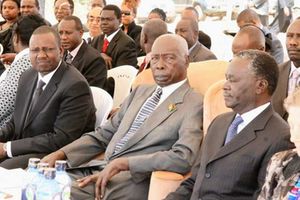
As the political battle to control the Mt Kenya vote continues between former deputy president Rigathi Gachagua and his successor, Prof Kithure Kindiki , it is often forgotten that the bloc itself was born out of turbulence.
Fifty-five years ago this month, Attorney-General Charles Njonjo quietly registered an organisation that would leave a long shadow over Kenyan politics: the Gikuyu, Embu and Meru Association, better known as Gema . Officially, it was presented as a welfare and cultural body meant to promote unity among the three Mt Kenya communities.
Former Attorney-General Charles Njonjo.
Photo credit: File | Nation Media Group
On paper, it appeared to be an innocent organisation designed to promote unity and identity among communities of the Mt Kenya region. In practice, however, Gema emerged at one of the most politically anxious moments in independent Kenya’s early history, when there were fears that President Jomo Kenyatta’s grip on power was weakening and that the military might intervene.
This timing was not accidental. When Gema was registered on March 10, 1971, Kenya was experiencing one of the most anxious moments of its post-independence history. President Kenyatta was ageing, and his health was declining.
The struggle over who would succeed him was turning into a dangerous political contest. The assassination of Cabinet minister Tom Mboya in 1969 had shaken the country, as had the suppression of Oginga Odinga’s Kenya People’s Union (KPU). Behind the scenes, elite rivalries were sharpening and confidence within the state was fraying.
On January 25, 1971, Idi Amin overthrew Milton Obote, sending shockwaves across East Africa. If a sitting president could be toppled in Kampala, many in Nairobi feared the same could happen in Kenya. Those fears were not idle. British historian Charles Hornsby has shown that by 1971, British officials were seriously considering the possibility of a coup in Kenya, especially in the event of Kenyatta’s death. Reports suggested that army commander Brig Joseph Ndolo had discussed the circumstances under which he might have to intervene.
The composition of Gema also betrayed its political purpose. It united the Gikuyu, Embu and Meru, but excluded the Kamba, even though they were linguistically and geographically close to the three communities. That omission was revealing. Ndolo, the army commander whose name surfaced in coup speculation, was Kamba. In retrospect, Gema appears less like a cultural umbrella and more like a carefully drawn political boundary — a bloc around Kenyatta’s core support rather than a broad regional alliance.
For Kenyatta’s inner circle, the lesson was clear: power needed firmer protection, and the registration of Gema formed part of that protection. That is why the argument that it was merely a harmless cultural association has never rung true. The speed of its registration alone told a different story. Accounts from those close to the process suggest that once the papers reached Njonjo, they were processed with unusual haste.
President Jomo Kenyatta and First Lady Mama Ngina pose for a group photo with newly-elected officials of Gema's Murang'a branch in Gatundu.
Photo credit: File | Nation Media Group
In Parliament, its registration immediately drew suspicion. MPs demanded to know its office-bearers, its aims and its real purpose. Njonjo, who would later style himself as an opponent of tribal organisations, reacted defensively and even angrily, brushing aside criticism. The contradiction was striking. That he approved Gema at all strongly suggested that the organisation enjoyed protection from the highest office. Njenga Karume, its long-time chairman, would later say as much, claiming that Njonjo acted on Kenyatta’s instructions.
Karume would later insist in his memoir that Gema was not founded for political purposes. Yet even his own account undermined that defence. He acknowledged that Kenyatta allowed its formation in order to keep his lieutenants together — language that clearly suggested political consolidation.
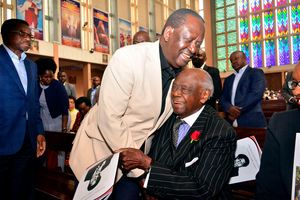
Former President Mwai Kibaki.
Photo credit: File | Nation Media Group
The names attached to Gema from the start made its significance even clearer. Julius Gikonyo Kiano became interim chairman. Mwai Kibaki served as treasurer. Jeremiah Nyaga was vice-chairman. Lucas Ngureti was secretary-general. Others included Waruru Kanja and Jackson Angaine. This was not an assembly of cultural enthusiasts. It was a roll call of the Mt Kenya elite — men with influence in Cabinet, Parliament, business and the provincial administration.
And Gema soon behaved accordingly. It became less a welfare association than a political machine. Its endorsements carried weight. Its networks influenced nominations, elections and patronage. In 1974, Muthoni Likimani openly complained that Gema had interfered in the Bahati parliamentary contest in favour of her rival, James Muriuki. Whether or not every accusation was justified, the perception had already hardened: Gema was a political kingmaker.
Its economic arm, Gema Holdings Limited, deepened that influence. Through land and property acquisitions, the organisation accumulated not only influence but also material wealth. Political muscle and economic power reinforced each other. This was not simply about identity; it was about access, patronage and leverage.
As the years passed, Gema’s political role became impossible to disguise. After the 1975 assassination of J.M. Kariuki, the Nyandarua North MP, public anger shook the country, and Parliament formed a select committee to investigate the murder. Gema entered the fray to defend the establishment. It warned Kenyans against being misled by what it described as “prophets and leaders of doom”, and later even questioned the motives of those investigating the killing. That was not the voice of cultural preservation but that of an organised political force protecting a threatened order.
However, not everyone within the establishment supported its ambitions. Kibaki and Njonjo kept their distance from its more aggressive manoeuvres. Once Moi assumed power in 1978, Gema’s days as an overt political force were numbered. In 1980, the new regime moved against it, and Njonjo — in one of history’s ironies — had officials linked to its renamed corporate arm, Agricultural Holdings, arrested for failing to file statutory returns. By that year, Gema was effectively dismantled.
As the tussle for the Gema soul — now often described as Mlima (Mountain) politics — continues, it is worth noting that Gema was never truly extinguished. It survived as an idea, a reflex and a political habit, revived repeatedly by politicians seeking to mobilise Mt Kenya voters into a single electoral bloc in order to strengthen their bargaining position.
Members of Gema and Nairobi business community pray before addressing the media at Sagret Hotel in Nairobi on September 25, 2017.
Photo credit: Dennis Onsongo | Nation Media Group
And Gema’s history is not unique. Kenya’s ethnic voting blocs have often been politically assembled. The Kalenjin identity, for example, was politically sharpened over time from several distinct communities before emerging in the 1979 census as a single category. Scholars argue that the Kalenjin identity was a conscious amalgamation of related communities designed to increase bargaining power in an increasingly ethnicised political arena. While the term “Kalenjin” was originally coined for a radio broadcast, by the 1979 census it had become an administrative category — demonstrating how umbrella identities can evolve into political instruments.
The Luhya provide another example. They are less a single tribe than a broad umbrella of several sub-groups. What politicians describe as tribal unity is often the result of political mobilisation rather than ancient inevitability. Gema was simply one of the earliest and most successful examples of that process.
For decades, Mt Kenya was seen as the country’s most disciplined voting bloc, often rallying with near-instinctive unity whenever its interests appeared to be at stake. That cohesion was never entirely natural or automatic. It was cultivated, organised, and repeatedly invoked by politicians who understood the electoral value of collective identity.
Rigathi Gachagua appears eager to revive that script in its rawer, more conservative form. Prof Kindiki, by contrast, seems to represent a less combative and more state-aligned version of regional politics. The clash between them may determine not only who leads Mt Kenya politically but also whether the bloc itself remains intact.
Yet the region has also changed. The old assumption that Mt Kenya voters would line up exclusively behind one of their own for the presidency was shattered when many backed William Ruto’s United Democratic Alliance (UDA). That decision surprised many analysts and demonstrated that while bloc voting remains influential, it is no longer as rigid or predictable as it once appeared.
That is why Gema, even more than five decades later, still matters. Its story is not only about the past but also about the political architecture of the present. It reminds us that ethnic unity in Kenya is often less about shared culture than about organised power.
Gema was born not out of nostalgia but out of fear — fear of losing control, fear of succession, fear of instability, and fear that the state itself might slip away. It was designed as a shield for a vulnerable presidency. It later became a weapon in succession battles.
And although the state eventually outlawed it, the method it pioneered outlived the institution itself. Gema, then, was banned but never buried. It survives wherever politicians invoke Mt Kenya as a single political marketplace, whenever elites attempt to rally communities into one electoral fold, and whenever identity is mobilised less as heritage than as political strategy. Fifty-five years on, the name may no longer be official, but the bloc it helped imagine is still with us. The question now is: who will take charge of that bloc?