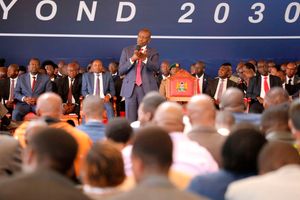
While meeting local traders in Nairobi on September 2, President William Ruto made reference to two Bills that were before the National Assembly.
He was responding to concerns from traders regarding competition posed by immigrant market players. The Local Content Bill, 2025; and Micro, and Small Enterprises (Amendment) Bill were the subject.
The former seeks to reserve specific micro-enterprise and retail distribution sectors – like hawking and kiosks – for Kenyans. It also mandates that foreign firms ensure up to 80 per cent of their workforce comprises Kenyans, and source at least 60 per cent of their goods and services locally. The Bill restricts foreign participation in small-scale trade and the informal economy.
The other Bill establishes legal boundaries for participation in the informal economy, ensuring low-capital ventures are protected for citizens. The much-maligned comments by the President were not his creation, but an illucidation of what was already before the Parliament. The overriding purpose of the two Bills is to streamline immigration, regularise businesses and protect small traders from external threats.
These domestic policies have drawn criticism from integration advocates for contradicting the free movement of labour provisions outlined in the EAC Common Market Protocol.
The reality, however, is that unfettered labour movement would normally attract mostly unskilled people from poorer neighbours who end up piling pressure on social amenities of recipient countries without commensurate contribution to development.
90-day regularisation window
Evidently, the President sought to clarify Kenya’s position on immigration without targeting nationals of specific countries. The government has launched a 90-day regularisation window starting September. Under this, foreigners operating businesses in Kenya are required to update or regularise their immigration status, work permits and licences. Such steps are important to ensure Kenya can account for all individuals within its borders, plan for education, health, water and other services and social amenities, secure the nation, and facilitate access to business credit.
Kenya has consistently lamented the huge gap between tax capacity and revenue collection. With an informal economy component accounting for up to 45 per cent of GDP, and rising, the country needs to streamline business operations in order to expand its tax base.
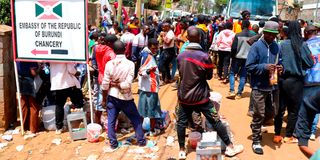
During the State House meeting, most speakers sought the President’s protection from market infiltration by immigrant traders from advanced economies, not small EAC neighbours. Unfortunately, the comments were blown out of context by politicians and civil society organisations, triggering immigration panic, particularly among Burundians in Kenya.
This created some semblance of veiled targeted xenophobia against Burundians. They became the default target mainly due to their large numbers in the informal businesses, and unclear immigration status. It should be remembered that Burundi has endured economic hardships for more than three decades.
The unfortunate turn of events has raised a diplomatic cloud in East Africa. Mistakenly believing that the order was targeted at Burundians, the Law Society of Kenya, The Institute for Social Accountability and Burundi Civil Society Organisation (Aluchoto), expressed indignation, saying the directive stigmatised migrant workers, violated the original spirit of the EAC and promoted xenophobia.
The two countries have moved quickly into diplomatic crisis management to prevent ties from severing further. Kenya’s Foreign Affairs PS Korir Sing’oei met Burundi’s Ambassador Evelyn Habonimana. They agreed to extend the registration and regularisation window by 90 days, and offered a temporary amnesty to undocumented EAC nationals.
Burundian immigration crisis
The two clarified that it is a routine matter of regulatory compliance rather than discrimination against Burundi nationals. Meanwhile, the Burundi government has demanded protection of its citizens as the EAC high-level regional summit is planned to address the situation. If not properly managed, the Burundian immigration crisis might cause a moral blot on Kenya’s credential as a champion of visa-free entry across Africa.
Perceived selective crackdowns on low-income informal traders from Burundi projects an image of economic insincerity. In any case, Kenya maintains a heavily favourable balance of trade with Burundi – approximately $56 million worth of exports relative to $70,000 imports. Mishandling of this issue could lead to retaliatory action.
As the dominant economic hub in the EAC bloc, Kenya carries a significant moral obligation to uphold regional integration protocols. Smaller economies should be given ample time to prepare for policy shifts in order to protect their fragile livelihoods. Such shifts should be communicated through established institutional frameworks as opposed to informal gatherings.
While the official position of the government is clear that nationals of EAC neighbours are welcome, the same message should be communicated to citizens, to avoid hostilities and vigilantism.
Most importantly, politicians and the civil society must refrain from their attempts to attract global attention by blowing routine legislative and administrative matters out of context. Elections come and go, but once a country earns the stigma of a “pariah state”, it may take generations to be accepted back to the community of civilised nations.
The ramifications are dire; including weak credit rating and inability to attract capital. Kenya cannot afford to take that trajectory. Our neighbours are our treasures and we need to jealously embrace them.
Prof Ongore is a Public Finance and Corporate Governance Scholar based at the Technical University of Kenya. [email protected] .