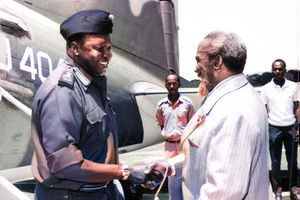
On February 20, 1980, as Daniel arap Moi, Kenya’s second Head of State, settled down for a meeting with US President Jimmy Carter in the White House Cabinet Room, his suspicion of Tanzania’s founding President Mwalimu Julius Nyerere was noticeable in the discussion that lasted one-and-a-half hours.
US State Department documents recently seen by the Weekly Review reveal how Moi told the US president that Tanzania was a hostile neighbour to Kenya, and accused Nyerere of exploiting Uganda and trying to build influence in Africa by supporting guerrilla movements. The Kenyan President, who took over in August 1978 upon the death of Jomo Kenyatta, also described Nyerere’s brand of socialism (Ujamaa) as misguided.
Incidentally, this was the first State visit to the US by a Kenyan president. Initially the US government under President Gerald Ford (1974-1977), had tried to organise one for Mzee Jomo Kenyatta, who was reluctant to make the trip across the Atlantic. The proposed visit became a subject of discussion in Washington DC between General Brent Scowcroft, the President’s Assistant for National Security Affairs and Anthony Marshall the then US Ambassador to Kenya on October 13, 1976.
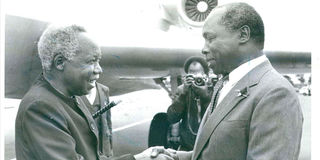
Former Tanzanian president Julius Nyerere (left) and his Kenyan counterpart Daniel arap Moi.
Photo credit: File | Nation Media Group
General Scowcroft sought to know from Marshall the status of Mzee Kenyatta’s health and whether he was fit enough to make the long trip to the US. Marshall, in previously confidential documents seen by the Weekly Review , explained that Kenyatta had a blood clot, which occasionally caused total unconsciousness for periods up to one-and-a-half days.
“This has occurred three times in the past year,” the diplomat revealed. However, he also noted that “the rest of the time Kenyatta is in good health for a man of 84.”
Mzee Kenyatta died two years later before making the Washington trip. Since Kenya was a strategic US ally, the invitation was extended to President Moi, who arrived in Washington on February 19, 1980 at the invitation of President Jimmy Carter.
Former US president Jimmy Carter speaking to the media after a meeting with United Nations Secretary General Ban Ki-moon at United Nations headquarters in New York on October 25, 2007. FILE PHOTO | STAN HONDA |
According to US State Department records, the two leaders discussed the close relations between Kenya and the US, the developing situations in Africa and the Middle East, and cooperation in East Africa. Moi informed Carter that Kenya was surrounded by hostile neighbours, including Ethiopia, Somalia and Tanzania. The Kenyan President said that when Nyerere invaded Uganda in October 1978 to depose Idi Amin, he hoped that there would be stability, but instead the Ugandan security situation had deteriorated and the infrastructure became dilapidated.
President Moi also revealed to his American counterpart that despite Nyerere’s government collecting revenue from Ugandan tea and coffee, which was being sold through Tanzania, all the money ended up in Dar es Salaam’s coffers instead of helping in the reconstruction of the occupied neighbour, whose infrastructure had been ravaged by the war.
He accused Nyerere of exploiting Uganda, revealing that after the invasion, Nyerere’s government began putting pressure on the newly installed transitional government in Kampala to pay the salaries of the Tanzanian occupying soldiers. According to Moi, Tanzania had between 25,000 to 30,000 soldiers in Uganda, which meant Uganda was spending £6000,000 monthly to pay them.
When Carter asked him whether there was a possibility of Nyerere withdrawing Tanzanian troops from Uganda, Moi said it was unlikely. The American President then asked him whether Godfrey Binaisa, the leader of Uganda’s transitional government, was independent of Nyerere.
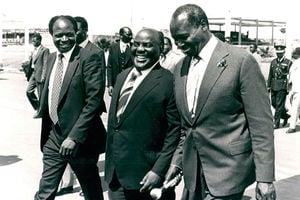
Ugandan President Godfrey Binaisa (centre) is escorted to his plane at Jomo Kenyatta Airport by Kenya’s President Daniel Moi (right) and Vice-President Mwai Kibaki after his visit to Kenya on May 8, 1980.
Photo credit: File | Nation Media Group
Moi replied that there was no way Binaisa could make his own decisions because his security was provided by the Tanzanians. Moi, however, assured Carter that Kenya was doing everything to make sure Binaisa was independent of Nyerere, something he said he told the Ugandan transitional leader the last time they met.
The topic then changed to Nyerere’s support for liberation movements and guerrilla activities in Africa, with Moi expressing his concern that it was the Tanzanian President’s tactic to expand his influence across the continent.
“President Moi expressed his concern for the expansion of Tanzanian influence in Africa, for example, with (Robert) Mugabe in Zimbabwe, in the Comoros and with Mengistu (Haile Mariam) in Ethiopia. He also revealed that Tanzanian soldiers were currently in Uganda, Seychelles and Mozambique,” reads a memorandum of the conversation.
Moi’s advice to Carter was that since many countries were spending too much money acquiring arms instead of economic betterment, the US should consider providing economic assistance to “those countries that don’t invest a disproportionate amount of funds in arms.”
Regarding Kenya’s diplomatic relations with Tanzania, Carter sought to know whether Moi favoured an open border between the two countries. The American President’s question was in reference to Tanzania’s decision to close its borders with Kenya in 1977 following the collapse of the East African Community. In shutting its borders, Dar es Salaam argued that it was retaliating against Kenya for sinking the East African Airways Corporation.
In response, Moi accused Tanzania for closing its borders in 1977, and Kenya only retaliated. However, he believed that his actions had taught Tanzanians a lesson on the danger of closed borders. Carter then asked Moi whether he was willing to open the borders soon—something the Kenyan president didn’t see as a likely possibility, and “even when it is open it won’t be as useful as it was before.”
Establish diplomatic relations
About the US military being based in Kenya, Moi said that he had no problem with that. However, he made it known to Carter that he preferred the word “facilities” being used instead of “bases” in any public references. Carter assured Moi that the US would try to be careful and refer only to “use of fatalities.”
Apart from regional matters, the two leaders also discussed world affairs, with Carter seeking to know Moi’s views on the Soviet Union’s invasion of Afghanistan, as well as the security and political situations in Sudan, Ethiopia, and the Middle East. When Carter asked him whether he had ever visited Iraq, he replied that he was once invited, but was yet to honour the invitation, adding that Kenya had been trying to establish diplomatic relations with Baghdad but the Iraqis were reluctant.
As the meeting came to a close, Moi and his delegation headed to the US State Department where the acting Secretary of State Christopher Warren Minor hosted them for lunch.
Warren would later inform the US president, whose single term ran from January 1977 to 1981: “At my lunch for President Moi, he reiterated the themes he had discussed with you about Nyerere’s misguided socialism, and Tanzania’s design on Uganda, Seychelles, Comoros and Zambia. The Kenyan Attorney General (Charles Njonjo) suggested we use our influence with Binaisa (Uganda’s transitional president) to ease out the Tanzanian presence in Uganda. Moi also repeated his concern about Soviet arms supply to Zambia and his hope that the West could provide more support so (Kenneth) Kaunda would not have to turn to the Soviets.”
Warren also briefed Carter about Moi’s arms request to Harold Brown, the US Undersecretary for Defence.
“Moi gave Harold Brown a shopping list (APCs, artillery, air defence missiles, C-130s, additional F-5 airplanes, and navigational aids). Harold told Moi we were aware of Kenya’s economic problems and would therefore want to consult closely on military priorities,” he wrote.
The climax of the four-day state visit was a State dinner hosted by President Carter and his wife in the East Wing of the White House at 8:10pm. In his speech before proposing a toast, Carter remarked, “The beauty of Kenya is astonishing to those who’ve been there. I stood beside President Moi tonight and had several people come through, who are citizens of our nation and have been to Kenya. And a frequent response to him was, ‘you have the most beautiful country on Earth’. Because I am the host, I didn’t question that analysis.”
In his humour laced speech, Moi said: “Some people complain that maybe God did not give others oil. I always say, each country has its own gifts from God, and therefore, no one should complain. Somebody from my own country asked me ‘Why have we not got oil?’ I told him, ‘We have fresh air; it is a gift of God.’ Others may have oil, but they suffer from the heat of the sun.”