President William Ruto has increasingly tailored his diplomacy to suit shifting global interests, using overseas trips to project Africa as a partner for investment while carefully navigating the demands of a Donald Trump-influenced world order.
The visit last week to Belgium, Norway and Finland was the latest in which the President sharpened his messaging abroad, portraying Kenya as a champion of Pan-Africanism and global partnerships despite political turmoil at home.
Over the past four years, President Ruto has learnt to appeal to varied audiences worldwide, especially since President Donald Trump returned to power in the US last year.
Under Trump, countries and leaders have often faced pressure when the US President takes a hard line on tariffs, visa bonds or migration. So far, Kenya has largely avoided such fallout as it maintains ties with Washington.
Government officials in Nairobi say this is not by chance, but the result of deliberate efforts to sustain relations amid global uncertainty.
“I think President Ruto is clear about the value of each partnership to Kenya,” Foreign Affairs Principal Secretary Korir Sing’oei told The Sunday Nation.
Foreign Affairs Principal Secretary Korir Sing’oei.
Photo credit: File | Nation media Group
“He understands the complexity of the present moment and the need to intensify engagement, while demonstrating leadership in addressing shared challenges.”
At the start of his term, Ruto focused on reforming the African Union, reducing reliance on the US dollar in intra-African trade, climate change, and Africa’s debt crisis. Over time, the dollar critique faded, replaced by emphasis on trade, climate resilience, and reform of global systems such as the United Nations.
Dropping criticism of the dollar appears to have been prudent, especially after Trump warned countries against undermining the US currency.
Dr Sing’oei said the President is navigating a delicate global stage where African countries must strengthen their position.
“He understands the need to better position Africa and Kenya, and seeks opportunities to project a stronger, unified African voice,” he said.
Ruto’s messaging is now largely consistent. In Africa, he focuses on integration and markets; abroad, on debt, trade, investment, and fairness in global systems.
However, his tone often shifts when addressing the US. During his May 2024 state visit under President Joe Biden, he described Kenya and the US as defenders of democracy.
Presidents William Ruto (Kenya) and Joe Biden (US) hold talks at the White House, Washington, DC.
Photo credit: PCS
“My visit provides an opportunity to celebrate 60 years of bilateral relations rooted in shared values of freedom, democracy, the rule of law, equality and inclusivity,” he said at the White House.
“I believe it is time the US, working with Kenya, rallies like-minded countries to advance democracy.”
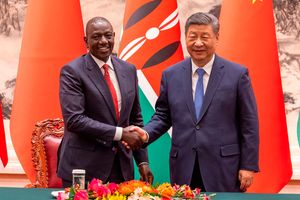
Biden later designated Kenya a Major Non-NATO Ally, a status briefly threatened after US lawmakers criticised Ruto’s April 2025 visit to China, accusing Nairobi of double-dealing.
Dysfunctional global system
In Beijing, Ruto emphasised China’s role in infrastructure development, calling it a partner in addressing a “dysfunctional global system”.
Despite concerns, neither Trump nor his administration has moved to revoke Kenya’s status, and proposals to review it were never debated in Congress.
Ruto’s approach to Trump appears guided by pragmatism: avoid direct criticism, offer praise where appropriate, and align messaging with US priorities.
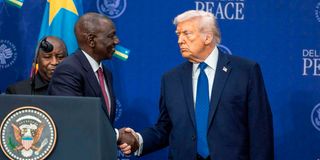
President William Ruto delivers his speech during the historic signing of a peace deal between President Donald Trump, President Félix Tshisekedi of the DRC and President Paul Kagame of Rwanda in Washington DC on December 05, 2025.
Photo credit: Reuters
While on a visit to South Africa last week and facing domestic criticism over a US-funded Ebola facility in Nanyuki, Ruto defended the project by highlighting decades of American support for Kenya’s health system.
“American taxpayers have supported Kenyan health infrastructure for decades. It would be unfortunate if we rejected a facility funded at their cost,” he said alongside President Cyril Ramaphosa.
At a Washington event marking an accord between Rwanda and DR Congo last November, Ruto praised Trump’s “bold leadership”.
“Reaching this point was made possible by the convening power of the United States and President Trump’s commitment to global peace,” he said.
By contrast, during tensions in the Gulf, Ruto avoided directly criticising Israel or the US following strikes on Iran.
“Kenya strongly condemns strikes in the Middle East,” he said, without naming Iran either.
Analysts say this careful balancing reflects an effort to avoid alienating key partners. Some also see continuity with past Kenyan leaders’ pragmatic diplomacy.
Ruto himself has defended his global engagements. In Brussels, he cited efforts to resolve issues around the Economic Partnership Agreement with the European Union and bring other East African Community members on board.
He also highlighted discussions on data adequacy, noting the growing importance of technology and data governance.
In Norway, he pointed to opportunities in the blue economy, estimating potential growth from Sh20 billion to Sh120 billion through better use of Kenya’s coastline.
Observers say such visits are increasingly focused on securing jobs and market access rather than aid.
“I think his policy rhetoric is accurate,” said international affairs expert Dr Calvince Adhere.
“When African leaders engage globally, it is important to position the continent as a destination for investment and partnership, rather than dependence.”
However, critics argue that the messaging does not always match realities at home.
“He has done well projecting Africa positively and calling for reform of exploitative global systems,” said Dr Kizito Sabala of the University of Nairobi.
“But these statements often end with the meetings. The reality on the ground remains very different.”