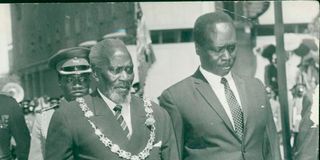
As Kenya’s senior ministers prepared to travel to Washington seeking weapons to defend the country in 1978, an American official proposed a radically different solution: persuade President Jomo Kenyatta to give Northeastern Province to Somalia.
The startling proposal appears in a US State Department memorandum dated February 28, 1978. Its author’s name remains redacted.
The memorandum suggested that in case Kenyatta agreed to the proposal, Kenya would receive economic assistance to soften the loss, and Somalia would get money to develop its newly acquired territory. Before that happened, Washington was to help prepare the ground by encouraging discussion of the proposal in newspapers, academic journals and television coverage.
“Certainly, only Kenyatta has the stature to undertake such a step,” the official wrote.
But the proposal encountered strong opposition within the department. In a subsequent reply, Anthony Lake warned that encouraging Kenya to surrender territory could wreck relations with Nairobi and provoke instability across Africa.
While the two documents reveal an internal American argument over Kenya’s borders, they however do not establish that the proposal became US policy or that it was ever presented to Kenyatta.
What they expose, however, is a remarkable calculation: that Kenya could be persuaded to exchange part of its territory for development assistance, and that Kenyatta’s political authority might make the bargain possible.
The February memorandum was drafted at a sensitive moment when Vice-President Daniel arap Moi, Foreign Minister Munyua Waiyaki, Attorney-General Charles Njonjo and Finance and Planning Minister Mwai Kibaki were expected in Washington from March 1 to 3 to negotiate defence funding.
According to the official, the delegation would probably request additional defensive equipment, possibly including jet aircraft, TOW missiles and artillery, together with American financing.
There was by then fear in Nairobi that Somalia would attempt to seize the Somali-inhabited North Eastern Province. Its response was to strengthen its capacity to defend the territory.
The memorandum calculated that, if Congress approved a proposed $10 million allocation for the 1979 financial year, American financing since 1976 would total $70 million towards 12 F-5 aircraft. This would fulfil a promise previously made by Secretary Henry Kissinger. The official anticipated that Washington’s good relations with Kenya would encourage it to accept Nairobi’s assessment and respond favourably.
The writer seemed to accept that Somali nationalism was the strongest political force in the Horn due to shared language, culture, religion and identity. The answer, according to this reasoning, was to accommodate Somali territorial ambitions. The memorandum thus suggested for the horn stability, America should allow Somali acquisition of both Ethiopia’s Ogaden and Kenya’s Northeastern Province. American effort was then to focus on “convincing Kenyatta of the wisdom of ceding Somali-inhabited territory to Somalia”.
Daniel arap Moi (left) and Charles Mugane Njonjo.
Photo credit: File | Nation
And if Kenyatta accepted the proposal Kenya should receive compensating economic assistance for its remaining, non-Somali areas. The writer questioned the effectiveness of directing assistance into Northeastern to secure the loyalty of its indigenous Somali population.
Somalia, meanwhile, should receive economic assistance for the areas acquired from Kenya. According to this proposal, the move would have several advantages: reduce tension, lower Kenyan defence expenditure, and thus channel more resources to development. It would also lead to improved trust between Washington and Mogadishu.
The writer understood how explosive the suggestion would be. He feared that Kenyans would probably regard territorial surrender as evidence of fear and weakness, unworthy of a proud nation. Again, if the suggestion came from the US, it would be accused of favouring Kenya’s dismemberment.
The best way forward, the memorandum suggested, was to persuade the public that losing territory would improve economic conditions elsewhere in Kenya. Also, before approaching the President, the writer wanted the political atmosphere prepared.
First, officials should assemble material supporting the contention that North Eastern was unlikely ever to make a net positive contribution to Kenya’s economic welfare.
President Daniel Moi and Somalia's Said Barre exchange copies of an MoU on economic and technical cooperation in 1984.
Photo credit: File | Nation Media Group
Next, the idea of ceding territory should be floated in the press and respected academic, foreign-policy and African affairs journals, allowing the argument to circulate among Kenya’s elite. Also, television coverage would draw attention to the province and visiting members of the American legislature could then raise the question, citing published articles as the starting point.
Lake’s reply came on August 2, more than five months later.
“With apologies for the long delay,” he began, before offering a substantive response to what he called the official’s provocative paper.
His objections went to the heart of the proposal. He said that Somali acquisition of the Ogaden and North Eastern stood in sharp contrast to the American and Organisation of African Unity positions on preserving the territorial integrity of existing African states.
There is no recorded response from Kenyatta in either document and there is no suggestion that it was ever shared with Nairobi. Kenyatta died three weeks after Lake’s letter.
What remains is the startling proposal itself: that while Kenya’s ministers sought American help to defend North Eastern, an official inside Washington was suggesting that their President should be persuaded to give it away.