Power in Kenya is a seductive illusion. It glitters, blinds and deceives those who hold it into believing they are untouchable. Yet history has an impeccable memory. It forgets nothing and forgives slowly.
When its wheels begin to turn – creaking, deliberate, relentless – they grind down the monuments that men like John Joseph Kamotho built on the shifting sands of impunity.
In 1991, Kamotho, then a towering figure in President Daniel arap Moi’s inner circle, acquired 25 acres in Thika. He never evicted the family living there, but that did not stop him from selling off portions of it. It was the way of the powerful: possession by decree. In 1994, Kamotho reached for something far grander – part of Karura forest, the green lung of Nairobi.
The land, now valued at Sh4.8 billion, became a symbol of excess. This week, justice finally came calling. The High Court revoked the lease issued to Gigiri Court Ltd, a company tied to Kamotho, and returned the land to the government.
It was a seismic act, a reminder that while justice in Kenya moves with the speed of a funeral procession, it does eventually arrive at the graveside of corruption.
Early this year, the court delivered yet another blow to the Kamotho estate, ordering it out of the parcel in Thika on the grounds of adverse possession. The land, now valued at Sh960 million, slipped from the estate’s grasp like sand through clenched fingers. It was not merely a legal defeat – it was a reckoning.
In just one year, the Kamotho estate has watched property valued at Sh5.7 billion vanish. From the reclaimed expanse of Karura forest to the fertile soils of Thika, the empire that once symbolised unchecked privilege is disintegrating. What was an inheritance built on proximity to power is now a ledger of losses, every court ruling striking off another chapter of ill-gotten gain.
The numbers alone are staggering, but the symbolism runs deep. In financial terms, billions have been wiped away. In moral terms, it is the collapse of a dynasty once propped up by impunity. What took decades of political clout to amass has been undone by the slow and patient hand of justice. The fall of Kamotho’s estate is not just a forfeiture of land – it is the evaporation of a myth, a reminder that time eventually reclaims what power once stole.
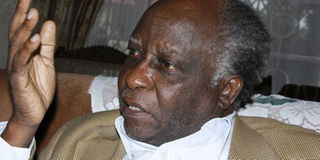
Former Kanu Secretary general and Mathioya MP Joseph Kamotho. PHOTO MARTIN MUKANGU | NATION MEDIA GROUP
Kamotho’s story is a masterclass in the dangers of power. For years, he was a colossus striding across the Kenyan political landscape, Kanu’s secretary-general and Moi’s bulldog, feared for his sharp tongue and ruthless efficiency. He understood power not as service but as weaponry – something to wield, hoard and punish with. He was the man who could make or break careers with a single sentence. But behind the thunder of authority was truth that time would later whisper: power is temporary, and those who dance with it must one day pay the piper.
His rise was meteoric, but his fall was Shakespearean. In 1983, when the Charles Njonjo “traitor” affair gripped the country, Kamotho found himself on the wrong side of Moi’s paranoia. He and GG Kariuki had dared to defend the Kikuyu from accusations by Martin Shikuku, Justus Tipis, Elijah Mwangale and John Keen that some of its leaders were plotting against Moi. When Moi took to a rally in Kisii and declared that “foreign powers” were grooming a traitor – carefully absolving Mwai Kibaki – he set off a purge. Njonjo was named the traitor, and Kamotho was swept out with him.
It was a spectacular tumble. The once-mighty minister became broken, reduced to running a corner shop in Nairobi. Friends vanished. Power, that fickle mistress, had found new suitors. Yet Kamotho’s political instincts, honed in the dark arts of Kanu survival, did not dull. When Moi needed foot soldiers to bring down his critics – including Kenneth Matiba and Julius Gikonyo Kiano – Kamotho was summoned from exile. His loyalty, forged in humiliation, was absolute.
He returned to the corridors of power reborn, a servant with vengeance. When Matiba was rigged out of the Kanu chairmanship in Murang’a in 1988, Kamotho’s hand was visible in the machinations. Matiba resigned from the Cabinet, setting off a political earthquake that would eventually shatter Kanu’s single-party rule. The regime’s contempt for democracy was total in the 1989 Kiharu by-election. Votes were altered and results rewritten. Even the declared “winner”, Kamau Mweru, later confessed that he had lost.
“I had no supporters. We took Matiba’s 24,000 votes and added them to mine,” he said.
That grotesque arithmetic of dictatorship earned Kamotho his Cabinet seat – a reward for obedience and deceit. He soared. In June 1989, Moi’s nine-minute party reshuffle made Kamotho Kanu secretary-general, replacing Moses Mudavadi. With that post came influence and access to parastatal tenders, land, the inner sanctum of Moi’s patronage empire. The line between governance and greed vanished. Public resources were treated as personal spoils and Kamotho, ever loyal, was among the beneficiaries.
The 1990s brought the storm of multi-party politics, and Kamotho met it with aggression. He weaponised fear, normalised the use of hired goons to terrorise rivals and sneered at the democratic tide sweeping across the country. When Ford Asili trounced Kanu in his backyard, Kamotho responded with contempt.
“Even a dog would have been voted on a Ford Asili ticket,” he said.
The arrogance of power had blinded him to the nation’s mood. Beneath the surface, the regime that fed him was cracking. Kanu factions sharpened their knives. After the 1992 elections, the youth-wing machine YK’92, led by Cyrus Jirongo, began challenging Kamotho’s authority. Moi’s house of cards trembled. Kamotho called for YK’92’s disbandment; Moi hesitated, then relented, suspending it only after Jirongo attacked vice-president George Saitoti. It was a glimpse into the chaos of a decaying system devouring itself.
Kamotho held on. He formed the Central Province Development Group with SK Macharia, Chrispus Mutitu, Samuel Gichuru and other tycoons aiming to consolidate his regional base as the 1997 elections loomed. Yet even he could not foresee the betrayal that would was coming. When Raila Odinga’s National Development Party merged with Kanu in 2001, bringing the fiery politician into Moi’s orbit, Kamotho and Saitoti protested. Moi was grooming a new generation – Uhuru Kenyatta and Odinga – and discarding the old guard that had served him faithfully.
The Kasarani Delegates’ Conference of August 24, 2001– “Kasarani I”– sealed Kamotho’s fate. The Rift Valley elite abandoned him and Saitoti, aligning with Moi’s chosen heirs. The empire he had built through loyalty, cunning, and corruption began to crumble. He had outlived his political usefulness. Power had moved on.
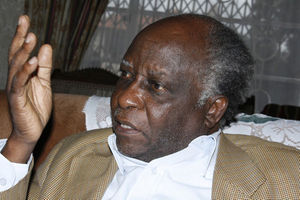
Former Education minister Joseph Kamotho during a past press conference on January 23, 2013. Photo/FILE/SALATON NJAU
When he died years later, Kamotho believed he had secured his place in history – and his fortune in land and business. But the slow, grinding machinery of justice had not forgotten. The Karura forest case was only one piece of the puzzle; many others remained buried in the bureaucratic sediment of the land registries. The courts began to stir. Files were reopened and the judgments were damning.
There is something poetic about the way time avenges the powerless. For decades, ordinary Kenyans watched helplessly as forests were fenced off, rivers diverted and public land sold to men who mistook office for ownership. Yet the same justice they mocked eventually came for them. The High Court’s decision to reclaim Karura was not merely legal, it was moral. It was an act of national memory, a reminder that no one escapes history’s audit.
Kamotho’s empire is a cautionary tale. It teaches that power, no matter how formidable, is finite; that wealth built on injustice is brittle; and that the machinery of justice, though painfully slow, moves forward with the inevitability of sunrise. His story is not unique – many have followed the same script of arrogance and downfall – but his life encapsulates the larger tragedy of Kenyan politics: the confusion of leadership with ownership, of public service with enrichment.
In the end, Kamotho’s journey from the heights of government to the footnotes of scandal is a parable of Kenya’s soul. He once strutted as the embodiment of authority; now he stands as a symbol of its decay. The forests he coveted have outlived him. The offices he once dominated have new occupants. The land he thought was his legacy has been reclaimed by the very state he once served and manipulated.
The lesson is clear: power is temporary, justice is patient and history never forgets. The wheels may turn slowly, but when they do, they crush the arrogance of the mighty and restore, however belatedly, the dignity of the nation.
John Kamau is a PhD Candidate in History, University of Toronto, Canada. Email: [email protected]