For only the second time in many years, I drove back to Magadi to see what progress more than a decade might have brought.
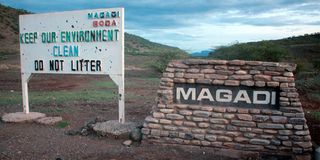
The drop-arm barrier was still there, guarded and manned. To enter Magadi, one must be allowed in and registered. It remains, perhaps, Kenya’s only town with a gate.
But Magadi is not really a town. I realised the former shopping centre is no more. Today, it is an extraction camp disguised as a town: workers’ houses, a hospital to keep them alive, a church and mosque to tend to their souls, a police station to maintain order, a court to administer the law, and a railway to carry away the soda ash. Parts of Magadi Road remain hopelessly potholed.
What surprises me is that after more than a century of mining, there is still no significant industry around Magadi. No glass-manufacturing complex. No large detergent factory. No fertiliser plant. No chemical-processing city.
The trona is extracted, processed only to a limited degree and exported. The greater value is created elsewhere. Like many colonial enterprises, Magadi was never designed to develop. It was designed to extract.
What struck me most as I drove towards the lake was the poverty. In settlements surrounding Magadi, residents had lined up plastic drums beside the road, waiting for water from government bowsers.
Why, after more than a century of mining a mineral worth billions of shillings, do communities around Lake Magadi still lack piped water? Why must they wait for government vehicles to deliver the most basic requirement for survival?
That contradiction is familiar across Africa. Ghana has gold but exports it largely in raw form. Zambia exports copper but manufactures little electrical equipment. Guinea sends out bauxite and buys back aluminium products. Nigeria exports crude oil but has spent decades importing refined petroleum. The Democratic Republic of Congo supplies cobalt for the world’s electric vehicles while its communities remain among the poorest on earth.
The heat reminded me of the words of Blayney Percival, the colonial big-game hunter who passed through the area at the beginning of the 20th century. “If I owned an estate in hell and an estate in Magadi, I would prefer hell,” he wrote in his diary.
Percival later helped organise former US President Theodore Roosevelt’s East African hunting safari. In African Game Trails, Roosevelt described him as “a tall, sinewy man” and “a fine rider”.
But when Europeans discovered the commercial value of its trona, a land dismissed as an African hell suddenly became a valuable imperial possession. Not because the colonial government wanted to establish a flourishing town, but because the lake contained a mineral needed by British factories.
Olorgasailie prehistoric site in Magadi, Kajiado County.
Photo credit: File | Nation Media Group
The mine required workers. Workers needed houses, medical care, water and places of worship. The extraction enclave also required a police station and a court. The colonial state and the company therefore provided only the institutions needed to sustain production.
More than a century later, we still have not built an industrial economy around the mineral. That is why Magadi has a hospital but no university, workers’ quarters but no significant commercial district, a church and mosque but no manufacturing belt, a police station and court but no major industrial training college.
It has a railway, but it points away from Magadi. Built to carry soda ash through Konza to Mombasa, it was an extraction corridor: mineral out, finished products back in.
More than six decades after independence, that colonial arrangement survives.
During my earlier visit, Magadi was both a company and a town. The boundary between the corporation, the former Ol Kejuado County Council, local politicians and community leaders was difficult to identify.
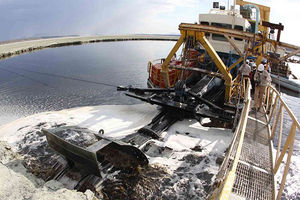
A dredging machine harvests soda ash at Tata Chemicals Magadi in Kajiado County.
Photo credit: File | Nation Media Group
The company employed doctors, nurses and even a mortuary attendant. It maintained a 55-bed hospital where treatment was free, including when government hospitals practised cost-sharing. It built dormitories for outpatients who had travelled long distances and provided them with food.
The company also supplied water and cooking gas, partly to discourage tree-cutting. Along the railway to Konza, it constructed water tanks for people and livestock. Bowsers served villages not connected to its water system.
Officials called this corporate social responsibility. But it could also be read as evidence of the absence of the Kenyan state.
When a company provides your house, hospital, water, cooking fuel and perhaps your final resting place, it is no longer merely an investor. It has become a government. Its generosity gives it economic influence, social authority and political power.
That is how extraction has worked across Africa. The corporation builds a clinic, drills a borehole and sponsors a school. These are presented as gifts to communities whose land has produced fortunes.
As Walter Rodney argued in “How Europe Underdeveloped Africa”, Africa’s poverty was not separate from Europe’s development. One helped produce the other. Colonial railways, ports and company towns were not intended to integrate African economies. They connected mines and plantations to the sea.
Tata Chemicals Company Magadi factory on June 14, 2025.
Photo credit: Stanley Ngotho | Nation Media Group
Its story began during the colonial seizure of Maasai land. Two Rhodesian prospectors, Thomas Deacon and John Walsh, recognised the industrial potential of the soda deposits. The East Africa Syndicate received what was supposedly a prospecting licence. Somehow, prospecting became a claim over thousands of acres.
This happened as the colonial government dispossessed the Maasai through the controversial agreements of 1904 and 1911. The 1904 agreement pushed them away from the railway and land earmarked for European settlement. They lost millions of acres and were confined to reserves.
The agreement claimed Maasai chiefs and laibons had decided “of our own free will” to surrender the land. But there is little freedom in an agreement negotiated between a conquering colonial power and a community facing military and administrative coercion.
Then came the lease of April 12, 1911. It purported to grant “full and uninterrupted right” to “dig, get, win and carry away” all soda and other minerals within the concession.
Read those words again: uninterrupted rights. They were written by a colonial regime that neither represented Africans nor had a democratic mandate, yet those rights outlived the empire that created them.
How can an independent African country continue to live under a colonial promise of “uninterrupted rights”? Uninterrupted by whom—the Maasai whose land was taken? The county government seeking rates? The independent state? The Constitution?
What, then, did independence interrupt?
The concessions eventually covered more than 224,000 acres. One embraced Lake Magadi, while another extended towards the Kenyan side of Lake Natron.
When large-scale mining began, mining towns elsewhere became centres of industrialisation. They attracted engineering firms, workshops, banks, technical schools, processing plants and administrative institutions. Magadi did not.
It remained a company settlement because the colonial government wanted soda ash, not an industrialised Kajiado. Independence should have changed that. Instead, successive governments celebrated mineral production and export earnings without demanding local value addition.
A lease granted in the 1920s was due to expire in 2023. But in 2004, President Mwai Kibaki’s government extended it by another 50 years, to 2053. Maasai leaders protested that they had not been adequately consulted. The explanation was that the company required a longer lease to obtain financing and restructure its operations.
Again, the question was not whether Magadi would become an industrial city. It was how to preserve extraction.
In 2005, India’s Tata Chemicals acquired control of Brunner Mond, the multinational group that owned the Magadi operation. Ownership shifted from British to Indian capital, but the economic arrangement remained remarkably similar.
This is the uncomfortable Pan-African irony. Political power moved from London to Nairobi, corporate ownership later shifted towards Mumbai, yet Magadi remained where colonialism had left it: at the bottom of the value chain.
Kajiado County is now demanding about Sh17.4 billion in disputed land rates and royalties. In October 2025, the Court of Appeal quashed the demand, finding that the county’s levies conflicted with the Mining Act and constitutional provisions governing public land and revenue collection. It also noted that the colonial and subsequent leases reserved payments to the national government rather than the county.
Kajiado took the dispute to the Supreme Court. On June 19, 2026, the court granted it more time to lodge an appeal, finding that the case raised weighty questions about county taxation, public finance and Article 209 of the Constitution. The merits remain unresolved.
The courts must determine whether the Sh17.4 billion demand is lawful. Beyond that legal argument lies a larger moral and historical question: can a sovereign republic continue administering colonial extraction agreements as though independence never happened?
A century of soda ash should have created a city, not an extraction settlement. A century of mineral wealth should have given every household clean water. Instead, it produced bowsers and plastic drums. Magadi possesses almost every institution required to manage an extraction colony. What it lacks is the industry needed to liberate it from one.
As I left, the drop-arm barrier rose and descended behind me. It seemed an appropriate symbol: wealth enclosed within, poverty abandoned outside.
Magadi is more than a Kenyan mining town. It is a monument to Africa’s unfinished liberation—a place where the mineral has travelled the world, but the people living above it have hardly moved.
John Kamau is a PhD student in History, University of Toronto. Email: [email protected] . On X: @johnkamau1