There was a time when Kenyans cared mainly about what happened in their villages. Cut off from events and drama unfolding beyond their hamlets, Kenyans were largely untouched by the acrid smell of petrol and diesel. They cooked over firewood and walked to markets, with only the wealthy owning bicycles.
Today, a war thousands of miles away in the Middle East, pitting the US and Israel against Iran, has unsettled Kenya as fuel prices rise, disrupting the movement of people and goods, farming, cooking and production of essential foodstuff.
As Kenyan society has changed, with more people moving to towns, the demands of mechanisation and mass production have drawn the country deeper into the global economy, enabling it to source more cheaply the inputs and supplies needed to sustain urbanisation.
One of these inputs is refined petroleum products. Kenya’s demand for petrol, diesel and kerosene has increased over the years. As the urban population has grown, more households have acquired cars, and more goods have had to be transported.
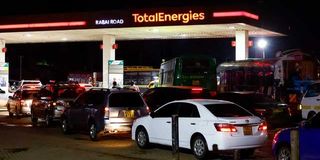
Since the US and Israel attacked Iran, triggering an energy crisis worsened by disruption to shipping through the Strait of Hormuz, retail prices of petroleum products in Kenya have skyrocketed.
A pump attendant serves a customer at a petrol station in Nairobi.
Photo credit: File | Nation Media Group
Diesel, which powers much of the economy through its use in farming, transport and manufacturing, increased by Sh9.90 per litre to retail at Sh227.76.
As the pain at the pump intensifies, those in leadership, particularly politicians keen to retain their seats next year, are becoming increasingly jittery.
The dynamics of the war, says Scholastica Odhiambo, an economics lecturer at Maseno University, mean that when Iran is attacked by Israel or the US, it retaliates against American allies, some of which are oil producers. US allies in the Gulf that have borne the brunt of Iranian attacks include Saudi Arabia, the UAE, Qatar, Bahrain and Kuwait.
“The supply chain is being affected in a complicated manner,” Dr Odhiambo says.
Kenya imports nearly all its petroleum products through arrangements with Gulf suppliers, including Saudi Aramco Trading Fujairah, Abu Dhabi’s ADNOC Global Trading Ltd and Emirates National Oil Company Singapore Ltd. Most of these suppliers are based in Saudi Arabia or the UAE.
Under the fuel subsidy arrangement , oil dealers retain the pump prices announced by Epra. The government then pays them the additional cost, using money drawn from the Petroleum Development Levy Fund.
Prof XN Iraki, a lecturer at the University of Nairobi, says Kenya is deeply connected to the global economy through trade and financial services.
“The wars in Ukraine and Iran have raised the prices of fuel and wheat. That has affected our pockets and jobs,” Prof Iraki says.
State officials have been burning the midnight oil in a bid to prevent what is essentially an economic crisis from snowballing into a political crisis. Emergency meetings involving the National Treasury, the Ministry of Energy, the Central Bank of Kenya, the Ministry of Foreign Affairs and the Ministry of Trade have been held as the war sends shockwaves through an economy that relies heavily on the Gulf for fuel imports and petroleum-derived products such as chemical fertiliser.
President William Ruto has moved to calm consumers, saying many countries have run short of petroleum products because of the war in the Middle East.
“There is war in the Middle East and the price of fuel is high everywhere, but in Kenya, tumepanga vizuri kuhakikisha kuwa ile bei ambayo ingeruka juu sana, tumeifanyia moderation (We have planned carefully to ensure the price, which would otherwise have risen sharply, is managed),” he said, referring to the fuel subsidy.
The President insists the country has enough fuel supplies, adding that Kenya is working with regional and external partners to ensure constant supplies so that the war in the Middle East does not negatively affect the economy.
“We have enough supplies and the government will not entertain artificial shortages caused by profiteers. Oil marketers must continue working within the confines of their licences,” President Ruto said.
In the recent fuel-pricing cycle, however, the government appears to have run out of room to sustain the subsidy, which cushions motorists from higher pump prices. With the subsidy unavailable, consumers have been exposed to the full impact of rising input costs.
Global wars affecting the Kenyan economy have increased, with the country barely emerging from one external crisis before being hit by another. Before the Iran war, Kenya was still coming to terms with Russia’s invasion of Ukraine, which pushed up the prices of wheat and fertiliser. Fuel took an indirect hit as a result of the Ukranian war.
The war in Ukraine – which, like the conflict involving Iran, unfolded ahead of an election – also fed into Kenya’s political narrative, with the administration of then-President Uhuru Kenyatta put under pressure to explain an energy crisis caused by a war being fought thousands of kilometres away.
During Labour Day celebrations at Uhuru Gardens on May 1, 2022, Mr Kenyatta linked the high cost of living to Russia’s invasion of Ukraine in February of that year.
“There is this war we don’t even understand that has caused fuel and food prices to go up in other countries and brought us other challenges… I, Uhuru Kenyatta, surely, am I in Ukraine? Was I in Wuhan (China) when Covid-19 came?” he asked.
Following Russia’s attack on Ukraine, the price of imported wheat rose by 25 per cent, putting pressure on the cost of bread and other wheat products.
The war in Ukraine also triggered shocks in international oil markets when the United States and other Western countries imposed sanctions on Russian oil, raising fears of a supply shortfall from one of the world’s largest crude exporters.
Brent crude, the international benchmark, briefly surged to $139 per barrel in March 2022, its highest level in nearly 14 years at the time, as Western countries weighed restrictions on Russian energy exports.
Like today, the rally threatened to overwhelm Kenya’s fuel subsidy programme, which had kept pump prices stable for four consecutive months despite rising import and shipping costs.
The pressure soon filtered into the domestic market. In March 2022, the government partially withdrew the fuel subsidy, prompting the energy regulator to raise petrol and diesel prices by Sh5 per litre. Petrol rose to Sh134.72 in Nairobi, while diesel increased to Sh115.60, both record highs at the time.
Without the subsidy, petrol would have risen to Sh155.11 per litre, illustrating the extent to which public funds were cushioning consumers from the global price shock.
The increases continued in subsequent months. In June of that year, Epra raised pump prices by Sh9 per litre, taking super petrol to Sh159.12 and diesel to Sh140 in Nairobi.
The regulator attributed the increases partly to higher international crude prices and a weak shilling, which made imported petroleum expensive.
Though Kenya did not depend directly on oil from Russia, it was exposed to the global supply shock as buyers sought alternative sources and competition for available supplies intensified.
The effects extended beyond motorists. Higher diesel prices raised the cost of transporting goods, running machinery and manufacturing products, while expensive fuel added to inflationary pressure on households already facing rising food prices.
The episode demonstrated how a war thousands of kilometres away could quickly translate into higher costs for local businesses and consumers.
With the General Election fast approaching and the full impact of the US-Israel war on Iran still unfolding, government bureaucrats are expected to step up efforts to prevent the energy crisis from turning into a political catastrophe.
“The government needs to dig deeper into its pockets to cushion consumers against high oil prices,” Dr Odhiambo said.