For the families of Kenyan men recruited to Russia, the war did not end when their sons and husbands disappeared from the battlefield. It followed them home, leaving them to search for missing relatives, mourn men whose bodies they cannot bring home and fight for money they were promised but have yet to receive.
Their relatives left Kenya expecting jobs and better pay. Instead, some were drawn into Russia's war against Ukraine. Some have been killed while others remain missing, and for the families of those confirmed dead, even the final act of bringing a loved one home has become a struggle.
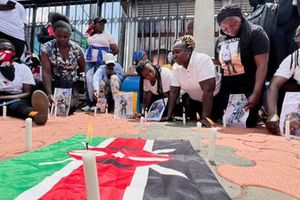
In some cases, relatives have been forced to hold symbolic burials for men whose bodies remain thousands of kilometres away.
Now, alongside the grief, families are confronting another question: what happens to the salaries, signing bonuses and compensation promised to men who died fighting a war they never expected to join?
“I have not heard of any case where Russia has compensated the families of Kenyans who died or went missing after being recruited to fight in the war,” said Muhammad Khalid of Voice of Africa.
For families whose sons and husbands were recruited to fight for Russia in the war against Ukraine, that question is no longer philosophical. It is a question of money, promises and, increasingly, silence.
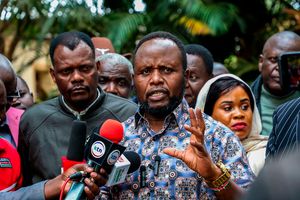
Vocal Africa Executive Director Hussein Khalid (Centre) flanked by families of Kenyans caught in the Russia-Ukraine war recruitment web address the media in Nairobi on January 27, 2026.
Photo credit: Lucy Wanjiru | Nation Media Group
Kenyans were lured into Russia with promises of lucrative salaries, signing bonuses and, in the event of death, compensation running into millions of shillings.
But as families wait for payments promised to them, a crucial question remains unanswered: how much is Russia actually paying for the life of a Kenyan killed in its war?
Some Kenyans were reportedly offered millions of shillings to enlist, while families of those killed have subsequently been approached by intermediaries claiming they could help secure compensation running into millions more.
Yet the families are struggling to establish what compensation they are legally entitled to, who is responsible for paying it and, most importantly, when the money will reach them.
“I went to Russia to work as a driver, but things changed. When we were recruited, we were told we would be paid $10,000 upon signing the contract. We were then told that 800,000 roubles had been deposited into our accounts, followed by another 200,000 roubles and a further 200,000 roubles. We were ordered to withdraw the money, but when we went to the bank, there was nothing there. We were told the sanctions were affecting the movement of money. They also told us that if anything happened to us, our families would be compensated,” said Mr Martin Wanyonyi* who was rescued and returned to Kenya.
The uncertainty has created a second market around the deaths of Kenyans, one in which grieving families are being approached with promises of huge payouts while the official compensation process remains opaque.
The State Department for Diaspora Affairs says 289 Kenyans have been recruited, with 64 having returned home and 69 either confirmed dead or missing in action. About 153 remain unaccounted for, either because they are in military camps, on the frontline, or their whereabouts are unknown.
The gap between the two figures leaves hundreds of Kenyans in an information limbo and raises questions over how many families are still waiting for news about relatives who travelled to Russia and never came home.
For Josephine Ngoya, the uncertainty surrounding her son began with a journey she believed was about work.
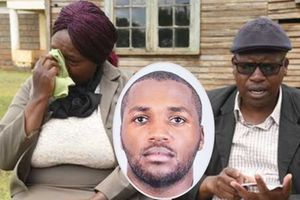
Erastus Mundia (also inset), who died in the Russia-Ukraine war.
Photo credit: Pool
“I only knew he was travelling for work. He had worked as a salesman before and had even travelled to America, so I thought this was another ordinary job. He kept telling me, ‘Mother, I only need your prayers.’ I asked him what was happening, but he wouldn’t explain,” Ms Ngoya told the Daily Nation .
It was during a WhatsApp call that she discovered he was in Russia. At first, he reassured her that he was safe. Then his messages changed.
About a month after arriving, Mundia sent his mother Sh10,000 and told her that it was not safe.
“Then I saw his picture with his military uniform, and I was scared. He was my firstborn, the breadwinner. What should I do? I am stressed,” she said.
The calls eventually stopped. For months, Ms Ngoya did not know whether her son was alive, injured or missing. The government eventually confirmed his death.
“The government is looking into the matter, and already the State Department for Diaspora Affairs is in communication with our embassy in Moscow to establish the circumstances surrounding Mr Mundia's demise,” said Jacob Ng'etich, Director of Press in the Office of the Prime Cabinet Secretary.
“I am praying to the government to help me. He has left me with two children, and I have nothing. Please help me. I have no means. To our President, I ask: please help. I don’t know how my husband’s body can come home. I have tried since last year to find a way,” said Grace Gathoni, a wife to Martin Macharia Mburu , a young man from Ruaka, Kiambu, who became the first officially confirmed Kenyan fatality.
Grace Gathoni displays a photo of her husband Martin Macharia (left in military uniform) during a press briefing in Nairobi on January 27, 2026.
Photo credit: Lucy Wanjiru | Nation Media Group
“My children keep asking where their father is. They don’t know if he has passed away. I am in pain. The government advertised these jobs abroad, which is why we are here. Help us. Help bring my husband’s body back,” she added.
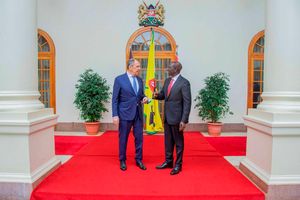
The uncertainty persists despite Kenya's attempt to stop further recruitment. In March, Mr Mudavadi travelled to Moscow for talks with Russian Foreign Minister Sergei Lavrov.
Russian Foreign Minister Sergei Lavrov shakes hands with Kenyan Foreign Minister Musalia Mudavadi during a press conference following their talks in Moscow, Russia, March 16, 2026.
Photo credit: Reuters
“They will no longer be eligible to be enlisted,” Mr Mudavadi said.
But the agreement did not immediately provide an exit route for those already serving. Mr Lavrov said foreigners with active military contracts would have to serve according to their terms.
Mr Mudavadi later acknowledged that bringing Kenyans already deployed to the battlefield home would take time.
“The process of getting them back is not instant. They are involved in the battlefield, and to extract them from there is not just going to a place and plucking them out and putting them on a plane,” he said.
The accounts of Kenyan families are echoed by concerns raised by Ukraine, which says the recruitment of foreign nationals has become a significant part of Russia's war effort.
Ukraine's Ambassador to Kenya Yurii Tokar said some of the Kenyan prisoners of war had described being recruited through promises of civilian employment or other opportunities before ultimately being sent to fight.
He said Ukraine currently holds five Kenyan prisoners of war, while Ukrainian authorities have identified more than 28,000 foreign nationals who signed contracts with the Russian armed forces.
“Their individual circumstances differ, but some have described recruitment involving promises of civilian employment or other opportunities before ultimately being used as expendable manpower in Russia's war,” Mr Tokar said.