Raila Odinga has been Kenya's quintessential opposition leader since 2005, when he created the Orange Democratic Movement (ODM) party. The iconic opposition leader had honed his political skills from a young age at the feet of his father and opposition doyen, Jaramogi Oginga Odinga. For three decades, Raila straddled the Kenyan political landscape like a colossus, shaping the country's democratic culture and evolution.
Over those decades, he made five unsuccessful stabs at the presidency, each time creating indelible jurisprudential and democratic milestones in the country's electoral architecture. The jury is still out there as to the extent of the political and economic impact of the enigma's absence from the impending 2027 general elections. Nonetheless, this article attempts to bring out some of the pertinent political and economic factors that are likely to be at play during and immediately after the elections.
As ODM's perennial unifier, Raila's absence risks the party's disintegration due to the raging internal power struggles between the Oburu Oginga/Gladys Wanga-led pro- Broad Based Government axis, and the Edwin Sifuna/Babu Owino group of young turks. The internal strife is likely to weaken ODM's voice in national and county assemblies as the party's nationwide fortunes begin to dwindle. While some pundits see a fragmented ODM as an advantage for President William Ruto , others believe it poses a challenge to his re-election as it removes a predictable opponent and guarantor of political stability. As a person who controlled roughly 50 percent of the electorate, Raila had managed to establish himself as a checkmate to the presidency, and a regulating force in Kenya's politics. The power vacuum created by his absence is prompting new political realignments in the country's political landscape.
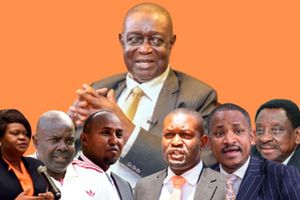
Already, UDA adherents have publicly rejected the proposed electoral zoning, arguing that the field should be opened up for everyone, irrespective of party affiliations, to vie for electoral seats of their choice. According to this school of thought, such an arrangement would ensure that President Ruto's votes are protected due to minimal disenchantment expected among ODM and UDA candidates. It is not lost on observers that the United Opposition, led by Kalonzo, Gachagua and Matiang'i are equally jostling to fill Raila's shoes.
Kenyans are waiting with bated breath to see who this team will ultimately coalesce around, and how the choice will change the trajectory of politics before and after the 2027 elections. Some analysts suggest that the post-Raila era is likely to be defined by a transition from personality-centred politics to one that is more focused on governance, economic issues and accountability.
This will test the mettle of the new opposition "honchos" in a manner that strengthens the social contract between Kenyans and the next generation of leaders. Besides, Raila's traditional strongholds, especially Nyanza, Coast and parts of Western regions may undergo political reconfiguration as voter loyalties become more fluid without his unifying appeal. Politicians whose careers were hinged on the Raila brand may face a brutal awakening from newcomers, and may struggle to survive in the unfolding dispensation. In the absence of a towering figure of the stature of Raila, the opposition field is likely to be crowded as none of the senior figures will feel compelled to step down in favour of colleagues in the presidential race. The participation of several candidates will significantly alter voter behaviour, strategic posturing by political parties and the overall health of the democratic process.
The intensified issuance of identity cards in the far-flung areas that were traditionally under-served, the expected increase in the number of candidates from 16,098 recorded in 2022 to over 20,000, and accommodation of diverse ideological preferences of the electorate are likely to boost voter turnout. Research shows that having an adequate number of relevant candidates can decrease the share of blank or null (spoiled) ballots, as voters are more likely to find a candidate they genuinely support.
The opposition should, however, be careful not to burden voters with a "choice overload" which could lead to poor voter turnout due to fear of making the wrong choice. Likewise, in a winner-take-all system like Kenya's, independent candidates could emerge to act as spoilers, making it difficult for any candidate to achieve an absolute majority (50%+1) in the first round, triggering a second round of voting.
In such a situation, the campaign period will be extended, piling up additional costs to be underwritten by taxpayers. The positive side of a run-off is that it ensures the eventual winner has the support of the majority of the voting population, thus enhancing the legitimacy of the government. Before his demise, Raila led the ODM party into a coalition with the ruling UDA, an arrangement that is likely to outlive the 2027 elections. Although some people have expressed reservations about this coalition, its supporters argue that the arrangement makes the government more inclusive and less able to unilaterally violate human rights. This is because the government must accommodate the views of diverse coalition partners. The post-Raila opposition field is likely to expand and lead to more valuable and diverse policy debates as different candidates bring their unique perspectives.
The new political reconfiguration will have palpable economic ramifications, more particularly in the fiscal realm. It is already forecast that more than 20,000 individuals will present their candidatures for the six electoral levels: president; governor; senator; member of the national assembly, woman representative, and member of the county assembly. The presidency will be particularly very competitive given the determination of the Mount Kenya region to punish President William Ruto for sacking their son, former Deputy President, Rigathi Gachagua. The region is famed for its huge financial muscle, which will definitely give President Ruto a run for his money. The impending 2027 elections are likely to have a striking similarity with the ones of 1992 that marked a return to multiparty democracy after three decades of Kanu's political monolithicism.
In that election, seven presidential candidates competed against the incumbent Daniel arap Moi, namely: Kenneth Matiba, Mwai Kibaki, Oginga Odinga, Chibule wa Tsuma, George Anyona, John Harun Mwau, and Mukaru Ng'ang'a. The government printed huge amounts of money to rebut the opposition onslaught, increasing cash in circulation by about 20.2 percent. This resulted in inflationary spikes that topped at 57.6 percent in July 1993. It is estimated that the economy lost up to Ksh 248 billion out of a GDP of Ksh 12,788 billion, due to instability and inflation. The real GDP dipped from.4.3 percent in 1990 to -1.0 in 1993. The interest rates on the bench-mark treasury bills hit a high of 84.7 percent in 1993, marking the highest ever recorded in Kenya. This rate is the standard reference point for pricing other financial instruments, and evaluating performance of the debt market.
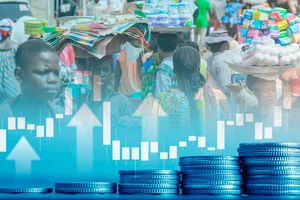
The absence of Raila from the ballot is likely to attract upto five opposition presidential candidates, making the presidency intensely competitive, and creating the risk of new cash being injected into the economy. Pundits are forecasting that this additional cash will be about Ksh 300 billion, raising inflation rate to above 10 percent, and Central Bank Rate to the fringes of 20 percent from the current 8.75 percent.
Efficient credit management
The commercial bank lending rate is likely to top 30 percent from the current 14.81 percent to 14.82 percent. In the circumstances, commercial banks will find it prudent to invest in government instruments rather than lend money to the private sector, and run the risk of high loan default rates. The banking sector will be crowded out, hampering its capacity to engage in creating money through efficient credit management.
Consequently, private enterprise development will be stunted, resulting in low GDP growth, missed revenue targets and widening of fiscal gap. With high inflation, the value of the Kenya Shilling will be battered, occasioning burgeoning of external debt obligations, and putting fiscal consolidation in disarray. The World Bank forecasts that Kenya's GDP maintain a growth trajectory of about 4.9 percent per annum to reach approximately $144.68 billion (Ksh 18.7 trillion) by end of 2027. Going by historial data on highly competitive presidential polls, the economy is likely to lose upto Ksh 400 billion in GDP value due to inflationary spikes and politically-induced economic instability. The impact of Raila's absence from the 2027 general elections is therefore expected to be huge, and unless it is skillfully managed, could have far-reaching political and economic ramifications. The government should therefore contain the temptation to inject more cash into the economy during the electioneering period. That way, the economy will largely maintain its stability, safeguarding the fiscal consolidation gains.
Professor Ongore is a Public Finance and Corporate Governance Scholar based at the Technical University of Kenya.