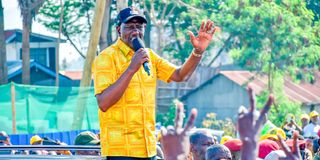
President William Ruto’s working tour of Luoland from September 13 to 17 carried immense economic and political significance.
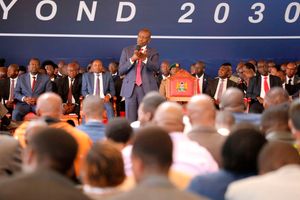
He started the visit with a leaders’ consultation meeting at Kisumu shipyard, before setting off for a tour of Siaya, Migori and Homa Bay.
Pundits have dubbed this tour as the most explicit charm offensive since President Ruto started his political rapprochement with former Prime Minister and Orange Democratic Movement (ODM) leader Raila Odinga, who died in October last year.
It is not lost on observers that the political landscape of Luoland has been stirred lately following the decision by Siaya Governor James Orengo – one of the region’s political luminaries – to bolt out of the “broad-based” government arrangement.
Mr Orengo’s move was viewed as potentially catastrophic, especially if allowed to snowball into an opposition movement against President Ruto’s re-election.
The President needs to consolidate and inherit the bulk of Odinga’s vote basket in Nyanza ahead of the 2027 General Election.
His tour of Nyanza was, therefore, planned not only to showcase the administration’s development projects, but also to neutralise opposition strategies in a region he considers to be critical to his re-election.
A trek back on Kenya’s political memory lane should suffice to explain President Ruto’s exuberance regarding his role in the post-Odinga Luo political dispensation. History registers that Kikuyu, Kalenjin and Luo Nations have had the greatest influence on Kenya’s presidential politics since independence.
In 1963, the combined Kikuyu/Luo voting bloc delivered the presidency to Jomo Kenyatta. When the founding president died in 1978, Daniel arap Moi took over the presidency as well as guardianship of the Kikuyu Nation until Uhuru Kenyatta emerged as the region’s undisputed leader.
It is noteworthy that though Mwai Kibaki succeeded Moi as president in 2002, he was a reluctant leader of the Kikuyu Nation.
When Moi finally retired from politics in 2002, the Kalenjin took temporary refuge under the wings of Odinga until such a time that Ruto was ready to take up the reigns of leadership.
Odinga’s close associates have intimated that the doyen of opposition politics had a premonition of his death, and adequately prepared for it by handing over the Luo community to Ruto for “temporary refuge.”
A leader of the Luo will emerge in the fullness of time. Those in the know opine that Governor Orengo’s recalcitrant defiance against President Ruto’s leadership could be explained against the foregoing background.
Being cognizant of the Siaya governor’s contradictory profile as an astute politician with threadbare socio-economic impact, the President couched his visit to Nyanza as an intervention against past discrimination of the region, hitting Orengo below the belt.
The President’s message resonated with the masses beyond everyone’s imagination. Luoland has, indeed, suffered economic neglect for decades.
At independence in 1963, it was one of Kenya’s economically vital and human capital-rich regions. It possessed an exceptionally literate population, producing the country’s early elite bureaucrats, trade unionists, doctors, professors, lawyers and engineers, who formed the backbone of the country’s civil service.
Logistically, the region hosted Kisumu, the historic terminus of the Uganda Railway, positioning Nyanza as a hub for regional commerce, connecting the East African countries through Lake Victoria.
The economy of Nyanza was driven mainly by fisheries and blue economy, agriculture and livestock and maritime trade and transport. Nyanza contributed up to 15 per cent of the economic production of Kenya in 1963. The comparative proportion for 2026 is a paltry six to 6.4 per cent.
For decades following independence, investments by successive governments into Lake Victoria and the wider Nyanza region were largely stagnant, primarily due to political fallouts between the central government and local leaders.
During this time, Kisumu port lost its vibrancy as maritime trade routes collapsed. The lake also suffered severe environmental degradation resulting from pollution and invasion of the water hyacinth.
To reverse this overt neglect, President Ruto’s administration has heavily expanded funding in the region, unveiling a massive long-term development agenda – valued at Sh600 billion and Sh700 billion – distributed across Siaya, Kisumu, Homa Bay and Migori counties.
So far, approximately Sh173.8 billion has been expended on development projects in the region.
These projects include construction of fish landing bays, improving beach management and establishing 10 cold storage facilities along the Lake Victoria economic corridor.
To reaffirm the administration’s determination to revitalise the economy of Nyanza, plans are under way to extend the standard gauge railway Phase 2B from Naivasha through Kisumu to Malaba, alongside multibillion-shilling road networks – including Mau/Rironi – and bridge construction, to link Kisumu and the hinterland.
Multibillion-shilling projects
Moreover, the government is building affordable houses and modern markets throughout the region to ease pressure on urban dwellings and formalise local commerce, respectively.
As the President directly commissioned, launched and inspected multibillion-shilling projects, locals went into ululations, signifying hope and rebirth of a region that was long forgotten by past administrations.
The message was loud and clear: a new dawn of truce has emerged in a region that was historically anchored in political opposition.
Economically, the President’s visit positioned the region as an active participant in national development, and not an isolated political zone.
This message, more than anything else, projects President Ruto as a partner to be embraced, and effectively ameliorates any suspicions that may have arisen from the 2022 political contestations.
President Ruto did well by staying above the sibling squabbles between ODM and the United Democratic Alliance, instead vouching for fair nominations.
My crystal ball tells me the gods have conspired to make William Ruto the frontrunner to inherit the bulk of Odinga’s Nyanza votes in the 2027 presidential race.
Prof Ongore is a Public Finance and Corporate Governance Scholar based at the Technical University of Kenya. [email protected]