In a world dominated by political rhetoric and self-serving agendas, Raila Odinga emerged as a beacon of hope, embodying selflessness and commitment to the common good.
Known for grassroots mobilisation and commitment to ordinary people, the former Prime Minister – who died in October last year – was not just a politician but a man of the people.
Kenyans remember him as a leader who championed the causes of the marginalised and pursued solutions to their problems with zeal.
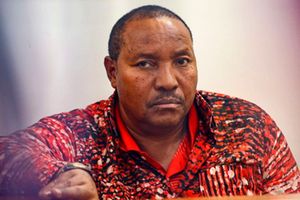
Peter R Makori, former detainee
The former Standard correspondent in Kisii, Peter Makori – now living in the United States – says Odinga used his international connections to defend for journalists and activists facing persecution.
“I met Raila Odinga at his Spectre International offices in May 1994, shortly after my release from Nakuru prison, where my three colleagues and I had been remanded for 15 days. We had denied engaging in subversive activities. I had met him during the by-election in Bonchari in 1993. He gave me a lift in his car from Suneka to Riana for a Ford Kenya rally.
When I arrived at Odinga’s plant on Mombasa Road, he received me. With laughter, he ushered me into his office and said: ‘Welcome back to civilisation. I know you’ve seen a lot’.
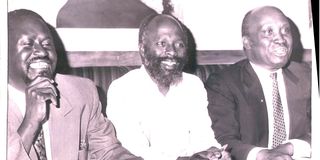
Raila Odinga with his father, Jaramogi Oginga Odinga, after his release from detention in 1988.
Photo credit: File | Nation Media Group
A former detainee himself, Odinga shared his experiences in some of the most dreaded detention centres. He said he and his fellow detainees composed the freedom song to show defiance against the dictatorial system that held them: ‘Niwekwe jela sitarudi nyuma... Nipiwe pingu, sitarudi nyuma’.
Odinga later wrote a petition that he faxed to the Committee to Protect Journalists (CPJ), the Human Rights Watch and other international groups over my case. It was the first time I heard of CPJ. Ida Odinga served us ugali and chicken before Raila drove me to a Ford Kenya press conference at Chester House.
Odinga was magnanimous and pragmatic. His quest to lead Kenya and turn it into an industrialised nation was curtailed at every step by the networks that feared his commitment to the greater good.”
“Raila Odinga was a unifying figure and a patriot who knew what to say, when and where. He put the interests of the people first. Kenyan politicians should learn from this and measure what they say to the public.
Through Odinga, I got an opportunity to traverse Kenya and interact with people from different communities.”
Mashengu wa Mwachofi and Odinga were from different backgrounds but their political journeys intersected in one of Kenya’s most consequential struggles: the fight against one-party rule and campaign for constitutional reforms.
Long before Odinga became one of Kenya’s most influential politicians, Mwachofi was among a generation of outspoken lawmakers who challenged the excesses of the Kanu government.
“I worked closely with the Odinga family. His father, Jaramogi, was my friend,” Mwachofi told the Sunday Nation.
“Odinga played a crucial role in the Second Liberation and making of Kenya’s current Constitution. He has left an indelible mark.”
Mwachofi was drawn into politics in 1979 while working on his master’s degree. He contested the Wundanyi parliamentary seat and beat powerful Kanu figures, including Dawson Mwanyumba and Juxton Shako.
Raila Odinga reunites with his family — his father Jaramogi Oginga Odinga (second right), wife Ida (holding Winnie), Raila Junior and Rosemary — at their Kileleshwa home in Nairobi after his release from 11 months’ detention on June 21, 1991. His release was announced by President Daniel arap Moi at the Kanu Annual Delegates Conference, Kasarani.
Photo credit: File
His door-to-door campaigns earned him strong grassroots support and marked the beginning of a career that would place him among the most outspoken critics of the establishment.
Attorney-General Charles Njonjo labelled him “Karl Marx” . Mwachofi joined six other young MPs – James Orengo, Koigi Wamwere, Lawrence Sifuna, Chibule wa Tsuma, Onyango Midika and Abuya Abuya – who became known as the “Seven Bearded Sisters” because of their criticism of the Daniel arap Moi regime. Their activism was at a time political dissent carried huge risks.
Mwachofi’s first term as MP ended abruptly after the August 1, 1982 attempted coup led to the dissolution of Parliament. He won the snap election the following year.
His political career was later cut short when Kanu operatives blocked him from securing the party nomination in 1988.
Odinga, meanwhile, emerged as one of the most persistent opponents of the one-party system and Kanu tyranny. His activism and detentions became part of the history of Kenya’s struggle for political freedom.
The two politicians’ contribution formed part of a movement involving opposition figures, activists, lawyers, religious leaders, students and civil society organisations.
The pressure eventually forced Moi and Kanu to reopen Kenya’s political space. In December 1991, Parliament repealed Section 2A of the Constitution, ending Kenya’s formal one-party political system. The change opened the way for the first multi-party elections in decades in 1992.
Mwachofi’s generation confronted questions of constitutionalism, political freedom, accountability and the distribution of power. He later led the Shirikisho Party of Kenya, but the political comeback collapsed when President Mwai Kibaki backed Chirau Ali Mwakwere in a party power struggle.
Mwachofi lives quietly in Voi, Taita-Taveta County. His political journey, like that of Odinga, forms part of the road from the struggle against Kanu dominance to the adoption of the 2010 Constitution, which introduced devolution, strengthened Parliament and expanded the Bill of Rights.
Mwachofi and Odinga’s story reminds Kenyans that the Second Liberation was not won overnight or by one individual. It was built through years of pressure and sacrifice among reform-minded Kenyans.
For Christopher Mwambingu, the ODM Youth Leader in Taita Taveta, Odinga was more than a politician. Mwambingu says his relationship with Odinga began shortly after he completed high school. He became involved in the Orange and Banana campaigns during the 2005 constitutional referendum.
It was a period that would shape his political views and give him an opportunity to work closely with Odinga.
“Immediately I completed secondary school, I interacted with politicians in the ‘No’ campaigns. Odinga was in the Liberal Democratic Party,” Mwambingu said, adding that Odinga quickly noticed his enthusiasm and commitment to the campaign.
During the referendum campaigns, Mwambingu was named Odinga’s international affairs youth representative, giving him an opportunity to work with the leadership of the Orange movement, including Prof Larry Gumbe.
Mwambingu says the experience was significant because he was young and still learning how political parties were organised and campaigns conducted.
After the referendum, his association with Odinga deepened.
“I was picked as a youth leader until I was nominated as MCA in 2017 on an ODM ticket for supporting the party and then-Mwatate MP Andrew Mwadime, the current Taita-Taveta governor,” he said.
Lang’ata MP Raila Odinga (left), confers with his father, Ford-K chairman Jaramogi Oginga Odinga (right) during campaigns for the Kisauni by-election in Mombasa on December 18, 1993.
Photo credit: Photo | Nation
In 2022, Mwambingu contested the Mwatate parliamentary seat.
“Odinga handed me a direct ticket. I came second in the parliamentary election,” he said.
Despite the disappointment, Mwambingu says his years around Odinga left him with a lasting impression of the former Prime Minister’s personality.
“Odinga was down-to-earth. He used communicated with everyone,” Mwambingu said, adding that his loyalty to the leader enabled him gain access to many senior politicians and government officials.
To Mwambingu, Odinga was a leader who could freely engage people, regardless of their political affiliation, social standing or background, making young politicians feel they had a place in the movement.
His account gives the evolution of ODM from a movement born out of the 2005 referendum campaigns into one of Kenya’s most powerful political parties.
For young politicians like Mwambingu, the movement provided an entry point into national politics as the country was going through important period politically, economically and socially.
Like many others, Mwambingu says ODM has changed in recent months. He says the leadership appears not comfortable with divergent views.
“It is unfortunate that the current party leadership does not want to listen to views it considers not palatable,” he said.
Mwambingu’s criticism comes after years of loyalty to the party and the former premier, during which he rose from a young activist to an ODM youth leader and later a Member of the County Assembly.
His political journey, he says, was shaped significantly by the opportunity Odinga gave him when he was still young and fresh from secondary school.
More than two decades after joining politics, Mwambingu’s memories of Odinga remain tied to the early years of the Orange movement, the birth of ODM and the campaigns that followed.
He says Odinga was a national politician, describing the leader he encountered at close range and worked with for years as accessible, humble and willing to engage ordinary people.
That relationship, he says, helped define his own political journey.