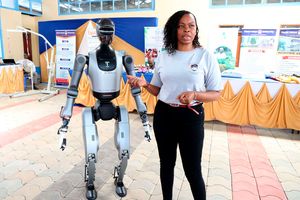
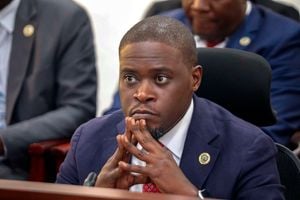
Officials from the ministries of education and health are among the stakeholders expected to appear before Parliament as lawmakers begin a month-long investigation into how deeply artificial intelligence has permeated the academic and health sectors.
Lawmakers are racing against time to craft a standalone law that sets guidelines for the use of artificial intelligence (AI), a tool whose use has become increasingly popular worldwide.
The National Assembly Committee on Communication, Information and Innovation has been given one month to table a report as lawmakers mull the introduction of a law that will guide the use of AI in the country.
Artificial intelligence involves the use of digital computers or computer-controlled robots to perform tasks commonly associated with intelligent beings.
The committee, chaired by Dagoretti South MP John Kiarie, is expected to address concerns about data privacy, cybersecurity and academic integrity arising from over-reliance on AI.
Through engagement with key government officials, the committee is also expected to establish how the adoption of AI in key sectors of the economy has contributed to economic development and improved service delivery in the public sector.
In its probe, the committee will also examine the current status of various laws, policies, regulations and safeguards governing the development and use of AI, particularly in relation to data protection, privacy, cybersecurity, accountability and harmful applications.
“This should not be rushed; let members and different stakeholders appear before the committee so that we have a proper law that will not be challenged in court,” said Ugenya MP David Ochieng, who gave the directives while presiding over the House in place of the Speaker.
Lawmakers expressed concern that there is currently no clear national framework to promote AI innovation while protecting citizens and ensuring that its benefits contribute to the country’s development.
Majority Leader Kimani Ichung’wah said the ministries of education and health should be given priority when the committee begins hearing from stakeholders because of the increased use of AI in these sectors.
“Comrades may be right always, but they cannot be right in using AI to do their academic papers. This is a matter that poses a real danger in how we develop our own children, especially those in schools, because some of them have turned to AI for everything,” Mr Ichung’wah said.
He said the committee should also engage the Ministry of Health on the use of AI in healthcare, given the increasing number of people seeking medical advice and then proceeding to “treat” themselves using AI.
“In the future we will have Doctors who are just Doctors on paper who fully depend on technology but cannot understand, interrogate issues and diagnose them rightly,” Mr Ichung’wah said.
However, Suba South MP Millie Odhiambo said the country could not ignore the use of modern technology such as AI.
“I am a PhD student and I use AI; the challenge we have as a country is that technology is moving faster than us. We must interrogate the use of AI in an ethical manner because we have to use it,” Ms Odhiambo said.
“It’s not a bad thing; we just need to learn how to use it. We must change with technology as a country because gone are the days when our grandparents would sit us down and teach us how to cook; those people are no longer there,” she added.
According to Molo MP Kimani Kuria, modern technology should not be viewed as a menace. He said the committee should use its probe to find ways of ensuring that AI does not erode societal values such as hard work.
“The committee should not think of AI as a menace or an animal; we just need to find a way of integrating it in our academics,” Mr Kuria said.
“Technology is here to help us, not to harm us. As we think on how to integrate it in our daily lives, we must think about it as a menace, but how do we make sure we integrate it to ensure that it does not affect values like the need to study,” he added.
Mr Kiarie assured the House that the committee would do “a thorough job and do what is best for Kenya in terms of technology”.
The 2022 Government Artificial Intelligence Readiness Index report ranked Kenya fifth in Africa and 90th globally in readiness to adopt AI.
Further, the Oxford Insights Survey 2022 pegged Kenya’s readiness to adopt AI at 40.3 per cent.