A year after Raila Odinga’s death, the hat his daughter Winnie carried home from India remains a symbol of an inheritance whose political ownership is unresolved. “The king is dead,” she declared at her father’s funeral. “But long live the crown.” The challenge now is who can earn the authority to wear it and whether Odingaism can survive the current succession intrigues.
That uncertainty extends beyond Raila’s household with followers wondering who can hold together the political constituency he assembled. Again, the other question is what remains of the movement he built for two decades and whether Odingaism is strong enough to survive without an Odinga capable of commanding it.
Looking at his biography, Raila left behind three inheritances: a family name, a political party and a following that reached beyond both. All these overlaps, and as historians have noted, are not interchangeable. And that is where the first dilemma of Odingaism rests. First, does the Odinga family leadership automatically confer control of ODM? If that happens, will the party title guarantee the allegiance of voters, and can the same person reproduce Odinga’s authority?
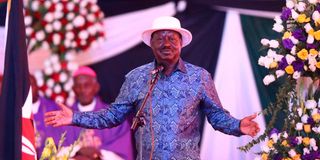
Raila Odinga's daughter Winnie Odinga eulogises her father during the burial service at Jaramogi Oginga Odinga University grounds in Bondo, Siaya County on October 19, 2025.
Photo credit: Sila Kiplagat | Nation Media Group
Looking back, Winnie understood that emotional inheritance when she carried her father’s hat home from India, where Raila died. That visibility made her a compelling figure in the succession debate, though she appears to have faded fast within the ODM politics.
However, her recent installation as Raila’s political heir, at the cultural level, has given her claim public expression. But something was amiss in that ceremony: While Ida Odinga and Rosemary attended, Raila Junior did not. It is also known that for the last one year, Winnie was opposed to Oburu Odinga’s brand of politics and his efforts to secure cooperation with President William Ruto. Whether Winnie would want to topple her uncle from ODM depends on the ODM membership where leadership is now a cut-throat affair.
To get there, Winnie still needs the confidence of organisers, delegates and elected leaders whose political futures depend on nominations and alliances, not family ceremonies.
But Winnie is not a stranger to politics. She worked around her father’s campaigns and serves in the East African Legislative Assembly. What remains unproven is her ability to build an independent national following, arbitrate disputes and command loyalty when difficult decisions disappoint supporters.
Raila Junior’s separate ambitions further complicate the picture. Recent reporting indicates that he said he had not been informed about Winnie’s installation and intended to build his own political career. While does not establish an irreparable family rupture, it exposes competing routes to prominence at the Raila family.
The casket bearing the body of former Prime Minister Raila Odinga during the public viewing at Jomo Kenyatta International Stadium in Kisumu on October 18, 2025.
Photo credit: Alex Odhiambo | Nation Media Group
The problem with Odingaism is that it not an estate up for succession and voters cannot be treated as part of the estate.
While Oburu Oginga has for the last one year provided continuity within the older generation, he does not give Odingaism a bridge to the future, according to his critics. More so, his recent hospitalisation has added urgency to questions about ODM’s preparedness for the 2027 election. Party officials say he is recovering, but the institutional issue is whether ODM can function when its leader is absent. After decades of reliance on Raila’s interventions, the party is required to demonstrate that responsibility can be shared and disputes resolved through trusted procedures.
Since Odingaism draws on the political histories of Jaramogi and Raila, its survival will be hedged on resistance to exclusion, demands for representation and an insistence that power must answer to those outside its inner circle. The paradox at the moment is that the party has also accommodated bargains with a government its supporters opposed in the last general election.
When he was alive, Raila gave those movements a personal explanation, either as a required handshake or as entry into a broad-based government. Raila’s successors now inherit the competing expectations, and how they navigate it remains to be seen.
This is why Raila’s own succession to Jaramogi offers a lesson. While his father gave him a powerful name and a history, Raila did not inherit the leadership of his father’s Ford-Kenya party. Instead, he left to build his own political base, repeatedly persuading supporters to follow him into new parties and alliances. While his inheritance gave him a foothold, it was his own political work that turned it into lasting authority.
The next generation, that inherits Raila’s version of Odingaism, must undertake its own political work beyond the surname. However, Odingaism should not be reduced to Luo succession. Raila’s national significance came partly from connecting regional grievances to wider struggles over constitutional reform, representation and the distribution of power. Whoever inherits only the regional base inherits only part of the project.
Kenya's former Prime Minister Raila Odinga.
Photo credit: File | Nation
With no Raila, there might emerge various centers of power within the party as politicians with competing ambitions wrestle for leadership in 2027. More so, there are those who survived thanks to their closeness to Raila, in reality or in the voters imagination.
That gives Ruto an opening. A divided ODM is easier to bargain with because its leaders approach negotiations with different needs and appetite. Some seek appointments, others electoral protection, others influence over nominations. When that happens, separate accommodations can erode the collective authority that made the movement consequential.
While cooperation with the presidency is not inherently surrender, the test to ODM followers is what it delivers, on what terms, and how its negotiators remain accountable. The voters know that roads, schools and public services are rights and should not be marketed as rewards for a community’s political obedience.
Raila’s Odingaism rose from its commitment on democratic reform, inclusion, devolution and accountable government. If loyalty to the surname is the organising principle, the ODM family disagreement would threaten the party and cause a succession crisis.
Survival would therefore require credible party elections, transparent nominations and room for dissent. For ODM to survive, members must be able to choose leaders and judge agreements without being accused of betraying Raila. Family members must accept that preserving his legacy may require sharing authority.
With the family matriarch Idah Odinga showing little interest in party affairs, it appears as if Winnie might step into that role which Raila Junior might try and contest. With Oburu ailing, the best scenario is for a well guided transition that gives younger organisers responsibility. Memories of Baba cannot supply a programme.
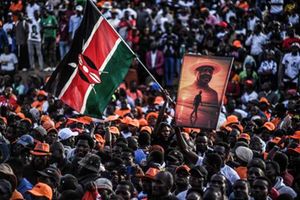
A portrait of Kenya's former Prime Minister Raila Odinga, who died while receiving medical treatment in India, is placed next to his coffin during a funeral Mass at the Jaramogi Oginga Odinga University of Science and Technology in Bondo, Siaya County, Kenya, October 19, 2025.
Photo credit: Reuters
Critics also say that a consequential successor may also emerge outside the Odinga family: someone able to organise members, earn public trust and connect local struggles to a national purpose. That would test whether Odingaism is a political tradition capable of renewal or an inheritance whose legitimacy depends on blood.
The first anniversary finds the movement rich in memory but uncertain about direction. The next election will force decisions about candidates, alliances and policy. Grief cannot make those decisions. Ceremonies cannot enforce them.
The main question after the first anniversary is whether Odingaism survive or has already been watered down by the cooperation with Ruto? It can, if its principles become larger than its custodians and its institutions stronger than personal access to its leaders. Whether an Odinga must lead that transition, the movement must also be capable of choosing someone else.
A year ago, Winnie carried Baba’s hat. Then challenge now is whether she can don that hat, or it will be done by another person, outside the party. For Odingaism to survive, the crown must outlive the king. But someone must earn the authority to wear it.