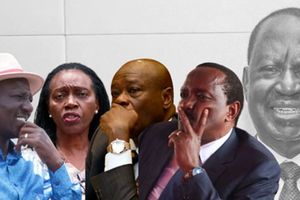
Three decades ago, the death of Jaramogi Oginga Odinga ignited an internal firestorm that tore through Ford-Kenya, the party he founded, nurtured, and dominated. Today, the tremors within the Orange Democratic Movement (ODM) feel eerily similar.
Then, as now, the party’s founding patriarch had courted cooperation with the government of the day. Then, as now, that policy was defended as pragmatic but condemned by others as betrayal. And then, as now, the looming question of succession crackled like dry tinder waiting for a match.
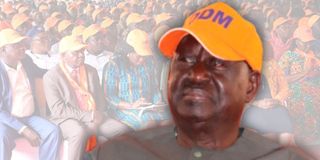
Former Orange Democratic Movement leader Raila Odinga addresses the party’s National Governing Council in the past.
Photo credit: Francis Nderitu | Nation Media Group
Political history in Kenya rarely repeats itself in perfect loops. Instead, it tends to rhyme—a familiar pattern of power, ambition, betrayal, and recalibration. In the mid-1990s, the cooperation policy Jaramogi struck with President Daniel arap Moi fractured his party, sharpened rivalries, and exposed its soft underbelly: it was a movement built around a man, not an institution.
Now, in the aftermath of Raila Odinga’s death , ODM stands at that same historical crossroads. For decades, Raila embodied the movement—its ideological heartbeat, its political strategy, its gravitational centre. His death has left a vacuum so profound that the party he built now resembles a powerful ship suddenly deprived of its captain. The first cracks are already visible.
Once again, the Luo political establishment, the bedrock of the party, is flirting with power in the name of development. Once again, critics within the party are bristling at what they view as capitulation. And once again, the question of succession, once whispered in the shadows, is now roaring in the open. There is open animosity between ODM chairperson Gladys Wanga and secretary-general Edwin Sifuna.
Raila’s long shadow held ODM together for nearly two decades, masking factional rivalries beneath the unifying banner of his name. With that unifying figure gone, the party faces its greatest existential test since its founding. Will it evolve into a durable political institution—or disintegrate, as Ford-Kenya did after Jaramogi’s death?
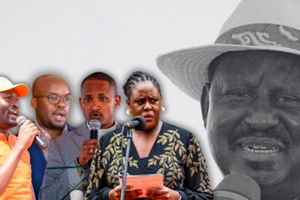
Raila Odinga's brother Oburu Oginga, Homa Bay Governor Gladys Wanga and ODM Secretary General Edwin Sifuna eulogise the former Prime Minister during the funeral service at Jaramogi Oginga Odinga University grounds in Bondo, Siaya County on October 19, 2025.
Photo credit: Sila Kiplagat | Nation Media Group
The House of Jaramogi is always full of surprises. In May 1993, seven months before he died, Jaramogi startled his supporters when he announced that Ford-Kenya would cooperate with the Moi government. For a man who had for decades embodied defiance of the State, the policy was as shocking as it was divisive. But Jaramogi was also a realist. His base in Nyanza had endured years of economic marginalisation since his bitter break with Jomo Kenyatta in the 1960s. Development projects had been systematically withheld. Cooperation, he argued, was not surrender—it was strategy.
Fast forward 30 years, and the same justification echoed through ODM in Raila’s final years. Raila, a man who had defined his political life through relentless opposition, carefully engaged William Ruto’s administration to ostensibly unite the country following the Gen Z uprisings.
His supporters framed the cooperation and entry into what is called a broad-based government as a developmental necessity—a tactical opening of State coffers for a region long locked out of political spoils. To them, it was pragmatism. To his critics, it was capitulation. And in that tension between pragmatism and principle, the seeds of today’s party fracture were planted.
President Ruto: ODM will either form or be part of the next government
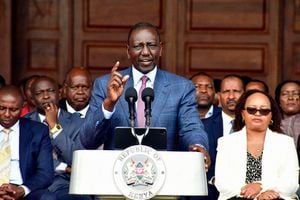
With Raila now gone, ODM finds itself at a perilous crossroads. The political patriarch who once defined its course is no longer there to steady the ship. Many of the movement’s orphans are in William Ruto’s hands. Ruto himself has made no secret of his intentions: ODM, he has promised, will either be in the next government or form it.
It is a strategic gamble with echoes of an earlier era. Ford-Kenya, despite its reformist slogans, was in many ways Jaramogi’s political vessel. His personal authority—moral, historical, and cultural—glued together a coalition that was neither stable nor fully aligned ideologically. When he died in January 1994, that glue dissolved. The fissures widened overnight. ODM rests on a similar foundation. Since 2005, the party has been more than a vehicle for opposition politics; it has been the House of Raila, a movement animated by his instincts, alliances, and charisma.
Even before Raila was buried, ODM was already convulsing with whispers of power struggles. The flashpoint, many believe, is Edwin Sifuna, the articulate secretary-general. Young, ambitious, and viewed by some as a natural successor to Raila’s legacy. Others, however, see him as an outsider—a man whose roots in Bungoma place him at a delicate distance from ODM’s traditional power base.
That perception is not without precedent. When Jaramogi died in 1994, Michael Kijana Wamalwa emerged as the compromise candidate to lead Ford-Kenya. Though eloquent, respected, and nationally visible, Wamalwa was similarly regarded by sections of the Luo political establishment as an outsider—a leader whose Western Kenya roots made him a caretaker rather than a true heir. That quiet resentment metastasised over time, eroding trust within the party and deepening factional rifts triggered by Raila Odinga’s quest to return the party to the House of Jaramogi.
Sifuna now finds himself standing on strikingly similar terrain. His Western Kenyan identity is both an asset and a liability: it gives ODM a veneer of national reach but also exposes him to scepticism from the House of Jaramogi loyalists who view Raila’s succession not as a national project but as an Odinga inheritance. At the same time, non-Luo blocs see in him a chance to redefine ODM beyond Nyanza politics. It is precisely the kind of ethnic and strategic tug-of-war that fractured Ford-Kenya three decades ago.
It is a combustible moment. Before Jaramogi died, a similar storm gathered around Paul Muite, the first vice-chairman and a pillar of the Mt Kenya “Young Turks.” Suspicion, ambition, and ethnic tension turned leadership questions into a party-splitting crisis. Within months, Muite and Gitobu Imanyara were out, and Wamalwa inherited a weakened, factionalised party. ODM now finds itself standing on the same brittle ground, with the same flammable ingredients.
This is not just about ideology; it is also about economics. Ford-Kenya in the 1990s was the poorest of Kenya’s major parties. Its Nyanza heartland lacked an entrenched business class or access to state resources. Cooperation with Moi was, for many, a lifeline. ODM faces a parallel reality. For decades, Luo Nyanza has remained on the political periphery, locked out of the state’s inner economic circuits. Raila’s flirtation with Ruto’s administration was cast in the language of pragmatism: cooperation as a bridge to development. The promise of roads, ports, hospitals, and tangible projects was powerful. But history warns that such cooperation, while seductive, can fracture a party from within. Ford-Kenya learnt that lesson the hard way. ODM may be next.
During the burial of Jaramogi, the cooperation was brought to an end after James Orengo delivered a blistering attack on Moi, condemning the very cooperation policy that had been Jaramogi’s final political act — while also denying him a State funeral. Moi, enraged, publicly severed the alliance.
While Ford-Kenya’s brief access to power evaporated that day, it is now Orengo who has been an advocate of ODM’s cooperation with Ruto and has been to State House to seek development. The irony is not personal alone; it is structural. Kenyan politics has a way of bending principle into pragmatism over time.
Like many political parties, Ford-Kenya was an ethnic coalition held together by Jaramogi’s personal authority. It was the preservation of the Odinga legacy within the party, that engineered the ethnic suspicion. ODM faces the same arithmetic. Though it has enjoyed alliances across the country, its backbone remains Luo Nyanza. Its non-Luo allies—especially from Western, Coast, and Nairobi—have long been loyal to Raila, not the party itself. With Raila gone, their political calculus might shift fast.
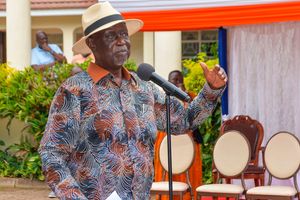
Former Orange Democratic Movement (ODM) party leader Raila Odinga dances with other party leaders in Funyula, Busia County on February 28, 2025 as they celebrated the party's 20-year journey.
Photo credit: File | Nation
This is why the succession debate is so delicate. That explains the fast installation of Raila’s elder brother, Oburu Oginga, as the party leader . However, Oburu lacks the charisma and energy to drive the party forward. The Ford-Kenya experience showed the party that while a non-Luo Nyanza leader might broaden its national reach, it could fracture its core base. This was exactly the trap that ensnared Ford-Kenya after Jaramogi’s death. It never recovered.
President Ruto knows that if ODM implodes, UDA will emerge stronger. When Ford-Kenya imploded, Kanu emerged stronger, not weaker. Ruto is now playing from a similar playbook. His charm offensive—development pledges, strategic appointments, and personal outreach—is already peeling away sections of ODM with Gladys Wanga, and other recent appointees kowtowing to the broad-based regime. The cooperation debate is not merely an internal party matter; it is being actively shaped by a president who understands the power of co-optation. In both eras, the ruling party recognised the same truth: opposition movements built around personalities, not institutions, are fragile. All it takes is a little pressure, a few promises, and a well-timed fracture.
As ODM grapples with its identity in the absence of Raila’s commanding presence, the ghosts of Ford-Kenya linger. The same language—cooperation, development, unity—is being deployed. The same internal suspicions are simmering. The same factions are aligning. And hovering above it all is the question that has haunted every major opposition movement in Kenya’s history: can a party outlive its founder?
Ford-Kenya could not. Within three years of Jaramogi’s death, it had splintered, weakened, and faded from the national stage. Raila himself walked out, bought and revived National Development Party (NDP), and carried the Luo base with him. There is no one of the House of Jaramogi who can do that. Winnie Odinga, the EALA MP is still young, though with a rising star. Without Raila, can ODM reinvent itself—or will it merely become a contested inheritance, fought over by ambitious heirs?