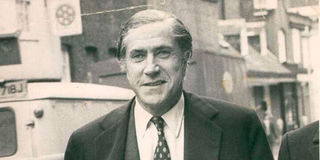
Tiny Rowland had a talent for mischief – and leverage. Long before the Kenyan passport became a headline in other people’s wars, the British wheeler-dealer understood what it could buy: movement, legitimacy and access. He took the Kenyan passport to the rebels in Mozambique and Sudan.
In the theatre of power, Rowland also used his Gulfstream jet as his entry passport. He could navigate migration desks with ease. It was also a private space through which African politicians, brokers and rebel leaders could be courted, persuaded or cornered.
Rowland became a familiar face at president Daniel Moi’s State House, especially after the 1984 deal in which he surrendered his 3,000 acres in Kesses for the construction of Moi University in exchange for the Uplands Bacon factory. From then on, his influence was not simply commercial; it was institutional, and linked state power, private enterprise and the rewards of closeness.
In London’s Savile Row, Rowland’s biographer records that Moi would place orders at “steep discounts” from Anderson & Sheppard, the high-end tailoring house managed by Rowland’s wife, Josie. The detail points to something harder: the comfort of closeness and the quiet privileges that come with it. From the moment Rowland entered Kenya’s business circuits in the 1970s, he understood a basic rule: real authority sat at State House. Wherever Lonrho operated, the chairmanship of its local subsidiaries rested with someone close to the president.
During Jomo Kenyatta’s era, Lonrho’s Kenya-facing interests were associated with Udi Gecaga, the president’s son-in-law. After Kenyatta’s death, the mantle shifted to Mark Too – reportedly after a direct phone call to Moi from the Norfolk Hotel, made in Rowland’s presence.
Rowland ran Lonrho as a system of business-by-proximity and knew something about the Kenyan passport, which carried uncommon weight. Until 1994, Kenyan passport holders could enter the UK without a visa – an ease of passage that made the document more than proof of citizenship. In the wrong hands, it could open borders, confer respectability and smooth over identities that would not survive scrutiny.
As Kenyans are outraged that a top official of Sudan’s Rapid Support Forces and other controversial foreigners are travelling with Kenyan passports – and with the silence within the government – the Rowland story gives a reflection of how passports end up with rebels and other rogue outfits.
Tiny Rowland’s Mozambican farming interests had been caught up in the war between the ruling Frelimo and Renamo rebels led by Afonso Dhlakama. According to Rowland’s biographer, the enterprise was contributing losses of £2 million every month to Lonrho.
Lonrho owner Mr Tiny Rowland, Lonhro chairman Mr Mark Too (centre) and Renamo rebels leader Mr Alfoso Dhlakama during the Mzoambican peace talks in Nairobi.
Photo credit: File | Nation Media Group
Secret payments to Dhlakama to desist from attacking Lonrho’s assets failed to guarantee protection. He had also paid $6 million to the Mozambican government to safeguard the railway line that transported Lonrho’s produce.
That is how Rowland wanted to end the war. The only person who could help was president Moi. In order for Dhlakama to move, he required a diplomatic passport.
He had been using a Malawian passport in the name of Brighton Lenga. The arrangement did not last after Mozambique signed the non-aggression Nkomati pact with South Africa in 1984 and Pretoria asked Malawi to withdraw Dhlakama’s passport.
Rowland urged Moi to provide leading Renamo figures with Kenyan passports, which effectively granted access to hotels, airports and negotiating venues.
Lonrho’s commercial interests depended on the restoration of peace. Renamo established an office in Nairobi, guarded by the GSU and run by Vincent Ululu, a Renamo operative with a Kenyan passport under a false name.
Using that document, Ululu entered Britain alongside Dhlakama’s wife, Dona Rosario, on May 14, 1992.
Top diplomat Bethwel Kiplagat stood at the hinge of the arrangement, dealing with the practicalities of access that included passports. With Rowland and Ululu, he wanted to position Moi as the Mozambican peace broker. That ambition came with prestige and leverage.
There are published claims that Mozambican president Joaquim Chissano was handed £50,000 “to buy construction materials” for a project. While the wording sounded innocent, the effect was precise: Rowland’s jet could land in Maputo at any hour of the night, and the airport would be opened for his entourage.
Moi’s involvement had moved from suggestion to instruction by January 1990. At State House, Moi called Kiplagat, according to Rowland’s account: “Come at 7.30 tomorrow morning to my office with Dhlakama.” Kiplagat knew Rowland would be there.
At Rowland’s suggestion, Moi agreed to issue Renamo officials with diplomatic passports. The shift to diplomatic passports was status. Rowland suggested that Moi allow South African Airways – then banned from Kenya – to start landing in Nairobi, now that Nelson Mandela had been freed. Rowland then flew Kiplagat in his Gulfstream to South Africa to meet Pik Botha, South Africa’s Foreign Minister, and sell the idea that a military solution would not work in Mozambique and that Kenya should lead negotiations.
Unfortunately, clandestine diplomacy has a weakness. Someone talks, and someone writes. Before any agreement could be reached, Africa Confidential blew the lid, accusing Kenya of being used as a haven for Renamo and a conduit for illicit weapons. The arms to Renamo, the report said, had been transported by a German company, Kuhne + Nagel, which was 50 per cent owned by Lonrho. Whether every element of that claim could be proved in court is a separate question, but its political effect was immediate. Once printed, Kenya’s claim to neutrality was extinguished, and Moi’s brokerage looked like sponsorship.
In the entire mix, Moi inherited some of Lonrho’s assets as he traded Kenya’s passport to Renamo through Rowland.
Renamo was not the only guerrilla movement to receive Kenyan papers. Rowland brokered travel documents for South Sudanese rebel leaders as well, opening another corridor from Nairobi into another war. It is on record that when the Sudan People’s Liberation Army (SPLA) was looking for space in Kenya, it turned to Rowland and State House.
They found a house off Riverside Drive – described by Riek Machar’s wife Emma as a “white stucco bungalow” – but the lieutenants vetoed it as difficult to secure against assassination attempts. It had to be modified. Later, SPLA bought a residential building in Nairobi where John Garang operated from. In his account, Garang had Kenyan and Ugandan passports, a detail that captures the way identity could be layered for survival and politics.
The Kenyan passport.
Photo credit: File
Garang’s bush support depended on Israel and the CIA. In the Cold War’s afterglow, insurgencies were rarely purely local. They were plugged into distant patrons, intelligence pipelines and resource calculations. Rowland had realised South Sudan had potential and knew of a swamp area where Chevron had invested huge sums and which was said to hold an estimated five billion barrels of oil.
He persuaded Moi to give Garang the Kenyan passport (in addition to the Ugandan diplomatic passport) and allow SPLA’s arms to pass through Mombasa.
For that, Garang cut a deal with president Moi’s government to cede the Ilemi triangle to Kenya if it got into power or the south seceded, in exchange for the logistical support.
Kiplagat was initially hesitant about meeting Garang, who still flew to Addis Ababa and met Rowland. The following week, Moi summoned Kiplagat to State House, and president Omar el-Bashir – who had flown to Nairobi – was there. Rowland had promised Moi that he would fly Garang to Nairobi but the SPLA leader declined.
One of the sharpest details in the Tiny Rowland story, and attributed to Rowland’s biographer, is that the only activity Kiplagat performed that day was to buy a toothbrush for Bashir, who spent the night at State House.
Backed by Rowland, Garang became unusually well-connected within State House. Lee Njiru, the former head of the Presidential Press Service (PPS), recalls that Garang was allowed to use the PPS studio to address his people, with the presidential press team filming the messages.
Njiru says General Lazarus Sumbeiywo and Joseph Nkaissery would instruct him to collect Garang from his Lavington hideout and take him to press conferences at KBC. It was a striking display of state power being lent, whether deliberately or carelessly, to a non-state actor, and of how a Kenyan passport could open doors and serve as an instrument of foreign policy.
One of the many faces of Fazul Abdullah Mohammed aka Haroun Fazul, a key operative in the August 7th Nairobi bomb blast.
That rebels could get passports opened a new window at Nyayo House and saw the rise of immigration brokers. Ever since, Kenyan passports have been seized by Al-Shabaab. Al-Shabaab leader Ahmed Aw Mohamud Godane, for instance, once visited the United Arab Emirates using a Kenyan passport under an unidentified name and held the Gulf State’s residency facilitated by Somali businessmen.
The Artur brothers, Margaryan (left) and Sargsyan.
Photo credit: File | Nation Media Group
During the Mwai Kibaki presidency, two Armenians, Artur Margaryan and Artur Sargasyan – the “Artur brothers” – acquired Kenyan passports and were deported after attempting to clear a colleague from Kenyan Customs at Jomo Kenyatta International Airport at gunpoint.
A raid on their house in Nairobi’s Runda neighbourhood reportedly found official documentation describing them as Kenyan deputy commissioners of police, and access cards granting unrestricted access to airports.
It is also known that one of Al-Qaeda figures Fazul Abdullah Mohammed – also referred to as Fazul Mustafa and “Jihad” – acquired a Kenyan identity card.
Whether through corruption, administrative manipulation or outright forgery, such cases illustrate the core danger of a compromised identity system.
It appears that beginning with Tiny Rowland and Daniel Moi, the Kenyan passport became currency for managing wars. Once the state learnt to treat citizenship papers as a negotiable tool of power, brokers flourished, discretion became a business model and the document began to travel far beyond any “national interest” claim.