The US has had a tortured relationship with the island nation since its independence in 1804. Haiti’s independence exploded fears in the US that the expulsion of white French colonialists by the majority black population from Haiti, would inspire slaves in the US to revolt against their masters resulting in a race war.
Almost 100 later, from 1915-1934, at the turn of the 19th Century, Haiti was occupied by the US as America developed an appetite for colonial conquest in the Caribbean region.
The occupation of Haiti ended in 1934, but not after the US established the roots of the brutal Duvalier ruling aristocracy. The crisis of leadership that persists today, developed during the rule of the Duvaliers. This tortured history raises many unanswered questions for Kenya’s Multinational Security Support Mission (MSS) in Haiti.
One of the glaring challenges for the Multinational Security Support Mission (MSS), has been whether additional Kenyan police officers are going to Haiti and what the future shape of the mission will be.
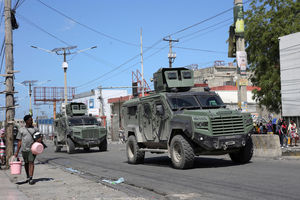
A Kenyan police officer walks in front of an armoured personnel carrier during a joint operation with Haitian police, in Port-au-Prince, Haiti July 29, 2024.
Photo credit: Jean Feguens Regala | Reuters
Will it remain a security support mission or will its role be changed to a peacekeeping force. China and Russia have been the main stumbling blocks to converting the MSS into a fully-fledged peacekeeping force.
Both countries feel the multinational security support mission has not yet fulfilled its mandate. Nor is there a “peace” on the ground for the United Nations to keep. In other words, changing the MSS into a peacekeeping mission would be jumping the gun. However, in a diplomatic sense, Russia and China could be seen as engaging in soft balancing. That is diplomatic manoeuvring to frustrate the American goal of a peacekeeping mission in Haiti because of US actions in other arenas of competition around the world like Ukraine – for Russia and Taiwan for China.
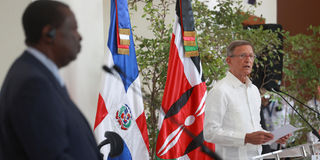
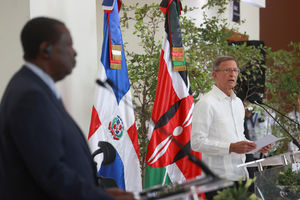
Kenya's Prime Cabinet Secretary Musalia Mudavadi and Dominican Foreign Minister Roberto Alvarez walk on the day they sign a bilateral agreement in support of Kenyan police officers deployed in the Multinational Security Support Mission in Haiti, in Santo Domingo, Dominican Republic, May 12, 2025.
Photo credit: Reuters
Aside from the jockeying of global powers in the shape of the Haiti mission, domestic pressures in Kenya, both fiscal, legal and in public opinion, pose a grave challenge for the Ruto administration. One Kenyan police officer has been killed in Haiti and the fate of another, Benedict Kaburu, is unknown. He is either dead or in captivity under the control of one of Haiti’s notorious gangs.
With 1,600 Haitians and 1 million displaced this year alone, there is significant domestic pressure to bring the Kenyan police back home. This is especially given that funding for the mission has not been forthcoming and with the Trump administration appearing to be unenthusiastic about spending American dollars on an impoverished state not central to core American interests.
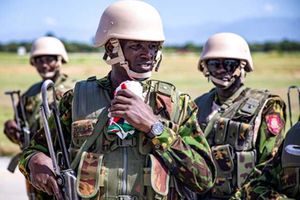
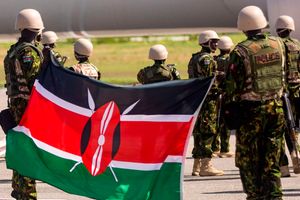
Members of a Kenyan police force, part of a new security mission, stand at the airport after disembarking, in Port-au-Prince, Haiti June 25, 2024.
Photo credit: Marckinson Pierre | Reuters
With the continued lack of material and financial resources, the future of the MSS appears doomed. It is also not clear how Trump’s America First foreign policy will affect the mission in Haiti. His non-interventionist and neo-isolationist preferences when dealing with foreign conflicts that could deteriorate into “forever wars” for the US, as in Iraq and Afghanistan, makes putting American troops on the ground or spending US taxpayer money on the conflict unlikely. What is clear is that the MSS mission cannot go smoothly forward without significant diplomatic, financial and intelligence support from the Donald Trump administration.
What is also unclear from the Prime Cabinet Secretary’s trip are three core questions. Firstly, for the MSS, in the long term, what does a successful mission in Haiti look like for Kenya?
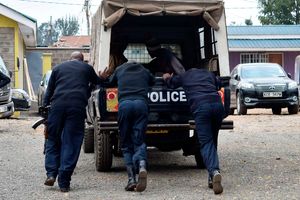
Haitian National police SWAT unit and Kenyan Police rush trough a steep hill to board an armoured vehicle after one of the vehicles broke down on a steep hill while patrolling through a neighborhood, after the arrival of the first contingent of Kenyan police as part of a peacekeeping mission, in Port-au-Prince, Haiti June 28, 2024.
Photo credit: Reuters
Secondly, what is Kenya’s national interest in intervening in this troubled Caribbean island nation almost 11,000 kilometers away? Lastly, is there a realistic way to contain the 200 gangs in Haiti with over half a million guns and sophisticated of weapons on the island? Mr Mudavadi better have some answers.