The six foreigners arrested with more than a tonne of methamphetamine (crystal meth) off the Kenyan Coast are said to be members of the Iranian Islamic Revolutionary Guard Corps (IRGC).
According to the latest United Nations Office on Drugs and Crime (UNODC) reports, Iran is a significant producer and transit country for methamphetamine, with production laboratories emerging across the country. The trafficking route begins in southwest Asia in the Indian Ocean to South Africa.
UNODC reports show that state-embedded actors, including those in the IRGC, are involved in transnational organised crime. Iranian criminal networks are some of the most notorious methamphetamine smugglers in the world.
It is suspected that the ability of the vessel to evade detection while in a busy shipping corridor could only have been facilitated by entities with sophisticated networks that continued to track and monitor its movement.
The operation under the Safe Seas Africa (SSA) programme was triggered by intelligence from the Seychelles-based Regional Centre for Operation Coordination (ROCC) and the Regional Maritime Information Fusion Centre based in Madagascar, which provided a maritime patrol aircraft for surveillance updates.
On Sunday last week following a tip-off, Kenya Navy ship MV Shupavu was launched from Mtongwe to execute a lawful visit, board, search and seize operation some 350 nautical miles (630 kilometres) off the Kenyan coast.
The brown, white and blue-painted vessel spotted had the largest crystal meth consignment Kenyan has ever seized.
After repeated radio contacts that were ignored by the crew, a team of soldiers was lowered onto engine-mounted rubber dinghies in the cold ocean waters and ordered to board the suspicious vessel.
The waves were three to six feet, with a steady breeze of about 10 knots.
In waterproof military outfit and armed with 3.5-kilo Fabrique Nationale Special Operation Forces Combat Assault Rifle – commonly known as FN Scar – each with 30 rounds, the special operations team accosted the crew of the vessel, unsure of what lay ahead.
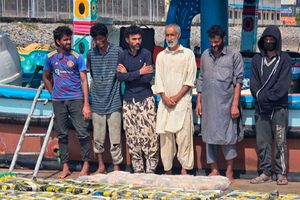
Despite language barrier and initial resistance, the soldiers boarded the vessel. They encountered captain Imtiyaz Daryayi, Mr Rahim Baksh, Mr Nadeem Jagdal, Mr Jasem Darzadeh Nia, Mr Imran Baloch and Mr Hassan Baloch, who identified themselves as Iranians.
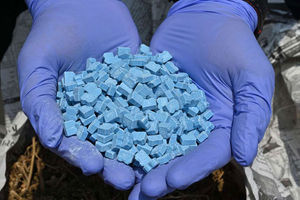
Packages of substances weighing 1,035.986 kilograms suspected to be methamphetamine valued at Sh8.2 billion at the Mombasa Port on October 25, 2025.
Photo credit: Pool
They had posed as fishermen and even showed the soldiers nets and food, including canned beans, bags of rice, cooking oil, bottles of juice, tomato paste cans and containers of liquid soap.
The six used a crammed wooden cabin as their living quarters and kitchen. For toilet, they used makeshift structures at the rear of the vessel from where they could relieve themselves directly into the ocean.
The soldiers found crystalline material packed in 769 black plastic bags in the hull labelled “100 per cent Roasted and Ground Arabica Coffee”. Every bag was 1.35 kilogrammes.
Kenyan security officials later said the sailors attempted to delay the journey to the port by stalling their vessel.
It was towed to Mombasa where Government Chemist employees got samples and confirmed that the crystalline stuff was 98 per cent methamphetamine.
The navy deployed five patrol boats whose heavily armed crew monitored the shipping corridor and kept the seized dhow protected.
The haul was eventually loaded onto a patrol boat and taken to Mtongwe Navy base it has remained for a week.
Iran has been listed by UNODC and other international agencies as a key transit country for opiates – opium and heroin – originating from Afghanistan and Pakistan. The narcotics are then trafficked to Europe through Turkiye and the Balkan states.
Some of the 1,024 kilogrammes of synthetic drugs seized from six Iranian crew members aboard a vessel. The haul, estimated to be worth Sh8.2 billion, was seized about 650 km off the shore of Mombasa.
Photo credit: Wachira Mwangi | Nation Media Group
The illicit drug trade in Iran is reportedly facilitated by systemic corruption and challenging governance structures, with profits often being laundered through informal banking systems and real estate markets.
According to the 2025 UNODC Report, seizures of amphetamine-type stimulants (ATS) – which include methamphetamine – reached a record high in 2023 and accounted for almost half of world synthetic drug seizures.
The synthetic drug market has been rapidly expanding due to factors like low operational costs and reduced risks of detection.
A record 236 tonnes of methamphetamine was seized in east and southeast Asia in 2024, translating to a 24 per cent increase from the previous year.
Kenyan Anti-Narcotics Police Unit head Samuel Laboso, whose team took over the case from the Kenya Navy, told the Sunday Nation that investigations are yet to establish the source and destination of the seized meth.
Detectives are analysing the mobile and satellite phones the six men were found with, the aim being to find out the people or entities they were communicating with before the seizure of the vessel and the arrests.
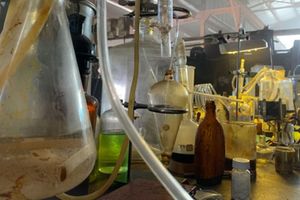
Mr Laboso added that there has been an increase in the seizure of precursors – drug-making ingredients – in the region, an indication of synthetic drug manufacturing.
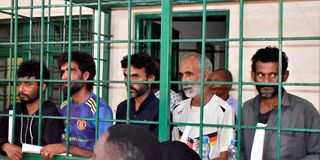
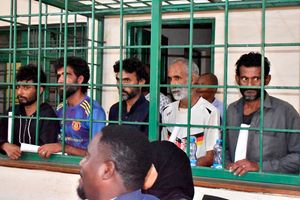
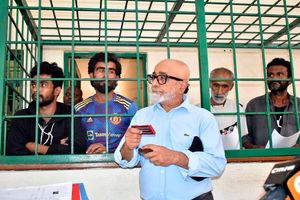
Some of the six Iranian crew members under tight security after a seizure of narcotics aboard an Iranian Vessel worth Sh8.2billion some 650 km off the shore of Mombasa.
Photo credit: Wachira Mwangi | Nation Media Group
“There has been a notable seizure of precursors. We recently unearthed such a factory in Namanga and Diani,” Mr Laboso said.
According to the UNODC report, there has been a notable increase in synthetic drugs presence in Africa from 2023 to 2024, especially in Mauritius and West Africa.
In May and June this year, the coordination of the ROCC and the Madagascar based Regional Maritime Information Fusion Centre cooperation led to the seizure of 770 kilogrammes of heroin and methamphetamine off the coast of Sri Lanka and 310 kilogrammes in Mozambican waters.