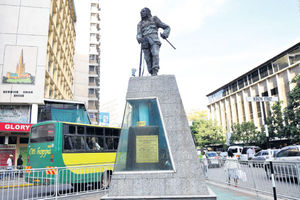
When someone prised the gun from Dedan Kimathi’s statue at the junction of Mama Ngina Street and Kimathi Street in Nairobi, it was not a “prank.” It was an attack on our national memory.
But let me say this: Kenya is full of contested histories and competing interpretations, and there are many things we will not always agree on. Still, we must concur on one principle: we do not settle our arguments with vandalism.
That was also the thinking Mwai Kibaki expressed in 2003, when pressure mounted for the removal of the defaced Nyayo Monument from Uhuru Park. He resisted that impulse, according to his advisers, arguing in effect that even unpopular symbols still mark an era in our history—and that history is better confronted, explained, and remembered than erased
When Kimathi’s statue was unveiled in Nairobi, it was an honour to defiance, sacrifice, and the painful birth of the Kenyan nation. Its very posture is a statement: a man who led others in organising resistance against colonial rule. To deface that monument is to do more than cause physical damage. It is to cheapen a symbol, and to turn history into a contest of impulses. It gives power to those who are angry today to imagine they can rewrite history with a hammer.
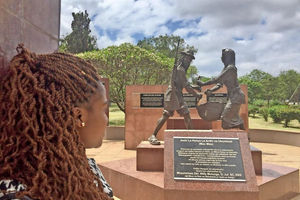
Another monument that was defaced last year, and yet drew little public uproar, was the Mau Mau veterans’ memorial in Uhuru Park, depicting a woman handing food to a Mau Mau fighter. Unveiled as a symbol of reconciliation between the British government, the Mau Mau, and all those who suffered during the Emergency, it was meant to honour victims of torture and ill-treatment under colonial rule.
The statue of Mau Mau leader Dedan Kimathi at the junction of Kimathi Street and Mama Ngina Street in Nairobi.
Photo credit: File
As Christian Turner, then the UK High Commissioner to Kenya, said at the time, it was intended as “a memorial to the victims of torture and ill-treatment during the colonial era,” and a marker of reconciliation. The monument was bound up with the 2013 out-of-court settlement in which Britain agreed to pay £20 million in compensation to Mau Mau veterans.
What are we becoming as a nation? Are we a country that speaks loudly about heritage but treats it casually? A city that sells “culture” to tourists, but cannot protect its own landmarks? Or a people that claim pride in the past, while allowing the past to be mutilated in public view?
Kimathi’s weapon, whether one likes the aesthetics or not, is not simply a gun. It stands for resistance in a time when the law was weaponised against Africans, when detention and dispossession were tools of governance, and when the language of “order” was used to justify injustice. To take the gun away is to perform a kind of symbolic editing: a clumsy attempt to domesticate a rebel, to make him safer, softer, easier to digest.
That is why the act stings. It is not only theft or damage—it is messaging. It tells us that our heroes can be mocked without consequence. It tells us that public space is unguarded. It tells every schoolchild who passes that statue that law is negotiable and memory is optional. But here is the deeper irony: even as we allow anti-colonial symbols to be attacked, we continue to live among colonial remnants—names, buildings, memorials, and old hierarchies stamped into the city’s design.
We have removed some statues, renamed some streets, and declared certain chapters “closed.” Yet the colonial era is still present, quietly, in how Nairobi’s centre was planned, in what was preserved, in what was ignored, and in what we still call “heritage.”
If we are honest, we have not built a coherent ethic of memory. We have built a mood. Consider the fate of the Queen Victoria statue that once stood in the Nairobi gardens that was initially known as Victoria Gardens— and now known Jeevanjee Gardens in honour of the Indian entrepreneur who donated the land to the people of Nairobi.
That statue, unveiled in 1906, outlived empires, survived political transitions, and might have turned 120 years—the oldest statue in Nairobi—had it not been beheaded and later knocked from its pedestal in 2015. When it was erected, thanks to Jeevanjee, there was even a proviso that it should never be removed. The city failed that promise, not through official debate or lawful decision, but through vandalism and neglect.
The lesson is uncomfortable: the same culture that “disarms” Kimathi also topples Victoria. As we have seen, vandals do not distinguish between colonial or nationalist statues. This is because vandalism does not discriminate by ideology and exists as an equal-opportunity destroyer.
The best way out of this is to have a law that allows the public to petition the existence of specific statues or memorials such that if you disagree with a monument’s message, your options in a lawful society are clear. You can petition, debate, legislate, relocate through due process, or contextualise. You do not smash. You do not steal. You do not deface. Because the moment we normalise vandalism as a form of “correction,” we give every faction—every grievance, every anger, every opportunist—permission to do the same. We turn heritage into a battlefield and public space into a scrap yard.
And Nairobi is rich with examples of this indifference. The Tom Mboya monument outside the Kenya National Archives has been repeatedly defaced and neglected. Let us remember that a statue is not an endorsement of everything the figure did.
Tom Mboya statue in Nairobi City.
Photo credit: File | Nation Media Group
A street name is not a command to worship. A memorial is not a demand for silence. Public history is not a shrine; it is a classroom. In 1938, Lady Delamere, then Nairobi Mayor, was permitted to erect her husband’s statue between the Torr’s Hotel (now the building that houses Grindlay’s Bank) and the Stanley Sarova Hotel, long known as the New Stanley Hotel. It stood at the point where a City Clock later stood.
In November 1963, as the political winds changed, the Delamere statue was taken down, as was the statue of King William outside the law courts. The road was renamed Kenyatta Avenue, and a chapter of colonial urban memory was effectively wiped clean from the street’s story.
Some applauded. Others mourned. But what is important here is not which side you take—it is the pattern. The Galton Fenzi memorial at the junction of Kenyatta Avenue and Koinange Street has to be fenced to guard it against vandals.
Protecting statues—all statues—is not about glorifying every past. It is about refusing to be a society that handles its disagreements with destruction. It is about understanding that history is not a buffet: you cannot keep Fort Jesus as “tourism” while discarding other uncomfortable relics as “trash.” You cannot celebrate the Gedi ruins as “heritage” while allowing Nairobi’s monuments to be mangled because they are politically inconvenient or poorly guarded.
Our inconsistency is the real scandal. We have kept some things, discarded others, and then looked away as vandals finished the job.
Even the “naked boy” statue outside the Supreme Court holding a fish survives as a strange testament to how monuments can outlast the arguments around them.
Ordered during the Second World War by Mrs Gertrude Hamilton to honour her late husband’s commitment to justice, lost when the original sank with a cargo ship, replaced by a replica that was stolen, and re-created again by Kenyan sculptor Robert Glan from faint images and imagination, this statue is, in its very survival, a lesson. It is not only art; it is persistence. It shows how fragile heritage is, and how determined people must be to keep it alive.
Every statue, colonial or nationalist, civic, awkward or beloved, should be treated as part of our shared archive. If we want to argue with history, let us do it with words, with museums, with plaques, with scholarship, with public debate. Not with pliers and paint
The loss is cultural, yes, but it is also economic: tourism thrives on layered stories, not on blank spaces where history used to stand.
Second, we must enforce the law visibly. “Gazetted sites and monuments” cannot be gazetted only on paper. Vandalism must carry consequences—investigations, arrests where appropriate, restitution where possible. Many monuments are not destroyed in one night; they are slowly killed by neglect. A neglected statue signals abandonment.
The defacing of Dedan Kimathi’s statue is not just an insult to a hero. It is a warning about us: about what we tolerate, what we neglect, and what we are becoming.
What am I saying? Let Kimathi stand, whole and guarded—not because he needs our protection, but because we need the lesson his statue is supposed to teach: that dignity is defended, that sacrifice is remembered, and that freedom does not mean lawlessness.
John Kamau is a PhD candidate in history, University of Toronto. Email: [email protected] @johnkamau1