A statue of a woman, her face averted, handing a basket of food to a dreadlocked man with a sword in his scabbard —his eyes cast downward—vanished from its marble plinth at Nairobi’s Freedom Corner.
Whoever hacked at the base of the Mau Mau memorial statue made it impossible to commemorate the tenth anniversary of its unveiling on September 15 this year. It was not made of metal, so this act was not theft for profit; it was political thuggery.
The statue was more than a piece of public art. It is a visual resurrection of memory: freedom fighters reenacted the scene from recollection, and this inspired the architects—Diana Lee-Smith and Davinder Lamba—working with master sculptor Kevin Oduor, to translate lived history into fibreglass.
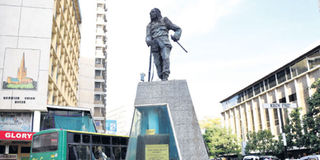
The violent erasure of this work is part of a disturbing pattern. In October this year, the statue of Dedan Kimathi in Nairobi’s central business district was decapitated, another symbolic attack on Kenya’s historical consciousness. An armed guard is now posted at the mesh-wire-fenced Uhuru Park.
The Mau Mau monument is the product of a struggle. It was erected as part of an out-of-court settlement following a long legal battle in which survivors of British colonial torture sought accountability for the abuses they were subjected to. The British government expressed “regret” for the period between 1952 and 1960 and agreed to fund the establishment of the memorial and provide some monetary compensation.
Thereafter, for over two years, British officials haggled over the language on the plaques to be inscribed at the monument. The final text was so sanitised that the Mau Mau War Veterans Association publicly disowned it for failing to convey the truth of their suffering.
Even as a compromise, however, the monument remains politically and spatially powerful: it stands in the line of sight between the basement of the Nyayo House torture chambers—where political detainees were brutalised in the 1980s—and the attic of All Saints Cathedral, where mothers of political prisoners sought refuge during the state’s violent crackdowns. Its destruction at a site already dominated by two contested monuments: the peace, love and unity fountain south of the park, and Nyayo decade monument to the north, suggests that the war of history is far from settled.
Over the centuries, Britain has perfected the art of erasing inconvenient history. Successive administrations systematically destroyed or removed records to suppress evidence of abuse, coercion and complicity. In the 1960s, Operation Legacy saw thousands of documents—detailing torture, forced labour and detention—either burned, dumped at sea or quietly transported to secret repositories in the UK. It was not until 2011, during the Mau Mau torture case, that the “migrated archives” collection at Hanslope Park was revealed.
The destruction of the statue is the contemporary extension of a historical pattern. Erasing physical markers of memory—statues, plaques, monuments—is the modern equivalent of burning files. It signals an unwillingness to confront the full truth of continuing colonial violence. In a society still negotiating the legacy of empire, the obliteration of public history is a reminder that history is not neutral; it is contested, and it is political.
A proposed public lecture in Nairobi this month by British historian David Anderson, entitled “How Koitalel lost his head”, sparked protest and controversy. Anderson, author of the acclaimed “Histories of the Hanged: Britain’s Dirty War in Kenya” and the “End of Empire”, is widely regarded as balanced in his historical scholarship. Yet, the reaction from local communities underscores how sensitive discussions about colonial violence remain. The lecture was framed as an academic inquiry, but for many, it raised questions about whose voices are centred, whose narratives are privileged, and who decides what counts as history.
Britain’s enthusiasm for erasing the past while preserving the illusion of historical propriety has been inherited by successor regimes in Kenya. The removal and defacement of statues is its latest manifestation, a physical representation of a persistent epistemic violence: the attempt to shape collective memory to serve the interests of the powerful.
For decades, independence narratives were sanitised for diplomatic expedience or political convenience, and monuments were erected in symbolic locations without fully acknowledging the legacies of violence they commemorate. If Kenya cannot protect the markers of its own history, it risks ceding control of that history to those who would rewrite it — or erase it entirely.
Kenya must treat its monuments, archives and oral histories not as ceremonial gestures, but as instruments of accountability and education. Public history must be defended with the same seriousness as law, policy, and national security because the battle for memory is inseparable from the battle for justice. Nations that fail to defend the truth of their own history risk repeating the injustices of the past, in ways that may be subtler, yet no less corrosive, than the colonial violence it seeks to erase.
The writer is a board member of the KHRC and writes in his individual capacity. @kwamchetsi; [email protected] .