Years after being outlawed, the dreaded Sungu Sungu vigilante group continues to feature in disturbing accounts of violence, intimidation and alleged hired attacks across Gusii land.
Once associated with mob justice and the lynching of suspected criminals, the group is now being linked to a more organised and commercialised form of violence involving land disputes, family feuds and political vendettas.
Group members reportedly have an office in Kisii town, from where they readily engage with anyone who wants to hire them for any kind of dirty business.
They have effectively become a militia for hire, settling private and land-related conflicts.
Recently, two members belonging to the group were allegedly hired by an individual based in the USA, who wanted to eliminate his brother over land.
Unfortunately, the deal went sour and the hitmen were cornered and lynched at Nyansiongo in Borabu Constituency, Kisii County.
This has renewed concerns about the resurgence of underground criminal networks operating in Kisii County.
In one case, a police report from Manga Police Station stated: “The incident began when the intended victim, who was grazing cattle on his farm, received a phone call from his wife informing him that two individuals had arrived at their home, claiming to have been sent by his brother to collect a land sale agreement.
After the phone call, the man returned home immediately and found that his wife had collapsed. The two visitors attempted to flee, but members of the public raised the alarm and they were caught and lynched. Police said that one of the men was burnt beyond recognition, while the other sustained multiple stab wounds.
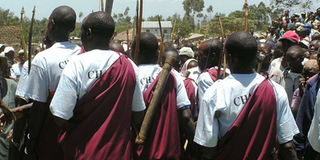
Sungu Sungu members during a past function in Kisii.
Photo credit: File | Nation
“Officers from Manga Police Station, working jointly with detectives from the Directorate of Criminal Investigations (DCI) in Borabu, visited the scene at Nyansiongo village,” the police said, adding that one of the suspects was identified through his national identity card.
The motor vehicle that the two men allegedly used to travel to the homestead was also burnt to ashes. The police did not provide the registration number in the report.
“The case has been taken up by the DCI in Borabu. Investigations are expected to establish the circumstances surrounding the incident, including the purpose of the visit and the events that led to the fatal attack,” said the police incident report.
This incident is not an isolated one. In another case, a businessman from Kisii allegedly hired members of the group to terrorise his wife, with whom he had had disagreements.
The businessman and his third wife were later arrested and charged after being linked to the alleged hiring of around 15 Sungu Sungu members to attack and evict his first wife and son from his rural home.
The businessman wanted to forcibly evict or eliminate his first wife following a land ownership dispute.
Armed with axes, machetes, and iron bars, the gang raided the first wife’s home at night in Manga, Nyamira County. They physically assaulted the victims and stole property valued at Sh220,000. The victims screamed for help, and villagers responded. The suspects were lynched.
The group’s ringleader, known as “Jose”, was beaten by the mob, and he later died from his injuries at the hospital.
The Sungu Sungu has long been categorised as a dangerous group. According to a report tabled in Parliament by President William Ruto during his State of the Nation Address on November 18, titled, “The State of National Security”, Sungu Sungu was listed among 309 criminal gangs and organised groups operating across the country.
“These groups undermine the rule of law through violent criminal activities, intimidation of communities, and the exploitation of vulnerable youths by recruiting them into criminal enterprises,” the report states.
The report also identifies Kisii as one of the counties experiencing political intolerance due to the use of goons and criminal gangs.
In parts of Nyanza such as Kisii and Kuria, the Sungu Sungu gang emerged in response to insecurity, theft, and distrust in formal policing. While some gang members operated as a local community policing group or informal justice structures, Kenyan authorities banned Sungu Sungu in 2007.
Although supporters have credited the group for curbing crime and cattle rustling, human rights organisations and analysts have linked it to extrajudicial violence, extortion, and abuse.
Some leaders have exploited the vacuum left by security agencies’ failure to stamp their authority and eliminate unlawful activities, by forming their own militias to do their bidding.
Police in the region fear these militias because they are associated with powerful political actors.
The Sungu Sungu group operating in Gusii region was formed by the provincial administration in the early 2000s, borrowing the concept from Tanzania’s Sungusungu — a version of neighbourhood watch or communal policing tasked with tackling runaway insecurity.
In Kenya, the group was formed in Bonchari Constituency and gained notoriety for lynching suspected criminals.
At the height of its operations, individuals suspected to be criminals or accessories to crime were either burnt alive in their homes or arrested, taken to a public square and brutally killed after being forced to name their accomplices.
In the Tanzanian model, that is being copied in Kisii, two communities, the Sukuma and Nyamwezi, formed theirs in 1981 to protect locals against cattle rustling that had become a menace.
According to news reports in Tanzania, the group first sprang up in the north-western region of the country, where locals were forced to form a communal vigilante after many cases of crime that the State security apparatus was perceived as being unable to contain.
It was viewed as a peasant revolt against established security organisations, because the people felt the regular forces had been unable to effectively provide safety, according to news outlets in Tanzania.
After the Tanzanian Government failed to infiltrate and weaken the group, it regularised and embraced it as part of the communal security management system recognised as a people’s militia.
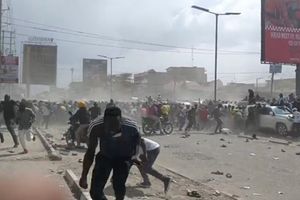
An upsurge in insecurity in Kisii town seems to have triggered the reactivation of the dreaded Sungu Sungu militia.
Photo credit: File | Nation Media Group
In Kisii, the Sungu Sungu was also established along these concepts. The district commissioner who instituted it at the time cautioned members to operate covertly, and assured the group of total support from the District Security Committee.
The now-retired DC placed some chiefs as the overall leaders, but invisible commanders, with an express mandate to round up suspected criminals.
Within weeks of its formation, people suspected to be hardcore criminals and those suspected of collaborating with crooks to perpetuate crime, especially in Suneka town, were the first casualties.
Locals started to embrace the group. But over time, the group started using force to enlist young men to participate in night patrols and sometimes commit macabre killings.
In 2003, leaflets circulated in Suneka town giving an ultimatum to two chiefs associated with the group to either disband it, or they themselves would be killed by July 7, 2003.
The two chiefs complained to their boss, the DC, that their lives were in danger and that suspected criminals had threatened a revenge mission. They informed the DC of the death threats.
Curiously, the DC did not listen to them. Instead, at a security meeting where the two chiefs expressed fear for their lives, he reprimanded them for allegedly mishandling the activities of the group, which was meant to operate under cover.
That night, the two chiefs were attacked and killed in their respective homes.
The killings triggered very serious reactions from the public, and the security apparatus had to seek the deployment of General Service Unit personnel to contain the fallout.
A survey has identified at least 309 criminal gangs in Kenya.
Photo credit: File | Nation Media Group
Twenty-three years later, questions still linger: “Who killed the chiefs?” Why were they not given protection after they claimed that they would be killed on that fateful night?
Homes of people suspected to have been behind the killings were burnt down, and their property was destroyed. The situation in Bonchari remained tense and volatile.
After a year of prosecution, all the suspects arrested and charged with the chiefs’ killings were released for lack of sufficient evidence.
However, one after the other, the main suspects were targeted and killed.
The killings again appeared to get out of control when the ringleader of the group, Wilson Batika Nyang’au, was tricked, cornered by unknown people and brutally murdered in Suneka. His deputy was also shot dead.
Years later, it became apparent that politicians and security personnel were hell-bent on misusing the group in one way or another for their personal gain..
Soon after it was disbanded, politicians rebranded it and later renamed it variously as vigilante or community policing. However, realising that “vigilante” has a criminal connotation, they stuck with “community policing”.