Artificial intelligence has become woven into nearly every aspect of modern life, and higher education is no exception. Its use among university students is now widespread.
A 2025 survey by the Higher Education Policy Institute found that about 92 per cent of students globally use AI tools.
In Kenya, 63 per cent of university students rely on generative tools for their studies, according to a survey by Chegg.org.
Although the idea of thinking machines can be traced to the early work of Alan Turing, artificial intelligence was formally introduced in 1956 at the Dartmouth Conference in the United States when computer scientist John McCarthy and his colleagues coined the term.
From those early experiments, AI has grown from simple rule-based systems into advanced tools capable of learning, reasoning and producing human-like responses that now shape industries, classrooms and everyday life.
At Chuka University, lecturer Vincent Keter says the technology has already taken root in academic work.
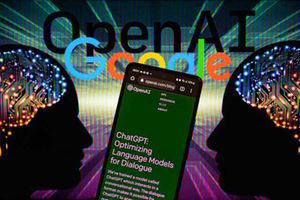
Google-OpenAI displayed on screen with ChatGPT on a mobile phone seen in this photo illustration.
Photo credit: AFP
“We have to acknowledge that AI is here with us,” he says. “It has been integrated into society, and we cannot run away from it.”
Keter notes that tools such as ChatGPT offer quick access to information and support more personalised study. Students can brainstorm ideas and clarify concepts with ease. Yet he warns that these benefits are accompanied by a worrying trend of academic indifference.
“In the case of a take-away CAT or assignment, the percentage of AI use is very high — even up to 90 or 98 per cent,” he observes.
He says many submissions appear perfect on the surface but lack comprehension, originality and the hallmarks of genuine research. To address this, he encourages assessment methods that include oral presentations and defences. In his classes, written tasks are balanced with in-person sessions where students must defend their ideas.
“After undergraduate level, what you are supposed to do is research,” he emphasises. “Research is not only about juggling materials; it requires intensive reading to become a professional.”
He warns that students who depend on AI risk graduating without the ability to justify their own work.
“Unless it is well managed and used,” he cautions, “it will result in professionals graduating without actually qualifying for the same.”
For Johhana Mwangi, a 2024 graduate of Chuka University, AI offers a different kind of support. He argues that it has not come to take the place of people but to empower them. Traditional research often required long hours in the library or sifting through large volumes of material online. AI tools eased this burden and reduced the cost of obtaining learning resources. For him, they became accessible academic companions that offered speed and clarity while still requiring responsible scholarship.
Johhana credits AI with making research more inclusive for students who previously faced limited access to academic materials. What once felt overwhelming became manageable and even empowering.
He says the impact on his studies was significant and contributed to his successful graduation. He also believes his experience reflects that of many learners who are now benefiting from this shift.
At Egerton University, lecturers are also dealing with the challenge of distinguishing between genuine student effort and work generated by machines.
Lecturer Nyamira Enoch says the change became clear when assignments began displaying a level of polish that did not match students' typical outputs.
He explains that AI-generated work often appears well structured but lacks the authentic voice, reasoning and connection to class discussions that signal real engagement.
His colleague, Dr Nobert Wafula, echoes these concerns. He notes that AI-assisted writing often reveals itself through an unusual overuse of adjectives, transition words and connectors that add little meaning. He says this embellishment often hides gaps in understanding.
The writing may look impressive, but the substance remains thin.
Beyond style, both lecturers point to the absence of analytical depth. Dr Wafula says that many assignments now contain elaborate explanations that fail to address the core question.
With the rise of generative AI tools such as ChatGPT, internet users may be outsourcing thinking itself.
Enoch observes that AI-generated work tends to be broad and generic, lacking the critical engagement that comes from grappling with course content. He says the most telling sign is work that circles the topic without truly addressing it.
Irrelevant or excessive information has also become a common indicator. Dr Wafula explains that some assignments include content that feels detached from the argument or does not support the point being made.
Instead of responding directly to instructions, the work becomes padded with vague material. Enoch adds that fabricated references are another major concern, noting cases where citations appear legitimate but lead to nonexistent sources.
He believes AI can help build confidence by filling gaps that classroom time cannot always cover, but he stresses that the mindset with which students use it is critical.
Both lecturers warn that heavy dependence on AI risks eroding foundational academic skills. They have encountered students who submit flawless essays generated by machines yet struggle to explain the same ideas in person.
As universities adjust to this changing environment, the line between empowerment and overreliance continues to shrink. On one side, AI expands access to knowledge and eases financial constraints.
On the other hand, it is quietly reshaping how students think, write and engage with their own work.
The future of higher education may depend not on how powerful the technology becomes but on whether students, lecturers and institutions develop the discipline to use it with intention and care.