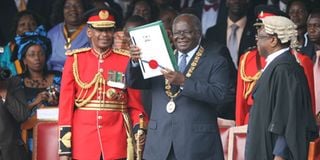
The image still lives in our memory: the late President Mwai Kibaki, beaming with joy, as he lifted high the Constitution of Kenya booklet at Uhuru Park.
That August 27 afternoon 15 years ago felt like a rebirth. Children sat on their fathers’ shoulders, women ululated, and men wept openly. Retired Chief Justice Willy Mutunga later called it Kenya’s “second independence.”
We believed the document would deliver us from authoritarian rule and end the culture of impunity. Many spoke of Kenya becoming the “Singapore of Africa.”
Today, as Gen Z protesters fill the streets demanding accountability, we must ask: has our transformative charter been captured by an “unholy alliance” — the Executive, Parliament, and sections of the Judiciary working together to subvert its intent?
The presidency still towers over all institutions. Freedom House notes that Parliament remains subordinate, its independence compromised by corruption and budgetary control.
The dominance is more subtle than Daniel arap Moi’s constitutional amendments or emergency powers, but just as effective.
When President William Ruto pushes for constitutional changes toward a semi-presidential system, echoes of power concentration are unmistakable.
The difference between today’s presidency and Moi’s is not substance but style, the same authoritarian impulses now cloaked in constitutional language.
Parliament, meanwhile, has become bloated and self-absorbed. Speaker Moses Wetang’ula boasts of hundreds of constitutional bills since 2010, yet the chamber is still captured by patronage.
During the Moi years, MPs traded conscience for cash. Today, they trade it for contracts, tenders, and party loyalty. Recent scandals show an institution more focused on self-enrichment than oversight.
The numbers confirm the rot. Kenya scores 32 out of 100 on Transparency International’s corruption index—barely above the African average and stagnant for a decade.
World Bank governance indicators place Kenya around the 30th percentile for corruption control, the same level it has occupied for 25 years. More public funds have been lost since 2010 than in the entire period before the Constitution, a damning indictment of implementation.
Constitutional commissions, designed as democracy’s guard dogs, have become lap dogs.
The Independent Electoral and Boundaries Commission was paralysed for months without commissioners. The Ethics and Anti-Corruption Commission lacks prosecutorial powers and remains vulnerable to political interference. As former Makueni Governor Kivutha Kibwana observed, those entrusted with these bodies have failed to use the authority they were given.
Research has shown that harsh penalties for misconduct often drive bad behaviour underground rather than stopping it. Kenya’s experience is proof.
More laws and more commissions have not reduced corruption; they have simply made it more sophisticated.
Yet the Constitution itself is not the problem. Kenya’s 47 counties, ranging from Turkana to Mombasa, are optimally sized for diversity.
Comparisons with Nigeria’s 36 states, which have not ended ethnic rivalries, or Ethiopia’s ethnic federalism, which has deepened tensions, show Kenya chose wisely.
When Raila Odinga argues that 47 counties are too many, he misdiagnoses the issue. The real problem is implementation. Funds are delayed, functions are resisted, and patronage continues to thrive.
If there is hope, it lies with Kenya’s youth. Seventy-five per cent of our people are under 35.
The leaderless Gen Z protests of 2024, which have already claimed over 100 lives due to police brutality, demand not constitutional reform but actual implementation.
These young Kenyans: tribeless, leaderless, partyless, represent the values-based politics that the Constitution envisioned. Their cry is not for new structures but for accountability and service delivery.
They understand what older generations seem to have forgotten: the Constitution is not broken. Political will is.
The judiciary, too, has faltered. Courts have aided the executive and police in unlawfully detaining demonstrators on terrorism charges, a blatant abuse of justice. The police officers who killed protesters remain unpunished, leaving families without justice for their dead. The Supreme Court’s refusal to enforce Article 10’s national values further signalled abdication, not constitutional weakness.
While the Bill of Rights inspired laws such as the Health Act and Legal Aid Act, Treasury has failed to fund them. Rights exist on paper but not in practice.
Albert Camus once wrote that each generation feels called upon to reform the world, but perhaps the greater task is to prevent it from coming undone. The 2010 Constitution gave us the tools for transformation. However, 15 later, we are watching decay instead of rebirth.
The framework is sound, but courage is absent. Gramsci’s words on “pessimism of the intellect, optimism of the will” resonate here.
We must face the truth that our institutions are captured and corruption entrenched. Yet we must also believe that the same Constitution, though betrayed, still offers the instruments of liberation. If only we, the people, are bold enough to wield them.
Fifteen years later, the choice is stark: genuine implementation or continued capture. In the end, our Constitution is only as strong as our will to defend it.
The writer is a whistleblower, Strategy consultant, and a Startup Mentor, www.nelsonamenya.com