Forging a new society that would enable us to break away from the past was the main dream when Kenyans gave themselves a new Constitution in 2010.
They prescribed ambitious values and principles in the document, mainly a new governance system that would address challenges of inequities in development and service delivery, and hopefully cure poor governance.
Fifteen years later, the creation of county governments remains one of the most cherished transformations the 2010 Constitution brought, even as other institutions introduced at the time are seen to be still struggling to find a footing.
Economists and experts who have reviewed the socioeconomic impact of the constitution have varied views on its place today, but, overall, they agree that it has delivered some level of transformation that would never be possible without it.
Creation of county governments has by far been the most impactful to Kenya’s socioeconomic development, due to how counties have made it possible to spread national resources across the country, though they still face some challenges that have denied citizens full benefits.
Ms Diana Gichengo, Executive Director at The Institute for Social Accountability (Tisa), terms devolution “a major shift from the past” which has enabled citizens to be served at the very local level, as Kenyans gain voice on how their resources should be used.
“If anything, before 2002, the process of distribution of sources was purely a presidential function,” Ms Gichengo says.
In June, the National Assembly’s Constitutional Implementation Oversight Committee released a report on the status of implementation of the constitution by three key institutions: the Auditor-General, Controller of Budget (COB) and the Commission on Revenue Allocation (CRA).
The institutions have a mandate to ensure discipline in the use of public funds and equality in the distribution of resources, to ensure that not only does every Kenyan get a piece of the national cake, but also that Kenyans get value for their money.
Overall, the committee concluded that the offices have largely succeeded in instilling discipline in the spending of public resources, though they continue to be crippled by underfunding from the executive and laws limiting full implementation of their mandates.
The Auditor-General is, for instance, mandated to audit and report on all public funds, resources, and accounts.
While the office has been prompt in tracing use of public funds, pointing out leakages in the public coffers and reporting the same to Parliament, MPs have derailed its effectiveness by taking years to approve audits and pave the way for corrective actions.
Deputy Auditor-General Isaac Ng'ang'a in April also told the committee that the office continues to be underfunded despite its scope increasing from auditing 1,192 entities in 2016 to 12,700 entities in 2024.
“The OAG conducts performance audits to assess public resource effectiveness, submitting over 50 reports to Parliament. Only two reports (2023 Flood Response, 2021 Services for Persons with Disabilities) have been debated,” Mr Ng’ang’a said.
Ms Jackline Kagume from the Institute of Economic Affairs (IEA) says that while the constitution has empowered the independent offices and constitutional commissions it created, their efficiency is undermined by inadequate funding and political interference.
“Moreover, despite the existence of progressive constitutional provisions, corruption and bureaucratic procedures continue to impede service delivery,” Ms Kagume, IEA’s Programme Officer, Law and the Economy, says.
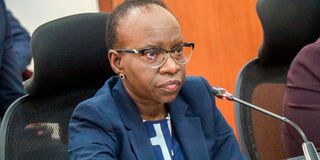
Controller of Budget Margaret Nyakang'o.
Photo credit: Jared Nyataya | Nation Media Group
COB Margaret Nyakang’o told the committee that while the constitution empowers her office to oversight spending of public funds, laws to guide its operations have loopholes, including denying it enforcement powers where entities fall short.
The COB oversees budget implementation and authorises withdrawals from public funds, though in some instances she is blinded after the money leaves official accounts and cannot track its actual spending.
“While the OCOB verifies and classifies pending bills as lawful obligations (having processed 12,347 such bills in FY 2023/24), the actual payment process excludes the office once funds are released to spending entities,” Dr Nyakang’o said.
The COB wants MPs to grant it enforcement powers to pursue entities to implement its recommendations, provide sanctions for violations and grant it oversight of kitties such as the Housing Levy that remain outside its purview.
Chairperson of the Commission on Revenue Allocation Mary Wanyonyi address senators on February 6, 2025, in Naivasha.
Photo credit: Boniface Mwangi | Nation Media Group
CRA Chairperson Mary Wanyonyi says the Commission has succeeded in providing technical support on both levels of government matters, revenue sharing, but notes that many counties are still non-compliant on crucial requirements.
The commission has also not been successful in attempts to have counties get a bigger chunk of the national revenues.
Ms Kagume says that though the constitution established clear rules for revenue generation and sharing, implementation of the law has been low and leakages have denied citizens full benefits.
“However, while the legal framework is solid, implementation has been inconsistent. Persistent leakages in public procurement and gaps in follow-up of audit recommendations have limited the intended gains significantly,” she says.
The committee’s report on the three offices shed light on crucial areas where institutions created by the 2010 Constitution are making impact on Kenyans, including ensuring equitable distribution of resources and proper use of the same resources.
In 2016 a working group established by parliament to assess the constitution’s socio-economic impacts, mainly on public finances, public institutions, social well-being and the economy in general, singled out devolution as the one area the 2010 Constitution delivered real impact for Kenyans, opening access to better health, agriculture and education services to citizens.
“Through devolution, citizens are getting better services than before; many see devolution as the best development to have ever happened in Kenya since independence in 1963,” the Group’s September 2016 report stated.
Devolution had increased predictability in the distribution of public resources across counties, and the exercise was no longer a subject of political leanings or the discretion of any officer or institution.
For the first time, the report noted, every part of the country was guaranteed a share of national revenue without political considerations.
“This is helping in building a sense of ‘one nation one people’,” it said.
The 2016 constitutional audit report, however, reckoned that wastage of public resources had grown at both levels of government, with the public wage bill rising to levels not previously seen, as fiscal imprudence ruled among public servants.
The two experts criticised Parliament as the weak link in the implementation of the 2010 Constitution, for failing to enforce decisions of independent offices after denying them enforcement powers, and failing to act by the will of the people.
“In parliament, when MPs want to be independent, like on bursaries and CDF issues, they stand up to the President. On all others, they go and bow to him. So, if you do think about it, the structure of the Constitution is potent. But the institutions have failed to safeguard the power that they have within the constitution,” Ms Gichengo said.
While public institutions have delivered services to the people, employment of workers continues to be criticised as many of them, including counties, break the law requiring institutions to have diversity by employing many persons from a single community