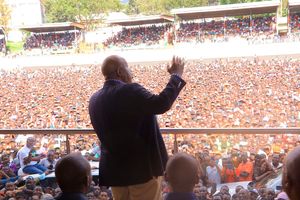
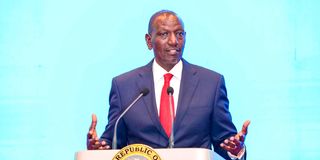
President William Ruto speaks during the opening of the 19th Ambassadors Conference at Safari Park Hotel in Nairobi on March 28, 2026.
Appearing on a popular radio show a month ago, rights activist Cyprian Nyamwamu provided a fairly stark prognosis for the Kenya Kwanza government and its leader, President William Ruto come the election in 2027. Heck, he doesn’t even believe that the election is riggable. Referring to research, he said 74 per cent of Kenyans believed the country is going in the wrong direction and that 64 per cent believe it is the president’s fault.
President Ruto is one of the most active and politically experienced leaders around, he has made promises about transforming the lives of the people, especially the youth, he has grand visions and is implementing grand projects, he is eloquent and persuasive and is communicating all the time. So why is he 64 per cent under water in the opinion polls, a rather deep electoral hole out of which to climb – even in a country where dark powerful forces, such as the inherent greed and dishonesty of the Kenyan political and technocratic elite and primitive ethnicity, have an inordinately outsize influence on voting outcomes?
So, will he win the 2027 election? Putting aside the Ouija board, crystal balls, tea leaves and other important devices of political astrology, there are two ways of approaching this hot ugali. First, one can try to unravel the psychology, the mental state, that is driving what appears to be mass disaffection. The second is an appreciation of the actions and decisions, the causative culprits, the political brick and mortar, that could bring the president’s political capsule crashing down from the orbit of power.
Me, the farmer of the reddest, roundest Wairimu beans in all of Makandune, the proud owner of 40 cows and calves and the grower of 3,000 ankle-high coffee seedlings, why would I go for the latter when I could have fun with the former? Why?
There is an expression in my mother tongue to the effect that someone has “removed the leaf from his face”, which means that someone has revealed their hand, or motivations or intentions. The connotation is that maybe the true intention should have left that hidden. Maybe through his own actions, the marketing of his political rivals from atop their vehicles and at funerals, the picture of President Ruto that has emerged is that of a leader who personally benefits from the policy decisions he has taken.
Now, I may take the sanguine view that power is like a sufuria, whoever has it in his hands cannot go to bed hungry – there is always something to lick, whether it is ugali or mukimo that was last cooked in it. Kenyans have come to believe strongly that everything that happens in government is an extension of private business. And I couldn’t tell you how damaging and dangerous that perception is. The resentment, frustration and anger that it creates might even carry on after the government leaves power.
The second factor is something that people take lightly – credibility. Kenyans fear President Ruto, but they no longer believe him. They try not to cross him because they believe that if one does so, he will come for you. I read in the papers how he personally became involved in a rather risky adventure to prove that Rigathi Gachagua forged the will of his brother, Nderitu Gachagua. Fear is important in the exercise of power, belief is important to the process of winning power. Even the loudest sycophants and toadies who are parroting the president’s virtues may not be doing it out of love or feeling safe in his care, but because they are feeding out of his hand and they fear losing their place on the trough.
The president and his minders haven’t accepted that propaganda (communications) is the sizzle, it is the marketing that causes the customer to salivate, but once you have marketed, people don’t eat the sizzle, they eat the sausage. You cannot froth propaganda in place of delivery. I was very happy when I read that the Ngong-Suswa road was finally tarmacked. But I was horrified to read public comments that it was not so much of a road, as a narrow, cratered track. We bought the sizzle, so where is the sausage?
Thirdly, there are these clouds of the humours of incompetence blowing around the government. I think this is born of the president’s over-confidence that he can run the entire government with one hand tied behind his back. So he appoints people to reward loyalty, friendship, or as a means of distributing largesse to his tribe or for political calculations, not necessarily to help him run the government.
As a result, the government is choking with people who seem not to know what they are hired to do. For the departments where there was some merit in the appointments, such as the Central Bank, the intelligence services and the general security sector, the results can be seen: the shilling is steady, the cost of living controlled, the country is peaceful. These are not flukes; it takes work.
In other places, half a billion shillings in cash is showing up in people’s homes. If it is true, that is a very strong indictment because if that level of theft is taking place on your watch, should you really have the job?
Mr Nyamwamu thinks Kenya Kwanza’s goose is cooked. Well, someone bring me my Ouija board.
Follow our WhatsApp channel for breaking news updates and more stories like this.
Mr Mathiu is a communications consultant and farmer. [email protected]