Courage Muhia finished secondary school in April this year. By August, he had publicly announced that he wanted to be Roysambu’s next MP.
Now 20 years old, he is trying to build support, one matatu at a time. His method is to gather unregistered residents at designated stages, arrange transport to a registration centre and bring them home once they have signed up.
He paid for the first trip himself, with a few friends chipping in. Persuading residents to contribute before they have seen it work has proven harder than he had expected.
He plans to contest the parliamentary seat in the 2027 General Election, on a message aimed at young people he says are invited to conferences but kept away from the real decisions.
“I’m tired of hearing youth conference, youth parliament, youth words,” he told Nation. “We need to be at the actual table.”
The ambition only became concrete in January 2026, he says, although his interest in how the country is governed began when he was about three years old. He was initially unsure, but it grew as he considered how Parliament could give him a platform to raise issues affecting young people nationally.
“I’m seeing it as an opportunity for me to voice out these issues that youth have,” he said, “to voice out these issues we’re facing at a national level.”
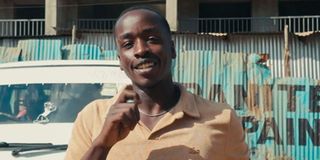
Courage Muhia creating social media content to raise awareness about his civic initiatives and engage with the public.
Photo credit: Pool
“The voter mobilisation initiative is part of my efforts to encourage greater participation in the electoral process in Roysambu,” he said, “where I hope to contest the parliamentary seat in the 2027 General Election.”
For now, he says, his activities remain focused on grassroots mobilisation, building an online presence and organising community initiatives, as he works to put his campaign finances in order.
Matatu trips to registration centres
Mr Muhia said he wants voter registration to become part of residents’ daily routines by using public transport, rather than requiring them to make separate trips.
“The idea was informed by the need to make voter registration more convenient,” he said, “particularly for residents who might otherwise have difficulties travelling to registration centres.”
He initially considered two ways of funding the trips: payments by residents or sponsorship. Getting people to contribute towards transport costs before seeing how the arrangement works has proved difficult, so he has relied on personal resources and contributions from friends to finance some of the trips.
“I funded the initial trip from my own pocket,” he said, “with the help of a few friends who contributed towards raising the money.”
“Systems is the thesis of my campaign”
Mr Muhia describes his platform as a push to reform institutions and improve how they serve citizens. He names infrastructure, education and youth participation as the three issues he would focus on.
“Systems is the thesis of my campaign,” he said.
He spent his early childhood in Thika, moved to Gumba, and settled in Thome at around seven years old, where he has lived since. He says that familiarity shaped his concerns.
“I have grown up here. I have seen the same old leadership,” he said. “It’s the same old recycled system. There is nothing that’s changing.”
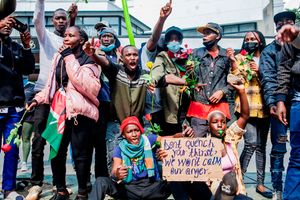
(At the centre) Courage Muhia explaining to his peers the importance of being a registered voter in Roysambu.
Photo credit: Pool
He acknowledges that road construction does not fall directly under the mandate of an MP, but says a legislator has a responsibility to raise residents’ concerns and push the relevant agencies to act.
“I know roads are not directly under the mandate of an MP,” he argued, “but we need better representation in the relevant government institutions to ensure these issues are addressed.”
On education, he said the conditions in which learners study matter.
“Our education system cannot expect students to perform well academically when the school environment itself is hostile,” he said.
He added: “We cannot expect children to develop in environments where they face violence and poor learning conditions.”
On youth participation, he argues that young people are often invited to conferences and public forums but are rarely given meaningful opportunities to take part in the decisions being made. He wants them to participate directly in decisions affecting their generation, their parents and those who will come after them.
A student leader’s record
His interest in leadership, he says, goes back to school. At around 10, he was chosen as a student mentor for his class, a role that linked individual classes to the student government.
“Basically, you were assigned to a class to ensure it remained in order,” he explained, “and to serve as a liaison between the class and the student government.”
He later served as environment prefect from 2022 to 2024. His duties included maintaining cleanliness and order, but he says he also engaged students on welfare and the school environment.
One dispute defined his tenure. A school rule required students to keep their hair short, initially at two centimetres.
“There were many outdated rules and restrictions that simply did not make sense,” Mr Muhia said.
Students challenged the restrictions, which led to a meeting involving teachers and students to discuss the regulations.
“We protested against it, but instead of relaxing the rule, the school made it even stricter,” he said.
Courage Muhia creates social media content to raise awareness about his civic initiatives and engage with the public.
Photo credit: Pool
He says the school tightened some of the rules and required him to apologise publicly before the student body.
“I did that, but then I reflected, and I was like, no, I don’t believe in that,” he said. “So, I resigned, and I went back now to just continue fighting for some of those things that I know didn’t make sense.”
After finishing secondary school, he joined the Sub-Saharan International Model United Nations, where he served as head of press alongside two colleagues.
Mr Muhia has also been involved in fundraising for traders in Zimmerman Ward, Roysambu Constituency, after a fire destroyed several shops. He says a young woman named Florence contacted him through TikTok to say her mother’s shop and five others had been destroyed.
He visited the traders and met Florence’s mother, Lilian Mbacha, before promising to mobilise support. Through an M-Changa fundraising drive, he says, about Sh20,000 was raised and sent to Ms Mbacha and another affected trader. Ms Mbacha died about two weeks later.
Courage Muhia creates social media content to raise awareness about his civic initiatives and engage with the public.
Photo credit: Pool
“This experience brought me closer to the family,” he explained. “It exposed me to the difficulties residents face when unexpected events disrupt their livelihoods.”
He says his parents support his interest in public service, and that his mother often helps him think through important decisions.
Kenya’s Constitution sets no minimum age for MPs. Article 99 says a person is eligible for election as an MP if they are a registered voter, and it adds educational, moral and ethical requirements and nomination by a party or as an independent. Because Kenyans can register as voters from 18, a candidate must in practice be at least that age.
John Paul Mwirigi was elected Igembe South MP in August 2017 at the age of 23, and is recorded as the youngest Kenyan ever elected to Parliament. He beat four well-funded candidates after campaigning on foot. He was re-elected in 2022 on a UDA ticket.
Before Mr Mwirigi, the record was held by Boniface Kinoti Gatobu, who was elected Buuri MP in 2013 at 26. In the 2022 polls, 17 people aged 35 and below were elected to the Senate and National Assembly, among them Linet Chepkorir Toto, 24, the Bomet Woman Representative.
A wave of young aspirants
Mr Muhia’s bid comes amid growing interest among young Kenyans in elective politics. A recent survey by the Youth Congress found that 113 young people plan to contest seats in the 2027 General Election, 74 of them targeting Member of County Assembly positions and 21 seeking parliamentary seats. Poor service delivery, including gaps in water and sanitation, healthcare, waste management and agriculture, as well as unemployment, featured among the concerns driving their ambitions.
The young people said they were frustrated with existing leadership and believed they could better represent their generation.
“Parliament is where everything happens,” Mr Muhia said. “It is the heart of government.”