When I walked into Thika Law Courts that morning, I knew the State was on a mission to humiliate the youth and terrify the country into silence. But what I did not expect was how shameless, loud and deliberate the intimidation would be or how the fire inside the courtroom would spill over into something that could not be contained outside— something that only defiant mothers in mourning could invoke.
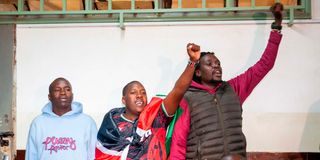
The courtroom was already full by the time I arrived, packed shoulder-to-shoulder with 50 young protesters in faded T-shirts and worn-out jeans. They had been in custody since the Saba Saba protests, all of them now facing trumped-up charges that made a mockery of justice. Some still bore bruises from the beatings they received during arrest. Most were university and college students from low-income families, and with no criminal record — until the day the government decided to turn their patriotism into a crime.
And then the prosecutor stood up, and with a voice that held no trace of shame, he declared that if these young men were found guilty, they would be hanged. It was not a slip of the tongue. It was not a legal formality. It was a deliberate pronouncement, a weaponised statement dressed up as procedure. He said “hang” as if it were a common word; as if it belonged in a courtroom in 2025; as if the lives of 50 sons could be reduced to a sentence in passing. And in that moment, every whisper we’ve carried since the protests began, every quiet fear that the State was willing to go further than we imagined, was confirmed.
These were not robbers, terrorists or violent criminals. These were innocent youths who marched for their future, shouted for accountability, held up placards in the streets, and now found themselves in handcuffs and locked cells, facing capital charges with no shred of evidence before the court. No CCTV camera footage, no credible witness, no police body cam, nothing but the brute force of a regime hell-bent on sending a message.
The judge, unmoved by the pleas from volunteer lawyers from the Law Society of Kenya who highlighted their clients’ backgrounds—their youth, their lack of criminal history, the obvious targeting of protesters, proceeded to set cash bail at Sh100,000 per person.
That’s five million shillings for all 50, a figure meant not to guarantee their return to court, but to punish them for having dared to speak up. In some cases elsewhere in the country, the bail has been as high as Sh300,000. It is economic violence dressed up as judicial discretion — a form of silencing by debt, a way of telling poor families to stay in their lane, keep their children quiet, or lose them to the system.
Outside the courtroom, where mothers, siblings, and friends had been waiting since dawn, the news hit like a hammer. I was still inside when I heard the screams begin—deep, guttural, unfiltered cries that rose up through the corridors like a tide breaking through stone. I rushed out, already suspecting what I would find. But nothing prepares you for the sound of mothers watching their sons being caged like animals, reaching their hands through metal bars of police trucks, shouting their names, pressing their palms to iron in desperation.
The young men were being loaded into the truck in chains, their hands cuffed and held behind bars, their faces strained and tired but somehow still defiant. They saw their mothers and started shouting back, calling out names, telling them not to cry, telling them it would be okay. But it wasn’t okay. It wasn’t okay to see a mother throw herself on the ground in grief.
It wasn’t okay to watch a woman climb onto the back of the police truck and try to break the chain with her bare hands. It wasn’t okay to hear a boy shout, “We’ve been inside for 10 days. Maybe they should just kill us already.”
But what happened next shook me even more. The mothers, overwhelmed by helplessness and fury, began to threaten to strip. One of them raised her dress. Another began unfastening her blouse. And as I watched them—women who had likely never been inside a police station in their lives, now threatening to go naked in public to fight for the freedom of their sons, I felt something move through the air. It wasn’t just protest. It wasn’t even just grief. It was the reawakening of a power this country has always tried to forget: the power of mothers in resistance.
I was reminded of the 1992 mothers who camped at Uhuru Park during the Daniel Moi regime, the ones who stripped naked to demand the release of their detained sons, forcing an entire government to reckon with their shame. I was reminded of Wangari Maathai. I was reminded of colonial times, of women who wept outside detention camps, tore at their hair, pounded their chests, and carried the weight of freedom on their backs while the men were locked up and tortured.
History was not repeating itself. It was roaring back. These women, whose only crime was raising brave sons, had now been radicalised. They were no longer pleading; they were demanding. They were no longer crying; they were organising. And that, I believe, is where the State makes its gravest mistake. You can beat a protester. You can lie in court. You can weaponise the Judiciary. But you cannot contain a mother who has decided she will not lose her child without a fight.
That day, I held their hands. I knelt beside them. I told them we would get their sons out. I said it even though I knew how hard it would be. I said it because it was true in spirit, even if not yet in fact. Now, with over 100 protesters still detained across the country on inflated, politically motivated charges, we are organising again—raising funds, sharing their stories, refusing to forget.
There is something broken in a country where the State threatens to hang university students for holding placards. There is something dangerous in a judiciary that appears more loyal to power than to justice. And there is something undeniably powerful about the fact that, even in the face of this cruelty, the people are not giving up.
The boys are still behind bars, but they are not broken. The mothers are still waiting, but they are not helpless. We are still resisting, still fundraising, still documenting, and still fighting.
And in the echoes of those courtroom screams and prison truck wails, I hear the beginning of something the State cannot silence.