The greatest achievement in our existence as a country is not the flats we are building in the woodlands, or the over invoiced Chinese railway running antediluvian engines; it is not even the elevated highway that has introduced those who can afford to convenience and luxury unheard of before: it was the decision to take up arms and fight a mighty, ancient empire for our freedom.
And Kenya’s greatest shame, the one that really exposed that we are not serious people, is the conflation of the independence struggle into crass tribalism, the refusal to acknowledge the sacrifice of those who fought because our tribe collaborated and participated in atrocities, the failure to truly understand the centrality of human freedom in our political history, so much so that our forefathers were willing to die for it. What a wasted opportunity.
For the record, the Mau Mau did not get any land, they were disinherited. They were not given power or big jobs; the independent Kenyan state and its wealth went mainly to the turncoats, collaborators, traitors and their seed. There are Kenyans who worked with the settlers to slow down the process of independence, but there are also Kenyans who worked in politics, in trade unions and civil society, such as it was, to mobilise, unite and rally the nation behind the demand for freedom. Their contribution was as important as that of those who fought.
By cheapening our struggle for freedom, either by refusing to acknowledge or honour it, we lost sight of the most important distinction in our measurement of the human experience; that in our measure, human progress and our barometer for humanity is qualitative, not quantitative. Progress is about improving the lot of human beings, how they feel about themselves and the world around them and how they are treated, not in giving them things. You can have all the roads, houses, schools and churches, but still remain a self-hating savage.
For the record, Kenyans did not fight the British just for land, although it was an important factor; their fertile lands were expropriated and given to settlers and they were forced to become poorly paid labourers on their own property. Neither did they fight to protect female circumcision as some people have argued. They fought for human dignity, they fought against racial discrimination and being left out of their country’s politics and economy, and they fought for the right to be free in their own land. They also fought to keep their way of life – to grow the crops they wanted, keep their animals and govern themselves like adults and not be treated like children. It was not about money and positions, mainly. And in those aims, they succeeded brilliantly.
The thing to understand is that the period between the 1940s and the early 1960s was a complicated time with many moving parts. Independence did not just come from the armed struggle, but also peaceful negotiations and political mobilisation. I believe that the bloodshed played a big role in convincing the British that however much they loved this colony, and however much they wanted the settlers to enjoy their moments in the sun, despite the tearful entreaties of the collaborators to their masters to stay forever, it was time to bugger off.
The war did not come in a vacuum, there was a lot of political education in the 1940s and the formation of political parties such as the Kenya African Union in 1944, with Jomo Kenyatta becoming leader in 1947. But with all this agitation, there was not sufficient progress in addressing African grievances. So in 1952, the Kenya Land and Freedom Army, as Mau Mau was formally known, decided they had had enough of talking and launched a guerrilla war against the settlers and their African supporters.
Powerful national symbols
When the Mau Mau started killing colonial chiefs, the government let out the kraken: declared a state of emergency, put Jomo in jail and launched a vicious counter-insurgency. The bloody war brought international pressure on the British government, persuading many that the sun was setting on colonial rule. A series of talks took place, resulting in constitutional reforms which, for example, allowed African representation for the very first time, in the Legislative Council, or Legco.
In 1961, African leaders came together in a kind of joint opposition to demand the release of Jomo and he was set free from prison and house arrest in Mararal in August of 1961. The rest, as they say, is history: Kenya gained full independence on December 12, 1963, with Jomo as its first Prime Minister, becoming a Republic a year later with Jomo as president. And that’s why today, our national day, is our most important celebration. Why is it that much of a big deal?
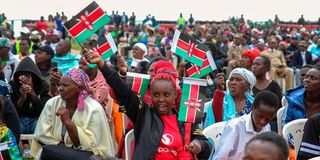
It is the day we achieved political independence and established our own sovereign state, led by Africans. The struggle, including the mobilisation by political parties, trade unions and the Mau Mau uprising gave us a strong sense of nationalism and political awareness that transcended tribal boundaries. It forged us into a nation. It also gave us heroes and powerful national symbols, such as our national flag, an emblem of our quest for freedom and the glue that holds the nation together.
That, is achievement number two.