His primary challenger, Robert Kyagulanyi (more popularly known by his previous stage name Bobi Wine), was immediately placed under house arrest after the vote, as soldiers and police laid siege to his home.
On January 16, they stormed the house. They found his wife, Barbie, and their children, but Bobi Wine had somehow escaped. Reporting from a "safe place", he repeated his rejection of the results giving Museveni victory as "fake".
With the level of violence his campaign faced, Bobi Wine had to take to the trail in a flak jacket and helmet. It will not be entirely surprising if it turns out that he also had a secret tunnel under his house, a new necessary Plan B arrangement for any serious challenger to a strongman African incumbent.
There were elements in the Ugandan election that sincerely united it with Kenyan and Tanzanian campaigns, and ultimately with several other African countries. However, at first glance, the three nations might seem different in how they conduct their electoral politics.
Museveni was declared the winner with 71.65 per cent of the valid votes cast. However, turnout was 52.5 per cent—the lowest in Uganda's history. With Museveni taking 7.9 million votes out of 21.6 million registered voters, it means he was re-elected by only 36.7 per cent of the electorate. If we include every Ugandan over 18, he will carry on with the mandate of barely 30 per cent of eligible voters. Bobi Wine officially garnered 24.72 per cent, with the Electoral Commission crediting him with 2,741,238 votes.
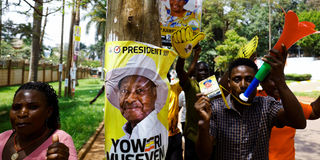
It didn't look that way during the campaigns. Bobi Wine's campaign trail, amidst many disruptions by the security forces, was dramatically electric; one would think 10 million Ugandans turned out to see or hear him.
He would arrive in some towns only to wake up and find his hotel surrounded by thousands of people in the red of his National Unity Platform (NUP). He would come out and look on, sometimes disbelievingly, at the sight below him.
As in Kenya, this is the perennial problem of young and urban folks massing for the opposition during campaigns but not on election day, partly because they don't register to vote. In Kenya, in 2022, youth (aged 18–34) made up 39.84 per cent of the total voter register. Meanwhile, Kenyans aged 35 and above made up roughly 60 per cent of the register that year.
However, with the Uganda election, we now need to think about these turnout numbers differently. It seems we have a divergence in our elections: one is a "parade", and the other is "balloting". People will turn out in record numbers to show support for opposition candidates in not-free or party-free countries like Uganda, Tanzania, and the Ivory Coast.
They do so in the knowledge that the system and State election fiddling make nearly impossible for them to win. On voting day, they don't turn out. And because many don't plan to vote or don't trust the system, they don't register.
The way the "parade" election works, therefore, is that people turn out organically in record numbers for the opposition candidate's campaign as a kind of vote, then stay home on ballot day. The privileged incumbent, meanwhile, has to rent a crowd using tate resources. But most of all, he gets the most voters on ballot day.
African states, including Tanzania, are beginning to understand the meaning of what’s happening. In the past, they would let rivals be nominated and then steal their votes. But since the vote is now the parade, this is leading increasingly to the exclusion of potent opposition figures from the election altogether. In Tanzania, it happened with Tundu Lissu of CHADEMA. In Cote d’Ivoire, the international banker Tidjane Thiam was excluded. Most famously, in Senegal, Ousmane Sonko was locked out by Macky Sall. In total, the last five years have seen leading opposition figures excluded from elections in over 12 African countries.
The democracy movement in Kenya of the late 1990s also introduced a feature that has now become the mainstay of campaigns. Because they didn't have the large budgets of incumbents and needed to avoid their rallies being broken up by police, which is easier to do at a fixed venue, Kenyan politicians popularised the "car-roof" campaign. It is a quick setup, done on the fly as you drive through a town, making it less prone to disruption and far cheaper.
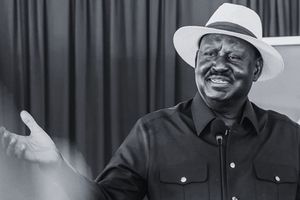
But for it to work, you need a particular type of politician; one with the gift of the gab who can wield popular street-level imagery and charisma. At its best in Kenya, it produced figures like Raila Odinga , but also, ironically, Uhuru Kenyatta and now President William Ruto .
As the dust settles in Kampala, the African election has split into two distinct acts: the passion of the street and the dark arts of the tallying centre.
The author is a journalist, writer and curator of the Wall of Great Africans. X@cobbo3