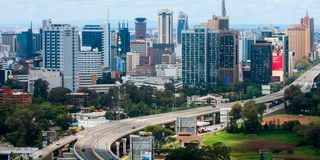
A view of the Nairobi city skyline.
For a few days, Kenya felt lighter. When Speed, the popular American streamer, landed in the country, excitement spread far and wide.
Streets filled, timelines came alive, and for hours many of us were glued to our screens, following the stream moment by moment. I was one of them.
It was impossible not to be caught up in the energy, the laughter, the genuine curiosity with which he experienced the country. Thousands of Kenyans showed up physically, many more followed online, and the affection was unmistakable. Speed felt it and said it plainly. Kenya showed up for him in a way only Kenyans know how to do.
That joy mattered. It came at a time when the country has been heavy with grief, anger, and exhaustion. Protests, funerals, economic pressure, and a constant sense of uncertainty have defined recent months. Speed’s visit offered a rare pause from that weight. It reminded us of our warmth, our humour, our ability to celebrate without over-thinking it.
For a brief moment, Kenyans were not defending themselves, explaining their pain, or arguing about politics. They were simply being themselves. Once Speed boarded his flight and vyombo vya wageni were returned to the cabinet, the country returned to its unresolved realities. That is often how it goes.
The noise fades, the cameras move on, and the issues we had temporarily set aside resurface. Because what Speed experienced, as genuine and joyful as it was, was also a carefully selected version of Kenya. A Kenya arranged to impress, to reassure, and to project competence to the outside world.
One of the first stops on Speed’s tour was Upper Hill High School. The symbolism was clear. A well-known national school, clean grounds, confident students, order and structure. It presented an image of an education system that is thriving, disciplined, and producing excellence. Watching it, one could easily believe that Kenyan education is on solid ground.
Sobering reality
Only days later, the country was confronted with a sobering reality. Reports showed that over 800,000 students had failed to report to Grade 10. That figure is not a minor policy hiccup. It is a national crisis. These children did not vanish because they lost interest in school.
They were pushed out by poverty, by poorly planned transitions, by rising costs, and by a system that continues to shift burdens onto families already struggling to survive.
In informal settlements, many parents simply could not afford the additional requirements that came with senior secondary school. In arid and semi-arid regions, distance, drought, hunger, and a lack of schools compounded the problem. Girls were married off early.
Boys were absorbed into casual labour. Some children stayed home to care for siblings while parents searched for work. Others quietly dropped out, their absence barely registered beyond their households.
Upper Hill High School exists, and it matters. But it exists alongside thousands of public schools without laboratories, without enough teachers, without desks, and without feeding programmes. Both realities are Kenyan.
Showing one while ignoring the other creates a comforting illusion that collapses the moment statistics are released. Speed was also taken to see affordable housing projects. New buildings, fresh paint, neat compounds, the promise of dignity and progress. To an outsider, it looked like a government delivering solutions. To many Kenyans, it felt like something happening at a distance. Housing remains one of the most pressing anxieties in the country. In informal settlements, families live under constant threat of eviction, fires sparked by unsafe electricity connections, and floods that turn homes into sewage-filled spaces.
In urban centres, even those with steady jobs spend most of their income on rent for cramped rooms. Affordable housing schemes often remain out of reach, locked behind qualification requirements that ignore informal work and unstable incomes. In some areas, development has arrived through displacement, leaving communities more vulnerable than before.
What Speed saw was aspiration. What millions live with daily is anxiety. This pattern repeats itself across sectors. What functions is displayed. What is broken is managed quietly. Kenya is increasingly presented outwardly as a success story while inwardly many citizens experience deepening exclusion. Education, housing, healthcare, employment, and public safety all reflect the same gap between image and lived reality.
Speed did not walk through public hospitals where patients wait for hours and relatives sleep on floors. He did not sit with young graduates sending out endless job applications with no response.
He did not meet families still grieving loved ones killed during protests, or survivors learning to live with permanent injuries and little state support. These stories do not fit neatly into livestreams, yet they define everyday life for millions.
Follow our WhatsApp channel for breaking news updates and more stories like this.
This writer is a journalist and a human rights defender. [email protected]